
ARI Model: Beyond Popularity—Detecting Influencers via Content Uniqueness
11184_An author-reader influence model for detecting topic-based influencers in social media.
The paper introduces the Author-Reader Influence (ARI) model, a novel framework for detecting topic-based influencers in social media by simulating the behavioral interactions between content authors and readers. It leverages a content-based citation graph and extends the Topic-Sensitive PageRank (TSPR) algorithm, achieving a 14% improvement over state-of-the-art methods like TwitterRank in information diffusion tasks.
TL;DR
The paper presents the Author-Reader Influence (ARI) model, a behavioral framework that identifies social media influencers based on their ability to generate "attractive" content—defined as being both relevant and unique. By modeling users as both authors and readers and applying a modified Topic-Sensitive PageRank, the researchers outperformed previous SOTA benchmarks (like TwitterRank) by focusing on how information actually diffuses through citations rather than just follower counts.
The "Million Follower Fallacy" and Motivation
For years, social media influence was equated with popularity. However, a high follower count doesn't guarantee that a user can sway opinions on a specific topic. Existing methods (Prior Work) often relied on link-structure or simple keyword matching. The authors argue that this is insufficient because:
- Topic Value is Dual: It's not just about what you talk about (relevance), but how specifically you talk about it (uniqueness).
- Behavior Counts: Real influence is evidenced by "citations" (retweets, mentions, replies), not static follower links.
Methodology: The Author-Reader Interaction
The core of the ARI Model is the simulation of a "Random Reader." In this model, a reader performs two main actions:
- Author Selection: Choosing an author based on whether their general "Selection Profile" aligns with the reader's needs.
- Author Citation: Explicitly acknowledging an author because a specific piece of content was satisfyingly unique.
The Formalization
The influence score is calculated recursively, combining a damping factor with a weighted sum of the influence of readers who cited that author:
What makes this unique is the use of KL-Divergence to weigh terms. A term is considered important if it appears significantly more in a user's content than in the general background corpus. This captures the Inductive Bias that influencers are those who provide a "unique point of view."
 The visual representation of the author-reader citation flow where nodes act as both sources and sinks of information.
Experiments and Performance
The researchers tested their model against 2012 US Election data. They compared three versions of their algorithm:
- ARI-S: Focused on Author Selection.
- ARI-C: Focused on Citation feedback.
- ARI-SC: The combined hybrid model.
Key Results:
- Information Diffusion: Using the Linear Threshold (LT) model, ARI-SC consistently reached more users than TwitterRank () and standard PageRank ().
- Active vs. Passive: A critical insight was that "Active" citations (Replies/Mentions) are much stronger signals than "Passive" ones (Retweets). Including them led to a 35% performance jump.
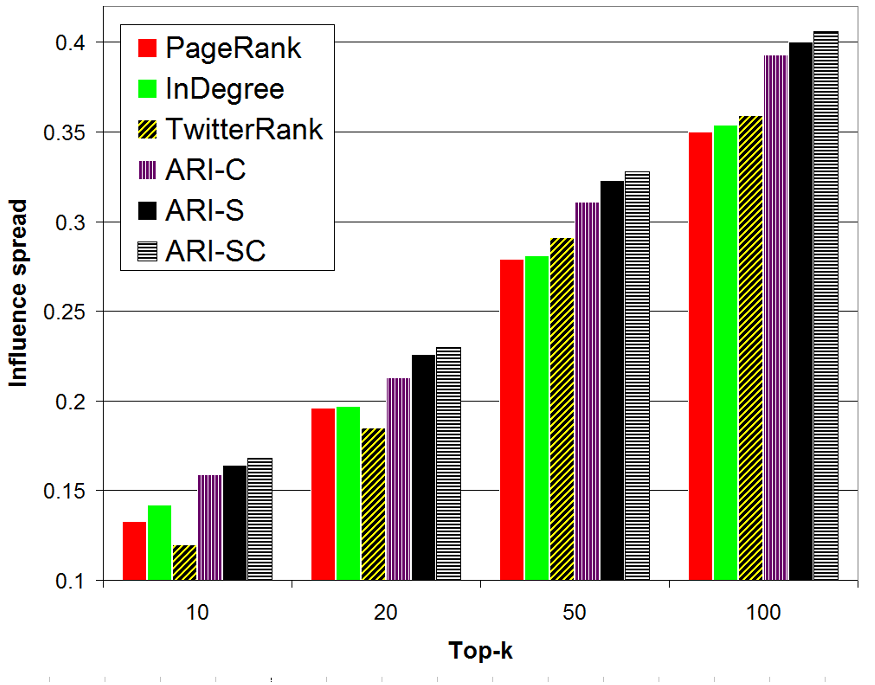 Performance comparison across various values of k (top users), showing ARI-SC (green line) consistently leading the pack.
Critical Insight & Conclusion
The ARI Model proves that "Topic Uniqueness" is a missing link in social network analysis. By moving from a static link-based view to a dynamic behavior-based view, we can identify experts who actually trigger information cascades.
Limitations: The model assumes that citations are positive signals. In modern social media climates, "ratioing" or negative mentions could potentially be misinterpreted as influence without a sentiment analysis layer.
Future Outlook: Integrating sentiment analysis and applying this behavioral model to short-video platforms (like TikTok) where "Influence" is driven by algorithmic discovery rather than just follower feeds is the next logical step for this research.