
The Pendragon Incident: Reconstructing Cyber-Terror and the Anatomy of Digital Rumors
Explanatory Case Study of the Authur Pendragon Cyber Threat: Socio-psychological and Communication Perspectives
This paper presents a retro-analytical case study of the 2014 "Authur Pendragon" cyber threat at The University of Alabama, utilizing socio-psychological and communication perspectives to examine how unverified social media threats impact physical safety. It highlights the escalation of rumors through platforms like Yik Yak and Twitter, contrasting student-led information flow with official institutional responses.
TL;DR
On September 21, 2014, a single YouTube comment under the alias "Authur Pendragon" paralyzed The University of Alabama. This case study deconstructs how social media transforms a digital comment into a physical crisis, leading to dorm lockdowns, police interventions, and a week of campus-wide anxiety. It reveals that in modern crises, the speed of information often matters more than its validity.
Background Positioning
Unlike traditional cybersecurity papers focusing on code or encryption, this work is a socio-technical post-mortem. It places the "Authur Pendragon" incident within the coordinates of Socio-Psychology and Crisis Communication, serving as a warning to institutions that rely on 20th-century communication protocols for 21st-century digital threats.
The Anatomy of the Crisis: When Social Media Outpaces Reality
The authors argue that the "Authur Pendragon" incident wasn't just a threat of violence; it was a failure of the information ecosystem. While the University Police (UAPD) were conducting methodical 14-floor searches of Tutwiler Hall, students were already "trending" the event nationally via the hashtag #Pray4Bama.
The Insight: Why the Panic Spread
The core problem was the Credibility-Recency Gap. Students didn't trust the university because the university was silent for the first 12 hours of the lockdown. In this vacuum, rumors became "facts":
- The Joker Myth: Rumors of a man in a Joker mask.
- The Machete Myth: Stories of blades stabbed through fraternity doors.
- The Choking Myth: Reports of students being attacked on the Quad.
None of these were true, but because they appeared on real-time feeds (Yik Yak and Twitter) with "visual evidence" (screenshots of texts), they gained a veneer of legitimacy.
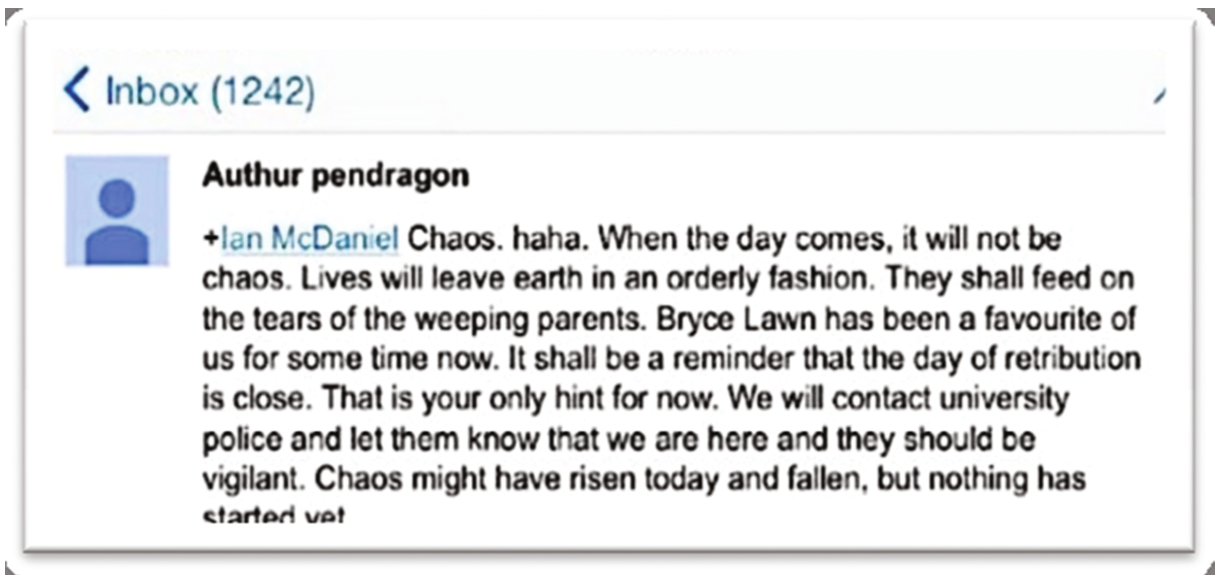 The timeline reveals the lag between social media "viral" moments and the official University responses.
Methodology: The Social Attachment Model
The authors reject the idea of "Mass Panic." Instead, they apply Mawson’s Social Attachment Model.
- Affiliation over Flight: Students didn't run away blindly; they moved toward the familiar. Local students stayed together, while out-of-state students (lacking local attachment figures) fled home to their parents.
- The Role of Proximity: Those further away (parents in other states) perceived the risk as higher than those on the ground, fueled by the terrifying, unverified images circulating online.
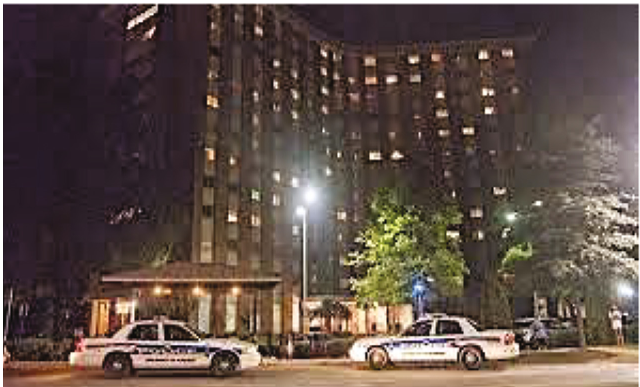 Students documenting their own 'barricaded' status, which paradoxically both sought sympathy and fueled the narrative of immediate danger.
Experiments & Results: The Cost of Silence
The case study highlights key "battlefield" results in the war for information:
- The Arrests: Two students were eventually arrested—not for the original threat, but for "copycat" pranks on GroupMe. These students claimed their threats were "just a joke," illustrating the dangerous normalization of cyber-terror rhetoric.
- Communication Lag: The University's first formal address of the threat (not just the lockdown) came 14 hours after the initial viral surge.
- Institutional Distrust: A significant drop in class attendance was noted even after the "all clear" was given, showing that the psychological recovery period far exceeds the physical search time.
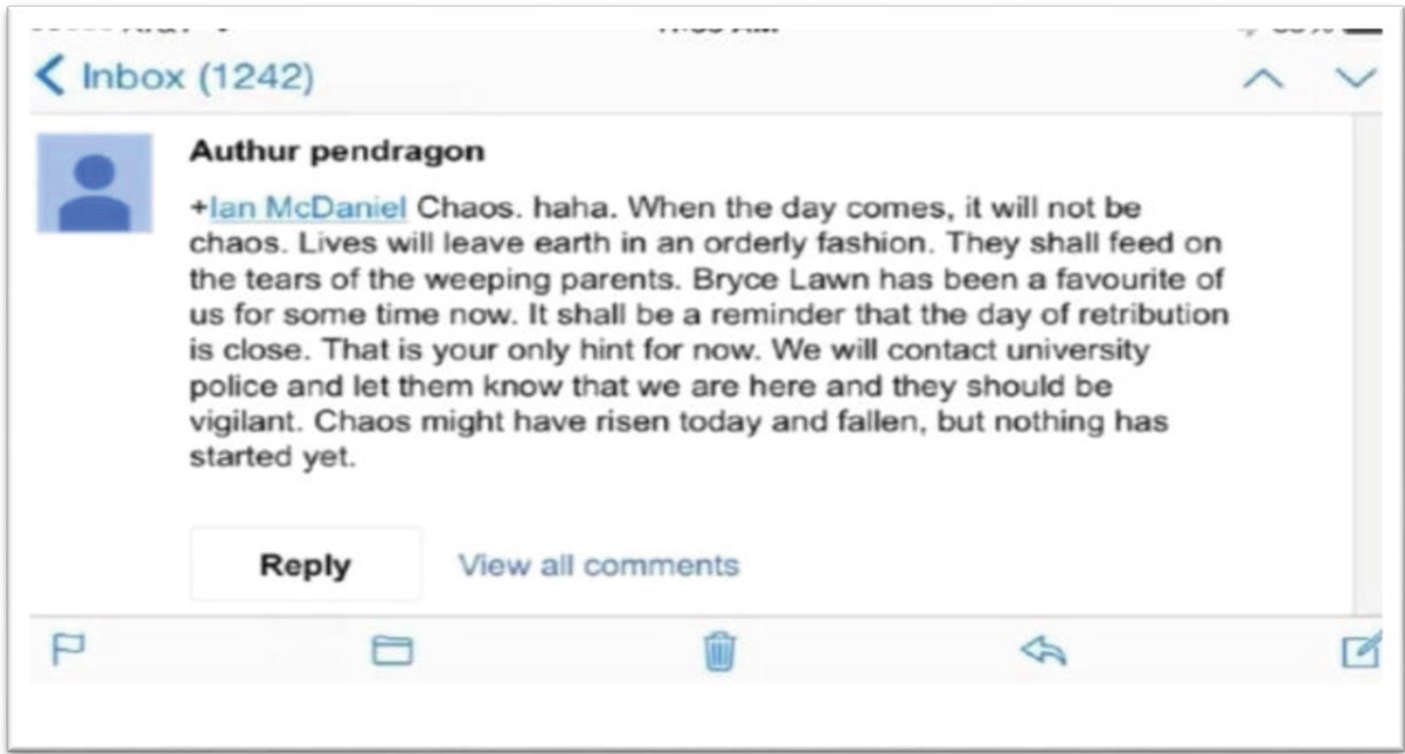 The original 'Second Threat' that bypassed UAPD and went directly to a student's inbox, once again putting the university in a reactive state.
Critical Insight: The "Curse of Knowledge"
The authors conclude with a vital lesson for tech-leaders and administrators: The Curse of Knowledge. Law enforcement and Deans didn't communicate because they knew there was no gunman. They waited for "facts." But the public doesn't have those facts. For a student in a dark dorm room, the absence of an official tweet is not "no news"—it is a confirmation of a cover-up.
Future Outlook
The paper suggests that future crisis management must be Platform-Agnostic. If students are on Yik Yak, the police must be on Yik Yak. To manage a cyber threat, one must occupy the same digital latent space where the rumors are born.
Final Takeaway: In the era of instant digital communication, an unaddressed rumor is as dangerous as a physical threat. Speed is the only antidote to viral fear.