
Digital Ink as a Window into the Brain: Automated Drawing Analysis for Dementia Detection
Automated Analysis of Drawing Process for Detecting Prodromal and Clinical Dementia
This study presents a machine-learning framework for the automated analysis of drawing processes using digital tablets to detect prodromal and clinical dementia. By extracting 190 multifaceted features across five drawing tasks, the authors achieved an AUC of 0.909 for three-class classification and successfully predicted MMSE scores and neuroanatomical changes (MTL atrophy).
TL;DR
Researchers from IBM Research and the University of Tsukuba have developed an automated system that analyzes the process of drawing (not just the result) to identify Mild Cognitive Impairment (MCI) and Dementia. By tracking microscopic movements like pen tilt, pressure, and millisecond pauses, the AI achieved over 90% accuracy in detecting dementia and, remarkably, could predict physical brain shrinkage (MTL atrophy) without an MRI.
The Problem: The High Barrier to Early Diagnosis
Dementia affects millions, yet 75% of cases go undiagnosed globally. Current screening relies on the Mini-Mental State Examination (MMSE) or MoCA, which are clinician-dependent, time-consuming, and influenced by a patient's language and education level.
The drawing tests within these exams (like "copying pentagons") are usually scored statically: "is the shape correct?" However, the motor-cognitive interface—the way your brain coordinates the hand to execute a stroke—contains far more data than the final image. The research intuition here is that "micro-behaviors" during drawing are sensitive enough to act as a digital biomarker for neurodegeneration.
Methodology: Beyond the Final Image
The study recruited 145 participants (Cognitively Normal, MCI, and Dementia). Instead of paper, they used a digitizing tablet (Wacom) to record data at high frequency.
1. Multifaceted Feature Engineering
The team didn't just look at speed. They extracted 38 types of features across four categories:
- Kinematics: Speed, acceleration, and "jerk" (the smoothness of the motion).
- Pressure: How hard the pen is pressed and the variability of that pressure.
- Posture: The X/Y tilt of the pen, reflecting grip stability.
- Pauses: The duration of "air time" between strokes, often indicating cognitive planning load.
2. The Task Battery
The system analyzed five distinct tasks to capture different cognitive domains:
- Sentence writing & Pentagon copying (from MMSE)
- Trail Making Test (TMT-A & B) (Executive function)
- Clock Drawing Test (CDT) (Visuospatial/Constructional)
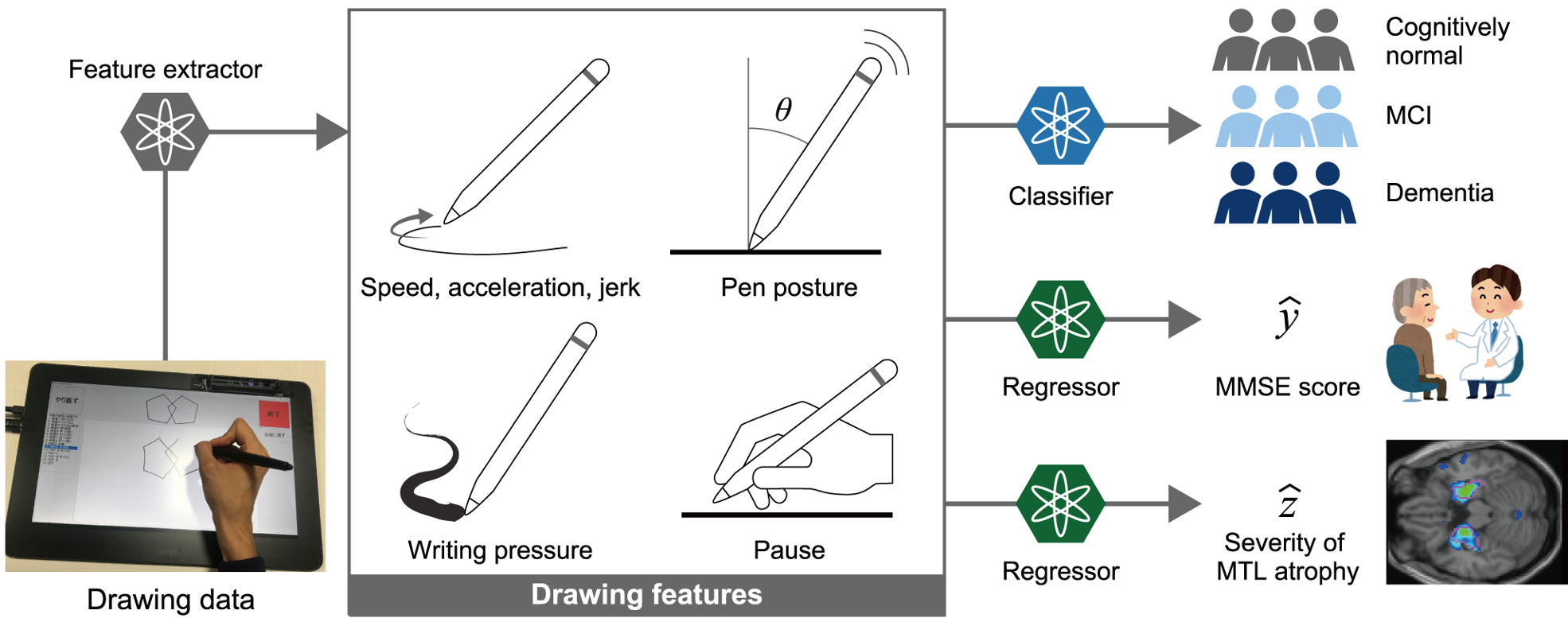 The workflow: from tablet capture to automated machine learning analysis.
Experiments & Results: Predicting the Unseen
The results validated drawing as a powerful proxy for brain health.
High Diagnostic Accuracy
Using Logistic Regression with Elastic Net regularization, the models outperformed traditional MMSE scoring for classification:
- CN vs. Dementia: 92.2% Accuracy (AUC 0.965)
- CN vs. MCI: 82.4% Accuracy (AUC 0.908)
Predicting Brain Atrophy
The most striking result was the link to Medial Temporal Lobe (MTL) atrophy. The MTL is one of the first regions affected by Alzheimer's. The AI could predict the severity of this neuropathological change with an R² of 0.293 using drawing data alone—providing a "behavioral mirror" of the brain's physical state.
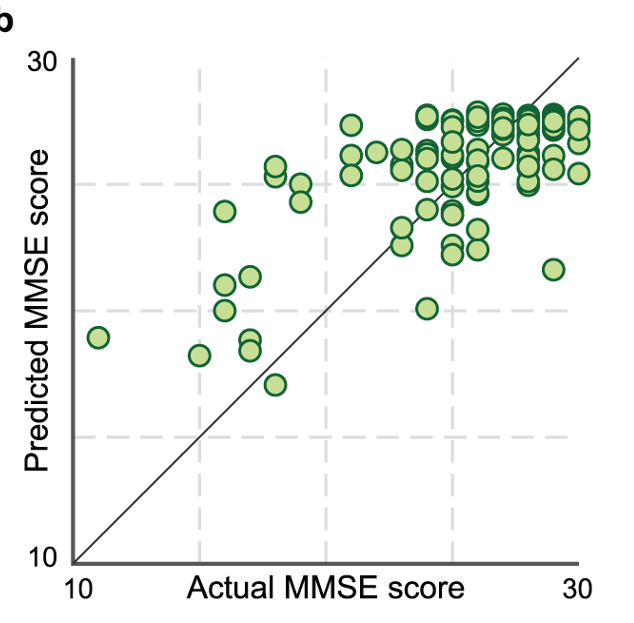 The correlation between predicted MMSE scores and actual scores demonstrates the model's reliability in measuring global cognition.
Critical Insight: Why This Works
Standard drawing tests measure "what" you drew. This AI measures "how" you drew it. A patient with MCI might successfully draw a clock, but they might do so with slower speed, increased pressure variability, and longer pauses as their brain struggles with the motor planning and executive demands. These "hidden" features are often invisible to the human eye but are highly predictive for machine learning models.
Future Outlook: A Self-Administered Tool
The authors showcased a mock-up of a screening tool (see below). Unlike speech or video analysis, drawing is less privacy-invasive and requires less bandwidth, making it ideal for remote monitoring.
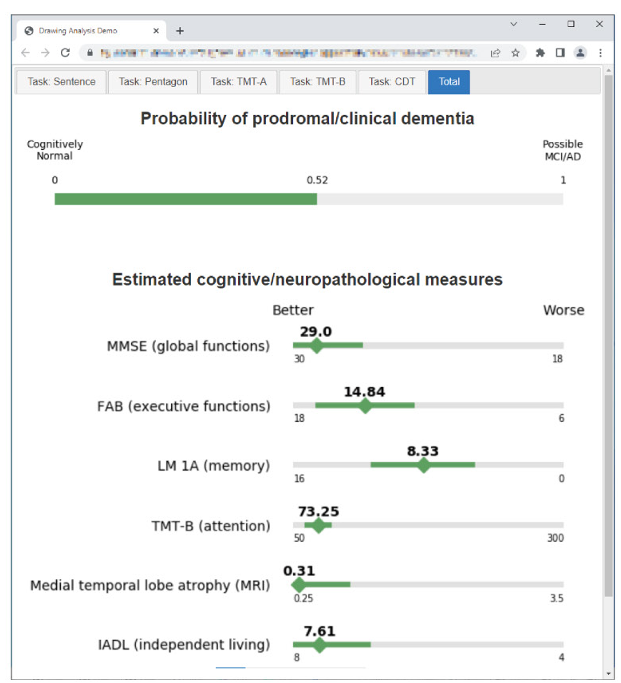 Future vision: A tablet-based app that provides an immediate "probability of dementia" and cognitive health report.
Conclusion
This study bridges the gap between behavioral data and neuropathology. By turning a simple drawing task into a high-dimensional data stream, we move closer to a world where dementia screening is as easy and accessible as playing a game on a tablet.
Limitations to Watch: The sample size (145) is relatively small and from a single center. Future cross-linguistic and larger-scale studies are needed to ensure these "digital ink" patterns hold across global populations.