
ATEC: Deciphering Executive Function Through the Lens of Children's Motion
An automated assessment system for embodied cognition in children: from motion data to executive functioning
The paper introduces an automated assessment system for the Activate Test for Embodied Cognition (ATEC), focusing on measuring children's executive functions through physical activity. By leveraging Kinect-based motion capture and machine learning classifiers (notably peak-detection and DeepGRU), the system achieves up to 78% accuracy in scoring complex cognitive-motor tasks like the "Ball-Drop-to-the-Beat" and "Sailor Step."
TL;DR
Researchers have developed an automated scoring system for the Activate Test for Embodied Cognition (ATEC), transforming raw motion data from Kinect sensors into clinical insights. By analyzing tasks like the "Sailor Step," the system bridges the gap between physical coordination and high-level cognitive processes like response inhibition and working memory, achieving up to 78% accuracy in automated scoring.
Perspective: Why Physical Movement for Cognitive Testing?
Historically, assessing a child's cognitive health—specifically Executive Functions (EF) like attention and self-regulation—has been a "sit-still" affair. Standard tests involve a screen and a keyboard. However, for children with ADHD, the real struggle isn't just clicking a button; it's coordinating thoughts with actions in a dynamic environment.
The ATEC framework operates on the principle of Embodied Cognition: the idea that our motor systems and cognitive processes are deeply intertwined. The authors argue that measuring "cognition in motion" provides a more ecologically valid assessment of how a child functions in the real world.
Methodology: From Pixels to Pedagogy
The system utilizes two Kinect V2 cameras to capture front and side views. The technical pipeline is split into two distinct domains:
1. Upper Body: The Ball-Drop-to-the-Beat Task
This task measures audiovisual processing. Children must pass a ball or raise it based on traffic light cues.
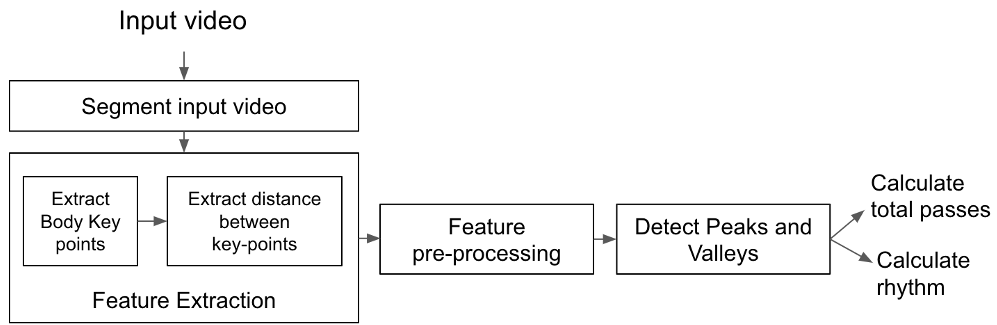
- The Technical Insight: Instead of relying solely on "black-box" neural networks, the authors found that a Peak and Valley detection strategy (using distances between wrists, elbows, and shoulders) was more robust for small datasets.
- Logic: A "pass" event is characterized by a mathematical convergence and divergence of wrist coordinates—a local minimum in distance.
2. Lower Body: The Sailor Step
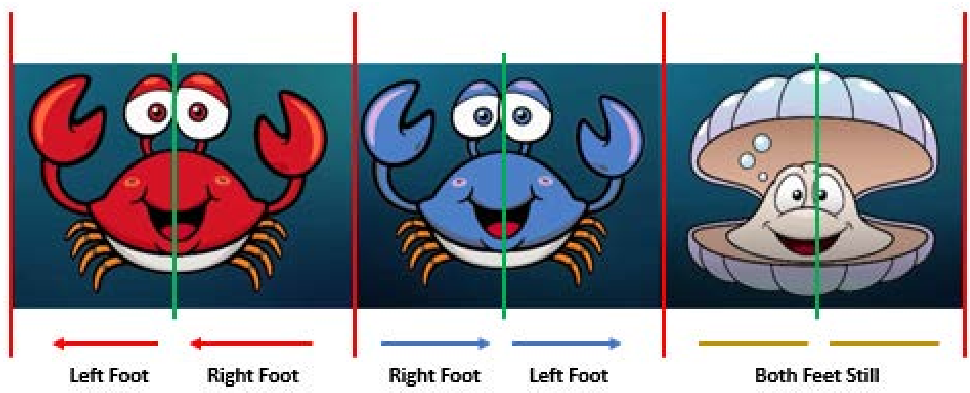
This is essentially a "dance-off" for science. Children move left or right based on "Crab" cues and must stop for "Clams."
- The Challenge: Distinguishing between someone who is perfectly still and someone who is "half-still" (responding late).
- The Solution: A hierarchical classifier. First, it identifies the direction (Left/Right/Still). Then, it drills down into Rhythm Scoring, checking if the movement hit the "beats" of the instructional music.
Experimental Showdown: Heuristics vs. Deep Learning
One of the most striking findings in this paper is that the custom heuristic method (78% accuracy) significantly outperformed DeepGRU (61%) and 1D-CNNs (59%) in the Ball-Drop task.
| Method | Overall Accuracy |
|---|---|
| 1D-CNN | 0.59 |
| DeepGRU | 0.61 |
| Proposed Method | 0.78 |
Why did the Deep Learning models struggle?
- Data Scarcity: Recurrent models like GRUs typically require massive amounts of data to generalize.
- Intra-class Variance: Children move in highly unpredictable ways. A "pass" for one 6-year-old might look like a "dance move" for another. The heuristic model, grounded in the physical logic of joint proximity, proved more resilient to these "random" movements.
Visualization of Results
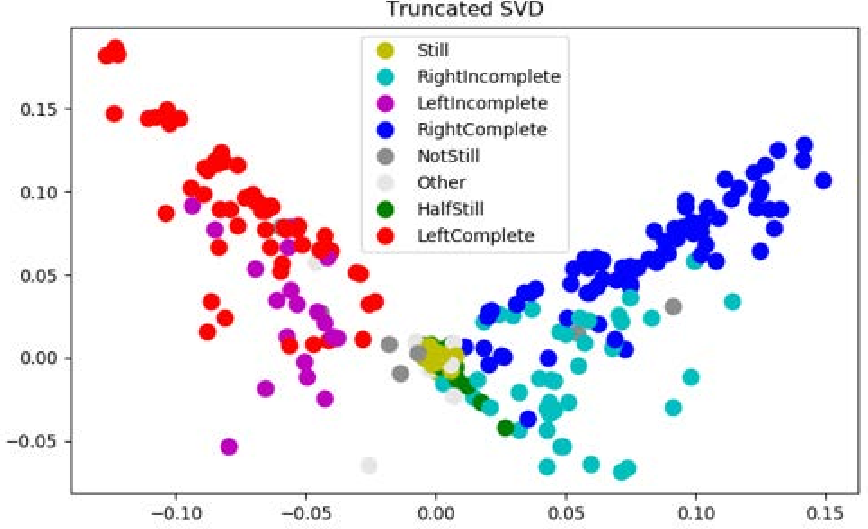
For lower-body activity, the researchers used Truncated SVD to visualize the movement data. As seen below, there is a clear separation between "Left" and "Right" clusters, but the "Still" movements (Response Inhibition) are much tighter and harder to classify, representing the primary area for future improvement.
Deep Insight & Conclusion
This work highlights a critical transition in clinical AI: moving away from generic action recognition and toward domain-specific kinematic logic.
The Takeaway: Automated systems are now capable of matching expert clinical annotations for motor-cognitive tasks. While deep learning is the ultimate goal, this paper proves that in specialized medical/educational contexts, physics-informed features still reign supreme when data is scarce. This paves the way for low-cost, Kinect-based assessment tools that can be deployed in every elementary school gym.
Limitations: The system still struggles with "Half-Still" movements—the subtle delays that often signal cognitive lag. Future work will likely involve synthetic data generation to "teach" the models the nuances of these edge cases.