
Automated Community Detection: Bridging the Gap Between Math and Social Intuition
Automated Community Detection on Social Networks: Useful? Efficient? Asking the users
This paper investigates automated community detection in Online Social Networks (OSNs), specifically focusing on identifying personal contact groups on Facebook. It proposes a cross-disciplinary approach that combines sociological user analysis, graph-based community detection algorithms (InfoMap, iLCD, CFinder), and profile data mining to automatically name and categorize social circles.
TL;DR
Social networks like Facebook have a "big list of friends" problem—your boss, your mom, and your college roommates all see the same updates. While "Circles" or "Smart Lists" exist, nobody uses them because manual sorting is tedious. This paper demonstrates that automated network analysis can accurately group your friends with minimal effort, significantly outperforming the profile-matching tools used by industry giants.
The "Context Collapse" Problem
In sociology, Goffman's theory of self-presentation suggests we wear different "masks" for different audiences. Online, however, these audiences collapse into a single feed. The authors found that while users feel the need to restrict certain posts, they rarely use manual group tools. Why? Because manual management doesn't scale. Existing automated tools (like Facebook's Smart Lists) are often "dumb"—they only look at whether two people went to the same school, missing the nuanced, informal clusters that form our real social lives.
Methodology: Let the Graph Speak
The researchers pivoted from "What do people say about themselves?" to "How are people actually connected?" By treating a user's contact list as an ego-centered network, they applied four distinct strategies:
- InfoMap: A compression-based approach that treats the network like a map.
- CFinder: An overlapping method that looks for "cliques" (tight-knit groups).
- iLCD: A multi-agent approach designed for dynamic networks (where groups change over time).
- Baseline: Simple connected components and Facebook's profile-based lists.
To make these clusters human-readable, they developed a Relevance Score for naming: This formula identifies terms (like "High School X") that appear frequently in a specific group but rarely in the rest of the network.
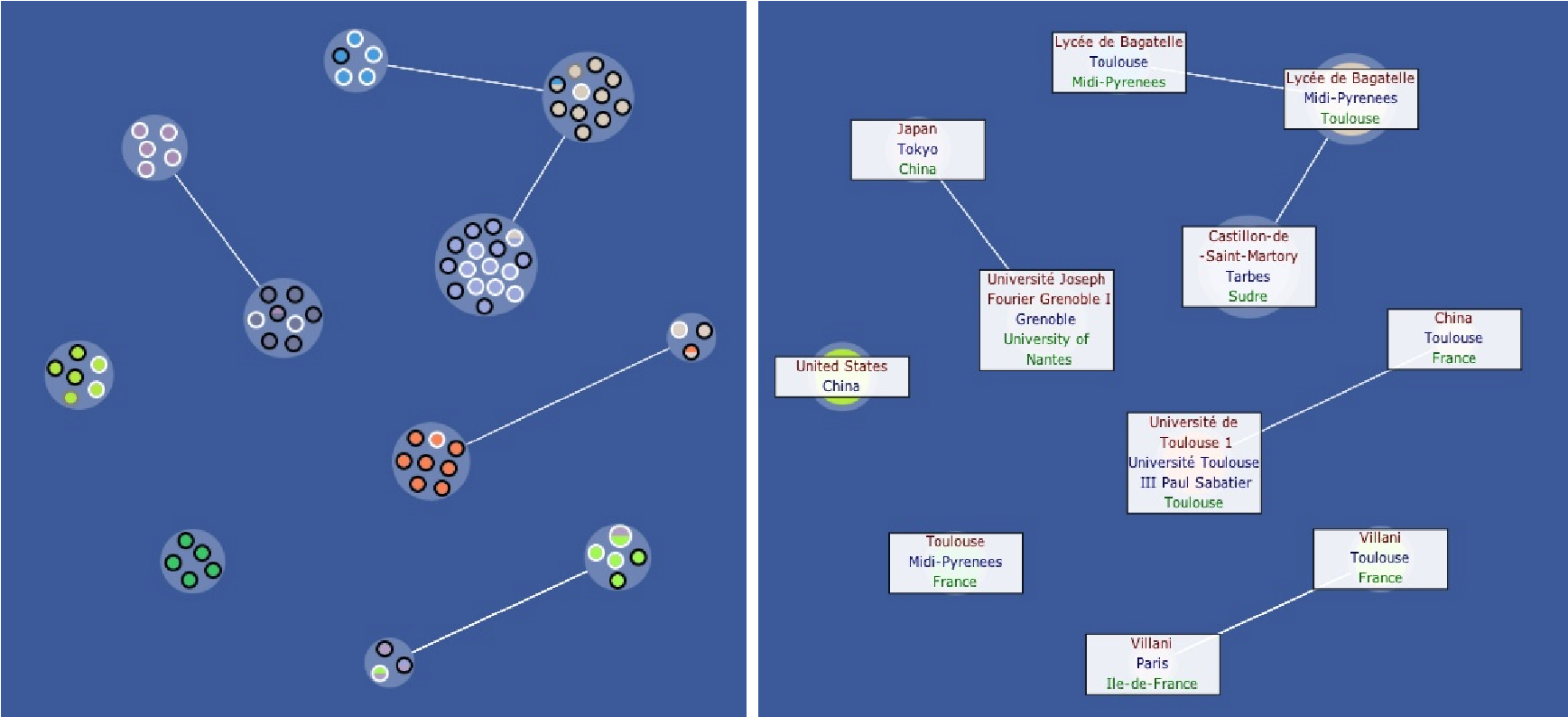 Figure: The experimental Facebook application interface showing detected communities as clusters.
Experimental Battleground: Topology vs. Profiles
The results were telling. Users rated algorithms on a scale of 1 (incoherent) to 5 (perfect).
- The Winner: Graph-based algorithms (InfoMap and iLCD) tied for the lead with high satisfaction rates.
- The Loser: Facebook’s native Smart Lists. Unless a user had manually curated them, they were judged as worse than the simplest mathematical baselines.
- The Insight: 90% of users found a highly accurate group layout from at least one algorithm, but different algorithms performed better on different types of networks.
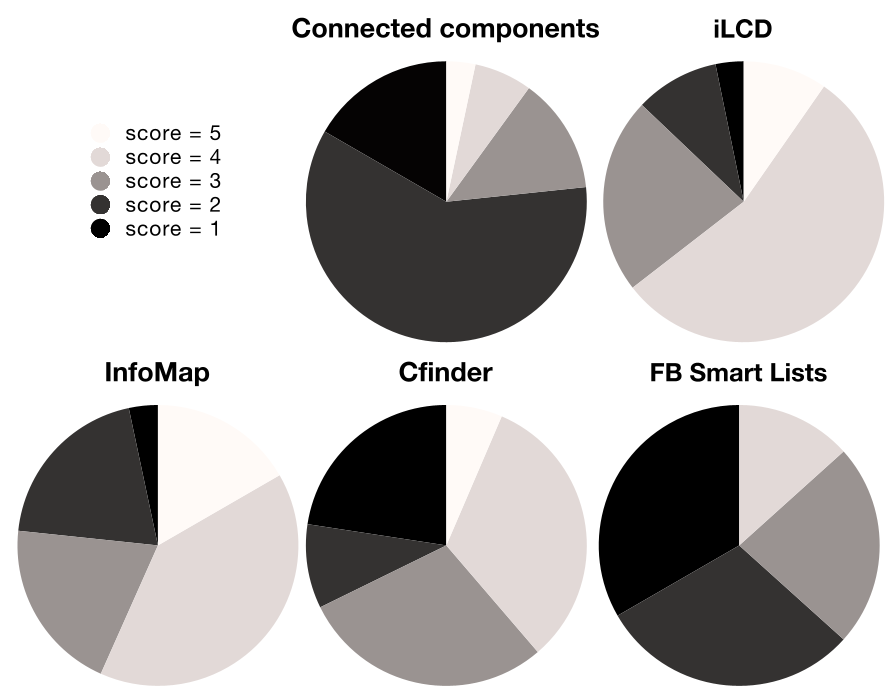 Figure: Scores for different algorithms. Note the significant lead of iLCD and InfoMap over Facebook's internal solutions.
Critical Insights & Future Outlook
The study proves a fundamental technical point: Topology is a better proxy for social reality than self-reported data. However, the authors also provide a reality check. An algorithm might group your "family" perfectly based on links, but Facebook's profile data (explicitly labeling someone as "Mom") is still more efficient for that specific category.
The Takeaway for Product Designers: The future of social OS is not purely algorithmic nor purely manual. It is a Hybrid System:
- Use Network Analysis to find the clusters.
- Use Profile Data to suggest the names.
- Allow User Feedback to refine the "edges" of the community.
As we move toward even larger social graphs and decentralized platforms, these automated "privacy-preserving" filters will become the essential layer between our data and our diverse social audiences.