
Beyond the Current Profile: Mastering Identity Resolution via Historical Behavior
Automated Methods for Identity Resolution across Heterogeneous Social Platforms
This paper introduces an automated framework for identity resolution across heterogeneous social platforms (Twitter, Facebook, Instagram, Tumblr). It proposes novel "Identity Search" methods—leveraging self-mentions, content, and network leaks—combined with a cascaded "Identity Linking" mechanism that utilizes historical username data to match users even when current profiles differ.
TL;DR
Identity resolution—the art of linking a single user's multiple personas across different social networks—is notoriously difficult due to profile obfuscation and attribute evolution. This paper presents a breakthrough by shifting focus from what a user says now to how a user has behaved over time. By analyzing historical username changes and cross-platform "self-mentions," the authors achieved a 44% reduction in false negatives compared to traditional SOTA methods.
The Problem: The "Static Profile" Fallacy
Most identity resolution tools assume that a user's profile is a static snapshot. They compare a Twitter name to a Facebook name and, if they don't match, conclude they belong to different people. This fails for three reasons:
- Intentional Obfuscation: Users purposely vary their names to avoid being tracked.
- Attribute Evolution: People grow, change interests, and update their handles.
- Platform Heterogeneity: Facebook requires real names; Twitter and Tumblr favor pseudonyms.
The authors argue that while current values might be dissimilar, the patterns of how users create and reuse those values are consistent "behavioral fingerprints."
Methodology: Search and Link
The paper breaks the challenge into two distinct tasks: Identity Search and Identity Linking.
1. Advanced Identity Search
Instead of just searching for "John Doe," the authors introduce:
- Self-mention Search: Detecting when a user on Twitter posts a link to their own Instagram photo or Flickr album.
- Network Search: Identifying "leaks" where friends in a user's network reveal the user's alternate identities.
- Content Search: Using cosine similarity to match the actual text shared across platforms.
2. The Cascaded Linking Framework
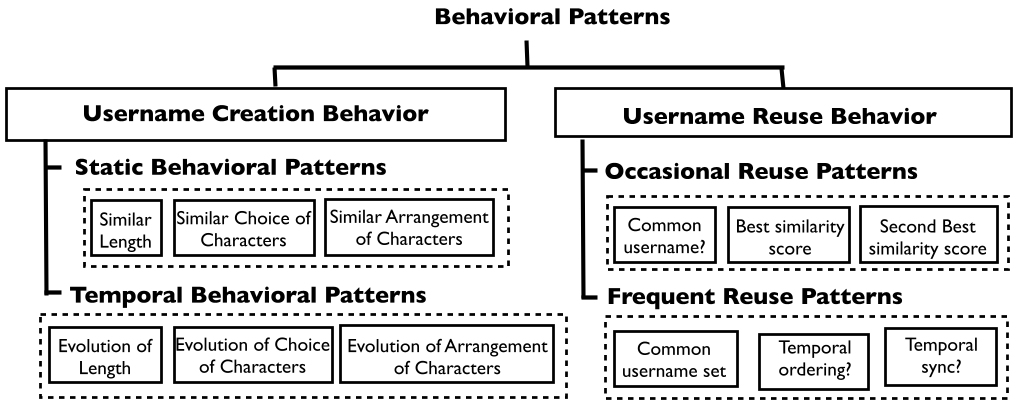
The core innovation is the linking phase. The authors tracked 8.7 million Twitter users over several months to build a dataset of username histories. They identified 26 features based on:
- Username Creation: Length, character arrangement, and how these properties evolve (Temporal patterns).
- Username Reuse: The synchronous reuse of old handles across different platforms to reduce cognitive load.
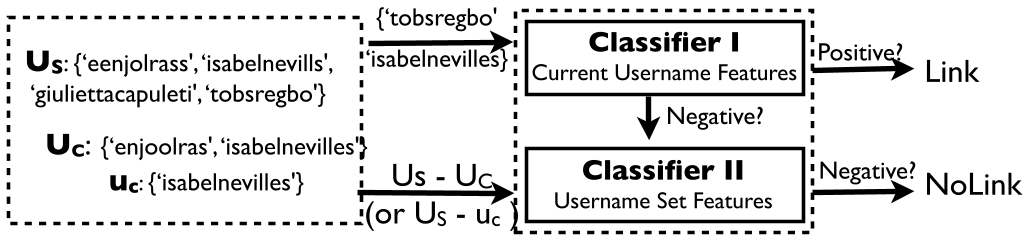
The Cascaded Framework (shown below) works by first using a simple baseline. If the baseline fails to find a match, the system triggers "Classifier II," which looks at the deep behavioral features of the username history.
Experimental Results
The evaluation was conducted on a real-world dataset involving Twitter, Facebook, Instagram, and Tumblr.
| Search Algorithm | Accuracy |
|---|---|
| Traditional Profile Search | 27.4% |
| Proposed Identity Search (Total) | 39.0% |
The linking results were even more impressive. By applying the cascaded SVM classifier to those who failed initial matching, the researchers reduced the False Negative Rate (FNR) from 89.34% to 45.16%. This proves that a lack of an immediate match at the surface level does not mean the identities are unrelated; the connection is simply buried in the history.
Critical Insight & Future Outlook
This work highlights a critical vulnerability in online privacy: even if you change your handle, the way you change it might still give you away.
Takeaways for the Industry:
- Security: Verification systems should look at "Attribute Lineage" rather than just the current state of a profile.
- Marketing: Multi-platform audience estimation can be significantly refined by looking at content cross-pollination.
- Limitations: The study relies on public data. As platforms increasingly "wall off" historical data behind APIs or privacy settings, these methods may require more sophisticated data collection.
The authors' future plan involves Authorship Analysis—identifying users by the rhythmic patterns and linguistic nuances of their posts (stylometry), further narrowing the gap where users can hide in plain sight.