
Scaling Social Intelligence: Formalizing Interaction with Massive Datalog Programs
Automated interaction in social networks with datalog
This paper introduces an enhanced "Query Network" model for social network automation using Datalog, where edges are formed through a decentralized coordination of proposal and acceptance queries. The authors develop and evaluate four specialized algorithms—Simple, Propose-Accept (PA), PA with Backward-Radius (PABRT), and Network Partitioning (NWP)—to handle massive sets of recursive rules on large datasets.
TL;DR
Social network data has grown so vast that manual management is impossible. This paper presents a framework to automate user interactions—like forming connections—using Datalog. By treating a social network as a massive recursive system of "Proposal" and "Acceptance" rules, the authors demonstrate how specialized algorithms like Backward-Radius and Network Partitioning can optimize query execution even when the number of rules is as large as the data itself.
Background: When Queries Are as Big as Data
In standard database theory, we assume a static, small query (a few lines of SQL) runs over a massive dataset. But imagine a social network where every user has their own unique rule for who they want to follow. Suddenly, the "query" is no longer a small script; it is a gargantuan collection of millions of rules.
The authors identify a critical gap: existing automation features in social media don't handle mutual interaction. A system shouldn't just suggest a friend; it should facilitate a "handshake" where User A proposes and User B accepts based on logic.
Methodology: The Propose-Accept Dance
The core of the paper is the Consensus Rule. Instead of just adding edges, the system evaluates: where is the Proposal IDB and is the Acceptance IDB.
1. The Strategy of "Sensing" (Backward-Radius)
A naive algorithm would re-evaluate every person's rules every time a single link is formed. The authors introduce Backward-Radius (BR).
- Insight: If User A and User B become friends, it only affects users who are "close" enough in the graph to see this change in their local neighborhood search.
- PABRT Algorithm: Only nodes within a specific directed distance (the "sensing" range) are re-evaluated, drastically cutting down redundant computations.
2. Network Partitioning (NWP)
Social networks are naturally "clustered" (people form tight-knit communities). The NWP Algorithm exploits this by:
- Splitting the graph into dense sub-communities (using algorithms like Metis).
- Resolving all proposals and acceptances inside those communities.
- Matching and merging communities to resolve "crossing" edges.
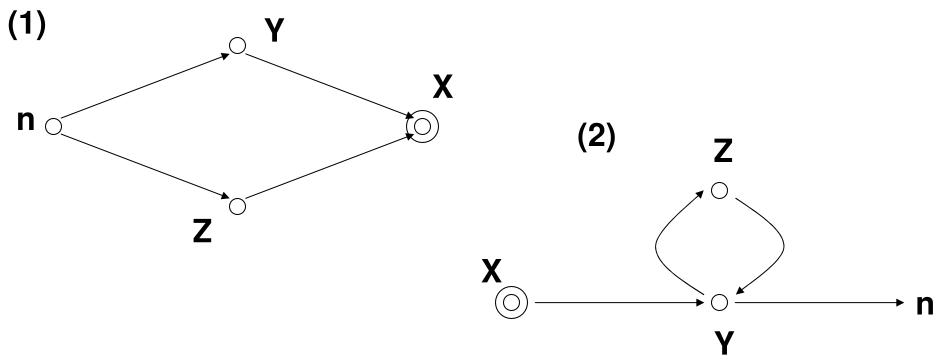 Figure 1: Visualization of Proposal and Acceptance query graphs, illustrating how a user evaluates potential connections.
Experimental Hardcore: From Synthetic Clusters to DBLP
The authors tested their system using both synthetic data (simulating social clusters) and real-world data from the DBLP bibliography.
Key Performance Insights
- Efficiency: The PABRT algorithm consistently outperformed the standard Propose-Accept (PA) approach across all datasets.
- Scalability: The NWP (Network Partitioning) approach showed the best performance, especially as the network size increased. It successfully mitigated the "rule explosion" problem by isolating 90% of the work within small partitions.
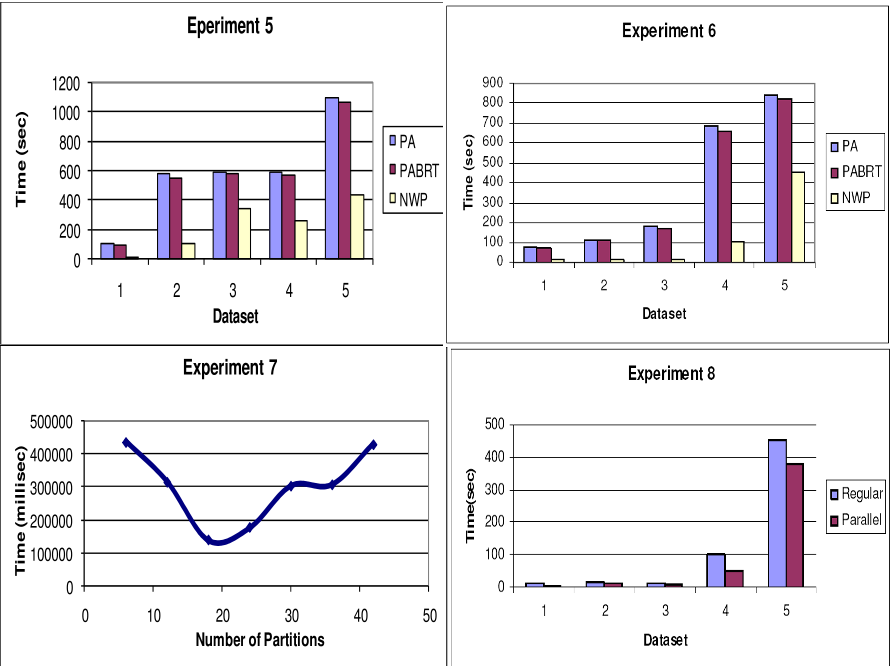 Figure 2: Comparisons showing that NWP (Network Partitioning) and PABRT significantly reduce execution time compared to naive Datalog evaluation.
Critical Analysis & Conclusion
This paper is a masterclass in applying "old-school" logic programming (Datalog) to modern "Big Data" problems. While Datalog is often criticized for being computationally heavy, the authors prove that by incorporating topological awareness (knowing that social networks are clustered), we can keep the recursion manageable.
Takeaway: The future of social media isn't just about algorithms suggesting content; it's about users programming their own interaction logic. If we can execute these programs at scale, we move toward a truly personalized, automated web.
Limitations: The model assumes "safe" Conjunctive Queries. If users were allowed more expressive (and potentially non-terminating) logic, the system's stability might be challenged. Furthermore, the parallelization was simulated; real-world distributed consistency in Datalog remains a non-trivial engineering hurdle.