
Unmasking Digital Aliases: Automated Twitter Author Clustering for Forensics
Automated Twitter Author Clustering with Unsupervised Learning for Social Media Forensics
This paper introduces an automated unsupervised learning framework for Twitter author clustering aimed at social media forensics. It leverages a multi-dimensional feature extraction strategy combined with Kernel Filtering and EM-based Gaussian Mixture Models (GMM) to group alias accounts belonging to the same individual without prior labeling.
TL;DR
Social media has become a breeding ground for state-sponsored disinformation and cybercrime, where a single actor often operates dozens of "alias" accounts. This paper presents an automated pipeline that uses unsupervised learning and Kernel Filtering to group these accounts by their "stylistic DNA"—even if the forensic investigator doesn't know how many authors are involved. Using a combination of personality insights, technical vocabulary, and activity patterns, the system achieves over 90% accuracy in identifying the true owners behind the masks.
The Problem: The "Sybil" Challenge in Forensics
In digital forensics, we often face the "Sybil attack" scenario where multiple online identities are controlled by a single malicious entity. While supervised learning works if we have a "suspect pool," it fails in real-world scenarios where:
- No Labels Exist: We don't have verified training data for every new hacker or bot operator.
- High Anonymity: VPNs and Tor render network-level forensics (like IP tracking) useless.
- Data Scarcity: Tweets are short, making it hard to extract the rich stylistic features used in traditional book or email forensics.
Methodology: Capturing the Invisible Fingerprint
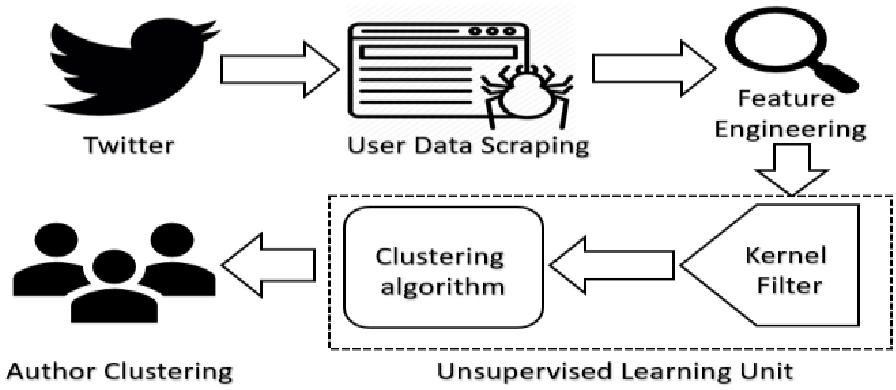
The core innovation lies in the Combination of Feature Extractors and the Kernel Matrix Transformation.
1. Multi-Dimensional Feature Engineering
The authors don't just look at word counts. They extract 11 distinct feature sets to build a holistic profile of an author:
- Personality Insights: Leveraging IBM Watson to map the "Big Five" personality traits (Openness, Conscientiousness, etc.) from tweet text.
- NIST Security Terms: Identifying the author's level of technical expertise by their use of specific cybersecurity jargon.
- Activity Behaviors: Mapping "Time Slots" to find usage habits and time-zone signatures.
- Stylometrics: Punctuation, character n-grams, and stop-word preferences that act as unconscious habits.
2. The Kernel Filter Magic
To handle the high dimensionality of these features (thousands of variables), the authors apply a Kernel Filter. This converts the dataset into an matrix where each entry represents the similarity between two samples.
Experiments and Results
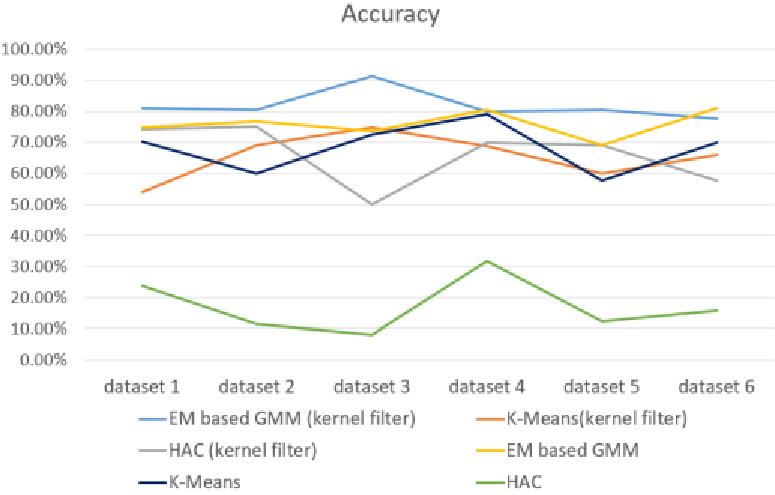
The researchers tested their approach against 120 Twitter accounts divided into six datasets, focusing on two scenarios:
Scenario A: Known Number of Authors
When the number of clusters is pre-defined, EM-based GMM with Kernel Filtering dominated. The kernel transformation significantly boosted the performance of GMM and Hierarchical Agglomerative Clustering (HAC).
Scenario B: Unknown Number of Authors (The Real Challenge)
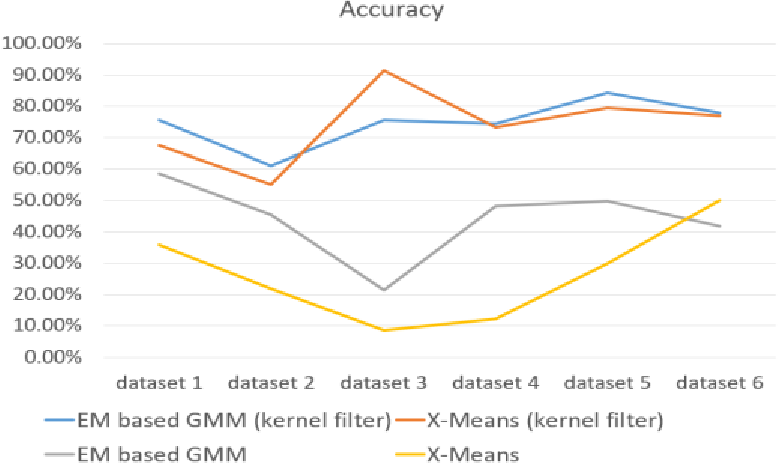
Using X-Means and BIC (Bayesian Information Criterion), the system attempted to "guess" how many authors were in the mix.
- Finding: The Kernel Filter was the "game-changer" here. Without it, models significantly underestimated the number of authors (detecting only 4-5 targets when 20 were present). With the Kernel Filter, the estimation became remarkably precise.
Critical Insight: Why This Works
The success of this method reinforces a psychological truth: Writing is an unconscious behavior. Even when an attacker tries to hide their identity, their choice of "MT" vs "RT", their frequency of using the "!" mark, and their underlying personality traits (extracted via IBM Watson) create a multi-dimensional "style" that is mathematically distinct. By using a Kernel Matrix, the authors allow the clustering algorithm to focus on the relationships between authors rather than the raw, noisy counts of specific words.
Limitations & Future Work
While powerful, the system currently requires a minimum word count (roughly 600-1200 words) for personality analysis to be accurate. In cases of extremely low-activity "sleeper" accounts, the model might struggle. Future research could explore incorporating Large Language Models (LLMs) to generate semantic embeddings that capture intent and sentiment even more deeply than n-grams.
Conclusion
This study provides a robust framework for social media forensics. By moving away from supervised "classification" and toward unsupervised "clustering," investigators can now map out entire networks of botnets and malicious actors starting from nothing but raw, unlabeled tweet data.