
ONTOSTRUCT: Automating Knowledge Engineering in the Regulatory Wild
Building automatically a business registration ontology
The paper introduces ONTOSTRUCT, a domain-independent system designed for the automatic extraction of ontologies from unannotated, domain-specific corpora. It leverages machine learning and statistical techniques to identify terms, cluster concepts, and derive hierarchical relations, specifically applied to the business registration domain for the New Jersey State government.
TL;DR
Building ontologies usually requires an army of linguists and domain experts. ONTOSTRUCT challenges this by proposing a dictionary-less, corpus-based framework that extracts structured knowledge—terms, concepts, and hierarchies—directly from messy, unannotated PDF documents. In its debut, it successfully mapped the complex domain of New Jersey business registration with 75% precision in relation extraction.
The "Small Data" Bottleneck in Domain Ontologies
Most modern text-mining systems are "data-hungry," relying on massive web-scale scrapes (like the early Snowball system) or pre-existing treasures like WordNet. However, government agencies and niche industries don't have billions of tokens; they have a few hundred PDFs containing permit forms, taxation instructions, and regulation handbooks.
The authors identify a crucial "Prior Work" gap: existing tools ignore the partial structure of these documents. A bulleted list in a business form isn't just a list—it's a goldmine of is-a relationships and synonymous attributes. ONTOSTRUCT was born to exploit these local cues where traditional statistical methods fail due to low sample sizes.
Methodology: From Raw Text to Semantic Graphs
The system operates as a sophisticated pipeline, moving from linguistic "parts" to holistic "knowledge."
1. Structural Awareness
Before performing NLP, ONTOSTRUCT identifies "list markers" (e.g., "Item", "Table", "Question"). This creates a locality tree. If two terms appear in the same sub-tree (e.g., under the same form section), they are assigned a high Locality Coefficient, which effectively boosts their similarity score during clustering.
2. Deep Term & Relationship Extraction
The system doesn't just look for nouns; it looks for the roles nouns play.
- Imperative objects: Nouns following verbs like "Enter" or "Indicate."
- Predicative links: Establishing
<Term> <Verb> <Object>triples to understand that a "Corporation" (Subject) "Files" (Verb) a "Form" (Object).
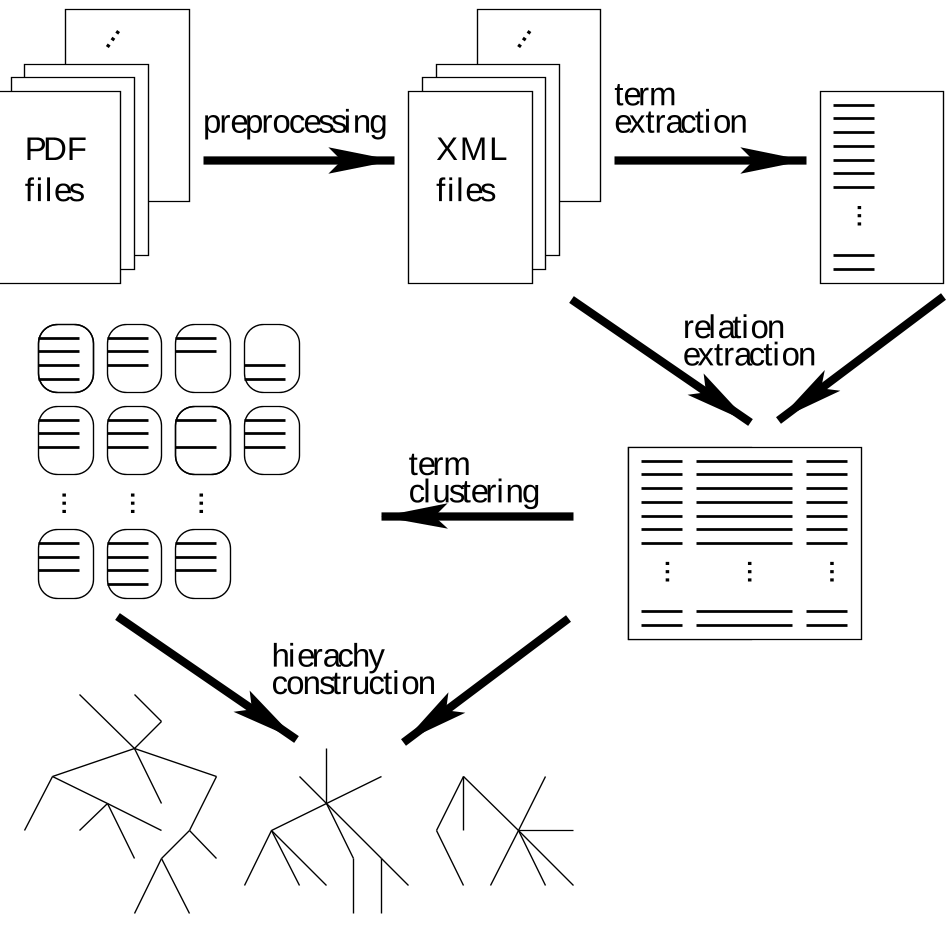 Figure 1: The modular architecture of ONTOSTRUCT, from PDF preprocessing to Ontology Management.
3. Concept Clustering
Instead of assuming every unique word is a new concept, ONTOSTRUCT uses complete-link hierarchical clustering. It groups terms like "Municipal Clerk" and "County Clerk" based on their shared attributes and the verbs they interact with.
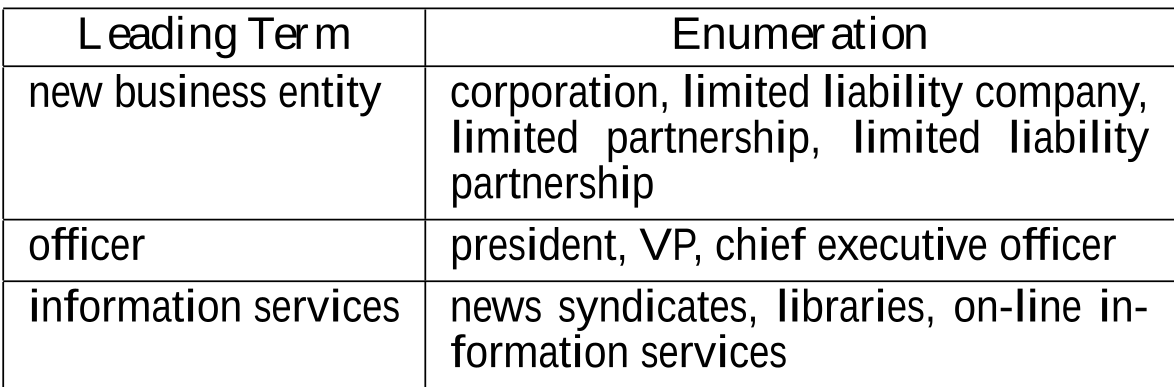 Figure 2: Examples of hierarchical patterns discovered by the system through parenthetical enumerations.
Analyzing the Results
In a domain as dry as taxation and business permits, precision is paramount. ONTOSTRUCT's ability to achieve 75% precision in relationship extraction is impressive given it had no prior dictionary.
| Metric | Result |
|---|---|
| Total Relations Extracted | 3,981 |
| Relation Precision (Judge Avg) | 74% |
| Inter-judge Agreement (κ) | 0.71 (Significant) |
| Concept Cluster Precision | 39% (Strict "Perfect" criteria) |
The lower precision in clustering (36-42%) reflects a "strict evaluation" bias—if a cluster of five related terms included even one outlier, it was marked as a failure. In practice, these clusters still provide a massive head-start for human editors.
Critical Insight: The Value of Implicit Structure
The standout takeaway is that form follows function. In technical and regulatory writing, the way information is laid out on a page (indentation, numbering, parentheticals) often contains more semantic signal than the actual words used. By encoding this layout into a "Locality Coefficient," ONTOSTRUCT effectively bridges the gap between Computer Vision (layout) and NLP (semantics).
While modern LLMs might seem to make these systems obsolete, the logic of ONTOSTRUCT remains vital: for high-stakes domains (legal, medical, government), we need verifiable, graph-based ontologies rather than "black-box" hallucinations. Systems like this provide the "Ground Truth" that modern AI still struggles to extract reliably.
Future Outlook
The authors suggest that future iterations will focus on pattern learning. Instead of pre-defining that "X of Y" is an attribute, the system will learn that in the Business domain, certain phrase structures consistently signal ownership or requirement. This evolution toward self-supervised pattern discovery is exactly what paved the way for the modern era of Information Extraction.