
Beyond History: Predicting Crime via Semantic Analysis of Social Media
Automatic Crime Prediction Using Events Extracted from Twitter Posts
This paper introduces a novel framework for predicting criminal incidents, specifically hit-and-run crimes, by analyzing Twitter data. The authors utilize Semantic Role Labeling (SRL) to extract event-based content and Latent Dirichlet Allocation (LDA) for dimensionality reduction, feeding the resulting topic distributions into a Generalized Linear Model (GLM).
TL;DR
Predicting crime has traditionally been a "rear-view mirror" exercise, looking at where crimes happened yesterday to guess where they will happen tomorrow. This paper shifts the paradigm by treating Twitter as a real-time sensor for environmental hazards. By using Semantic Role Labeling (SRL) and Topic Modeling, the authors successfully predict hit-and-run incidents by identifying specific event patterns in local news tweets, outperforming traditional statistical baselines.
The Problem: The Static Blind Spot of Crime Prediction
Most law enforcement agencies use "hot-spot" mapping, often powered by Kernel Density Estimation (KDE). While KDE is effective at showing where chronic crime persists, it suffers from two major flaws:
- Lack of Portability: It cannot predict crime in regions without prior incident history.
- Contextual Blindness: It ignores the real-time pulse of the city—road closures, protests, or local accidents—that often act as precursors to criminal activity.
Earlier attempts to use social media for prediction relied on sentiment analysis (how people feel) or keyword volume (how much they talk). However, hit-and-run crimes aren't usually preceded by "angry" feelings; they are preceded by specific events like traffic congestion and hazardous road conditions.
Methodology: From Raw Tweets to Predictive Insights
The authors propose a sophisticated pipeline that moves beyond simple word counts to "understand" the context of a message.
1. Semantic Role Labeling (SRL)
Instead of seeing a tweet as a bag of words, the system identifies Events, Entities, and Roles. For example, in the tweet "Rt. 20 closed due to a wreck," the system extracts a "close" event where the entity is "Rt. 20" and the cause is "wreck." This structured data is far more informative than seeing the words "closed" and "wreck" in isolation.
2. Dimensionality Reduction via LDA
Because there are thousands of unique events, the authors use Latent Dirichlet Allocation (LDA) to compress these events into 10 latent "topics." These topics capture broader themes like "traffic/accidents" or "legal/arrest proceedings."
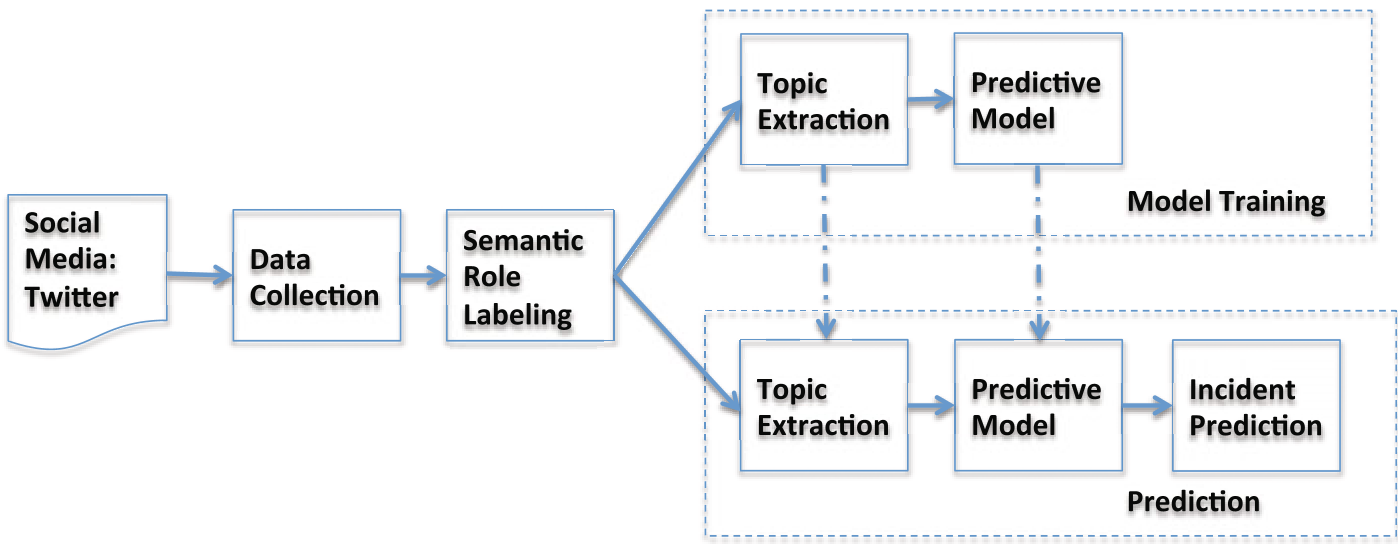 Figure 1: The system pipeline from Tweet collection to SRL, LDA topic extraction, and final GLM prediction.
3. The Predictive Model
The probability of a crime on day is modeled using a Generalized Linear Model (GLM): Where represents the topic distribution for that day.
Experimental Results
The study focused on hit-and-run incidents in Charlottesville, VA. The results were categorized into two major findings:
- Semantic superiority: The model using SRL-extracted events clearly outperformed the baseline.
- The "Bag-of-Words" Failure: When the authors tried to predict crime using all words in a tweet (without SRL), the performance dropped to near-random levels. This proves that semantic structure is the key—it's not just that people are talking; it's what they are reporting that matters.
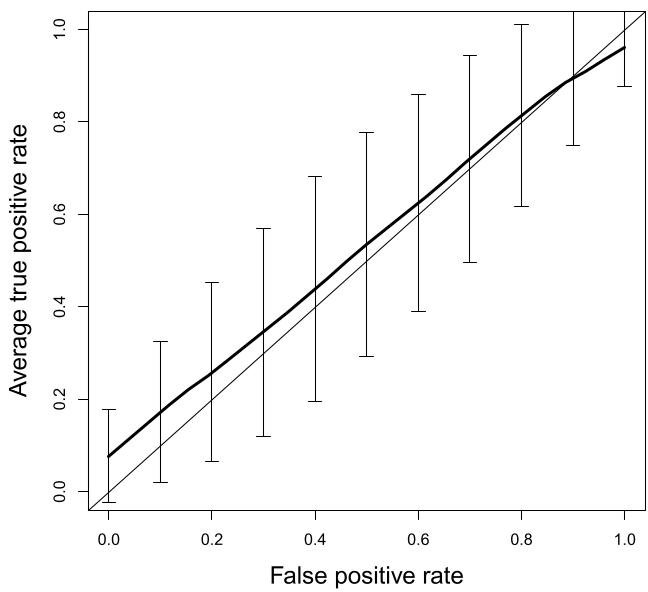 Figure 2: (a) Performance using SRL events vs. (b) Performance using raw words. Note how the semantic approach (a) pushes the curve significantly toward the top-left.
Critical Insight & Conclusion
The true value of this work lies in its Inductive Bias. The authors recognized that certain crimes are not random; they are ecological outcomes of environmental stress. By monitoring news feeds for traffic alerts and road hazards, the model essentially "sees" the increased risk factors before the actual hit-and-run occurs.
Limitations:
- The study used a single news feed (CBS19). Future work would benefit from a "crowdsourced" approach using thousands of individual users.
- The temporal aspect is simplified; the model assumes events today only affect crime tomorrow, whereas some hazards (like a major storm) might have week-long lingering effects.
Future Outlook: This approach paves the way for "Smart City" integration, where social media acts as a ubiquitous, zero-cost sensor network for public safety.