
Automatic Deduction of Classificatory Systems: Bridging Linguistic Theory and Computation
The automatic deduction of classificatory systems from linguistic theories (abridged)
The paper introduces a formal abstract device for the automatic deduction of classificatory systems (both classification labels and search indices) from finite linguistic theories. Utilizing Speciate Re-entrant Logic (SRL), the method converts general linguistic intuitions into explicit, computationally efficient structures suitable for tasks like automated dictionary acquisition and fast data look-up.
TL;DR
This seminal work by King and Simov addresses a fundamental friction in computational linguistics: the mismatch between high-level, implicit linguistic theories and the explicit, indexed classifications required by software. The authors present a logical framework using Speciate Re-entrant Logic (SRL) to automatically derive error-free classification matrices and decision trees from abstract theories, ensuring mathematical consistency that manual deduction lacks.
Background: The Implicit vs. Explicit Divide
Linguists naturally operate in the realm of the implicit. They prefer general theories that capture broad intuitions about language structure (e.g., how German nouns decline or how subcategorization works in HPSG). However, computers are inherently explicit. For tasks like syntactic processing or automated dictionary building, a computer needs a lookup table or a decision tree—a classificatory system.
Manually translating a theory into a system is a nightmare. A single error in a declension table for an inflectionally complex language like Bulgarian can cascade into systemic failure. The authors’ goal is to build a machine that does this translation automatically and provably correctly.
Methodology: The Logic of Classification
The authors divide the task into two core components: Classification and Indexing.
1. Generating the Classification (The Class Algorithm)
The input is a finite theory expressed in SRL. The device uses an algorithm to convert this theory into an exclusive matrix.
- Physical Intuition: Think of the theory as a large, overlapping map of possibilities. The algorithm "re-cuts" this map into a set of non-overlapping, distinct tiles (clauses).
- Logical Constraints: The algorithm ensures that no tile is empty and no two tiles cover the same territory (Semantic Exclusivity).
2. Building the Index (The Index Algorithm)
Once we have the "tiles" (the classification), we need a way to find which tile a specific linguistic object belongs to.
- The device builds an index tree. Each node is a "Query" (e.g., "What is the gender of this noun?"), and each edge is a "Response."
- The Insight: The algorithm uses a "Weight" calculation to pick the most informative query at each step, effectively minimizing the number of questions needed to classify an object.
Case Study: The "Herz" Problem
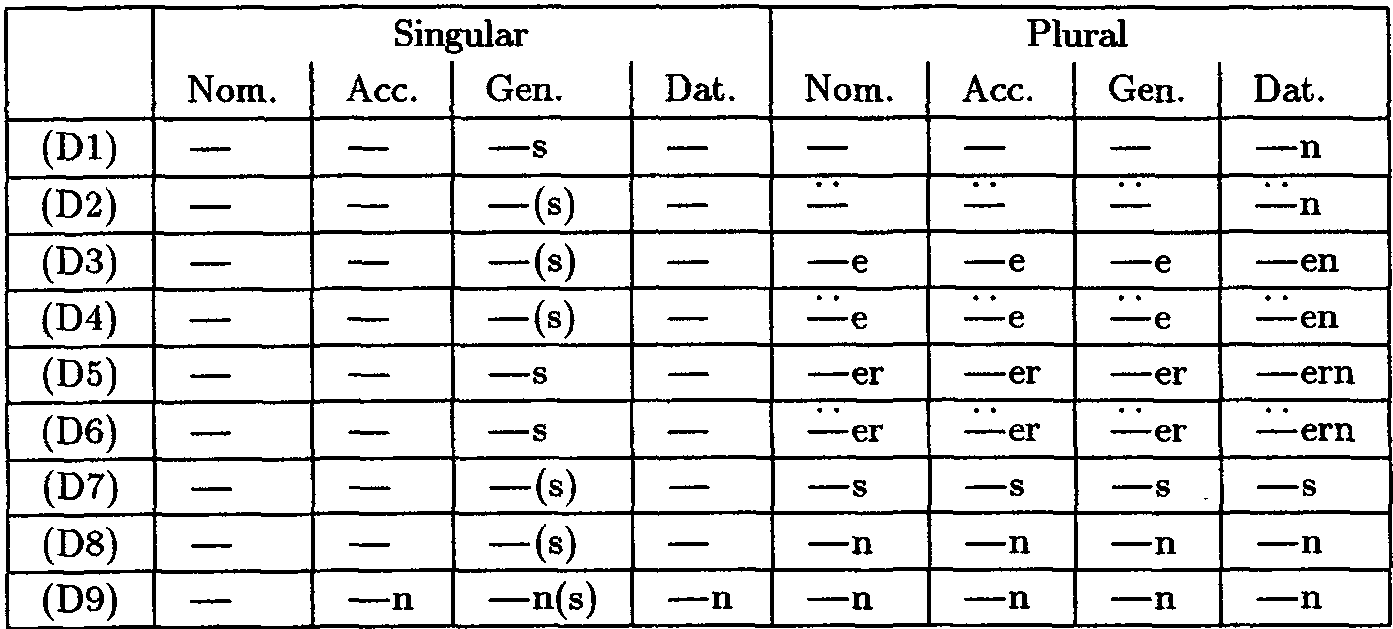
The paper illustrates the stakes using the German noun 'Herz'. A standard classification might simplify German declensions into 9 patterns. However, 'Herz' is an outlier. An manual indexer might accidentally assign it to pattern (D9), leading to the incorrect accusative "Herzen."
The authors' system avoids this by derviving the classification directly from a formal theory that accounts for such outliers, generating a new pattern (D10) and an updated index logic that specifically checks for the "genitive singular -ns" suffix to distinguish 'Herz' from standard (D9) nouns.
Experimental Analysis: Mathematical Proofs Over Performance
As this is a foundational theoretical paper, the "results" are not measured in frames per second, but in logical properties (Q1-Q5):
- Q1 (Uniqueness): Each object gets exactly ONE label.
- Q2 (Utility): No labels are "useless" (representing empty sets).
- Q4 (Accuracy): The index always points to the correct label.
While the authors admit the algorithms are computationally expensive (exponential time complexity), they prove that the automatic deduction of these systems is possible. This is a critical "existence proof" for the field.
Critical Insight & Conclusion
The true value of this work lies in its rigor. In a modern world of "black-box" NLP, King and Simov remind us of the power of formal logic. By treating a linguistic theory as a set of constraints, we can use automated reasoning to ensure our software never "misunderstands" the theory it is supposed to implement.
Takeaway for the Future: This approach is ripe for integration into modern HPSG-based parsers and large-scale lexical databases, where the complexity of constraints makes manual maintenance impossible.