
Deciphering Toxicity in the Arab Digital World: A Survey on Arabic Cyberbullying Detection
Automatic Detection of Cyberbullying and Abusive Language in Arabic Content on Social Networks: A Survey
This paper provides a comprehensive survey of 27 studies regarding the automatic detection of cyberbullying and abusive language in Arabic social media content. It categorizes existing methodologies into Machine Learning, Deep Learning, and Lexicon-based approaches, highlighting achievements in specific dialects and multi-platform datasets (Twitter, YouTube, Facebook).
TL;DR
Social media has democratized expression but also unleashed a wave of cyber-aggression. For the Arabic language—the world’s fifth most spoken—detecting this toxicity is a nightmare of dialects and complex morphology. This paper surveys 27 pioneering studies, revealing that while we are getting better at identifying "bad words" using Deep Learning, we are still struggling to capture the actual "bullying" behavior which requires context and repetition.
The Linguistic Minefield: Why Arabic is Different
Standard Arabic (MSA) is the language of news and formal writing, but social media is the domain of Dialectals. A word that is a neutral observation in one dialect might be a grave insult in another.
The authors point out a critical gap: The Definition Problem.
- Academic Definition: Cyberbullying is an intentional, repeated aggressive behavior.
- Current Research Reality: 90% of models classify single posts as bullying.
This discrepancy creates a "semantic gap" where a single angry comment (flaming) is mislabeled as an ongoing bullying campaign.
Methodology: From Lexicons to Deep Learning
The survey breaks down the detection pipeline into three generations of technology:
1. The Feature Engineering Stage
Early methods relied heavily on TF-IDF (Term Frequency-Inverse Document Frequency) and manually crafted Lexicons (lists of "bad words"). While effective for blatant profanity, they failed at sarcasm or coded language.
2. The Deep Learning Shift
Modern approaches utilize Word Embeddings (like AraVec) which translate Arabic words into high-dimensional vectors. These vectors capture the contextual relationship between words.
- CNNs are used to find local "toxic patterns" in phrases.
- RNNs/GRUs are employed to understand the sequence of words.
3. The Multi-Modal/Contextual Wave
Newer studies have started incorporating Emojis and User History. Emojis often act as "sentiment intensifiers" or substitutes for nouns (e.g., using animal emojis for insults).
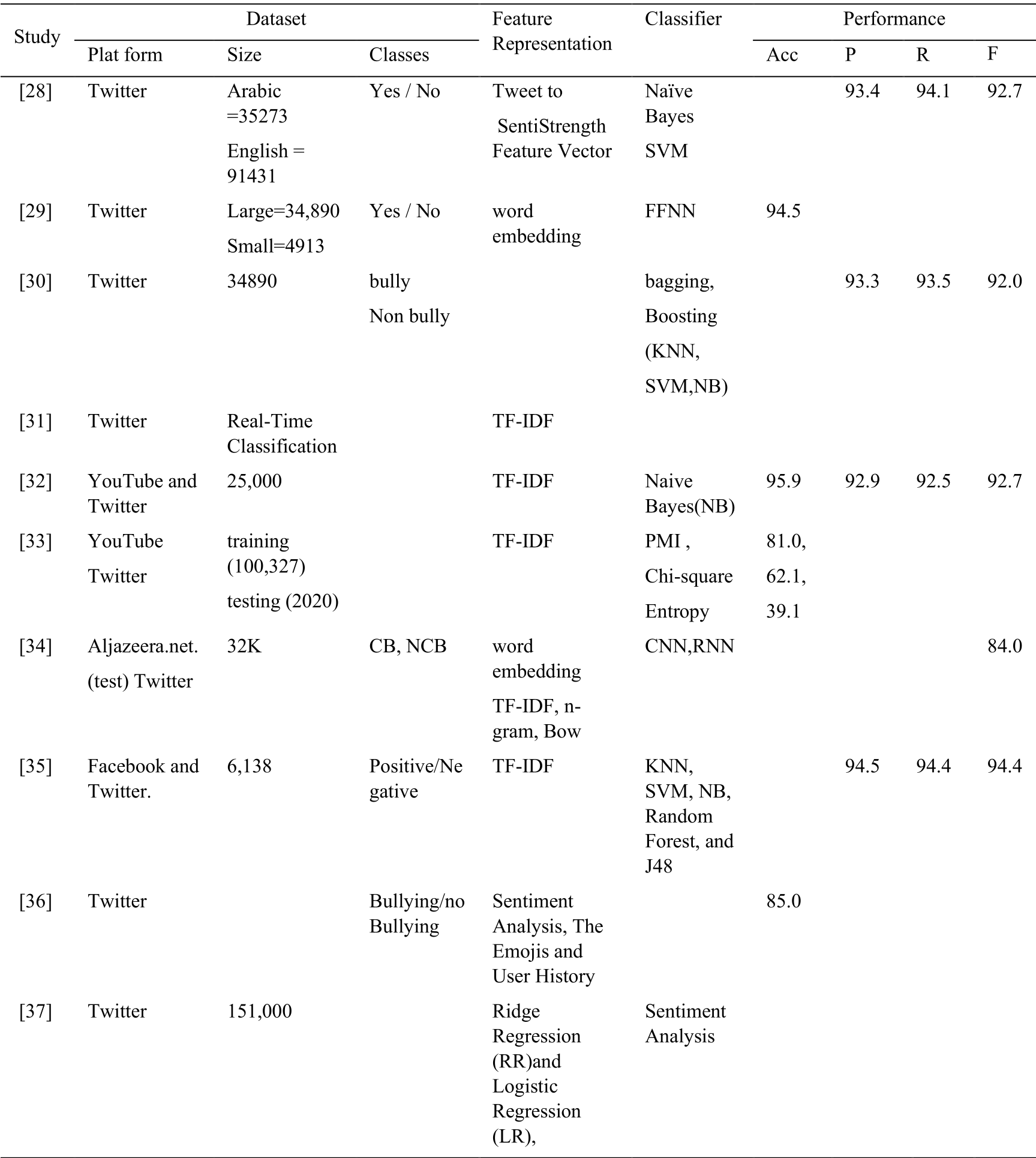 Figure 1: Performance metrics across various cyberbullying studies. Note the high F1-scores, but recall the limitation of imbalanced datasets.
Key Innovations and Results
The survey highlights several standout works:
- Haidar et al. utilized Ensemble Learning (combining KNN, SVM, and NB) to boost performance across multilingual datasets.
- Benaissa et al. showed that combined CNN-RNN architectures using AraVec reached an 84% F1-score on deleted news comments, proving that deep learning can handle the "noise" of informal Arabic better than traditional SVMs.
- Mubarak et al. created significant datasets from Aljazeera and Twitter, providing the community with benchmarks for "obscene" vs. "clean" content.
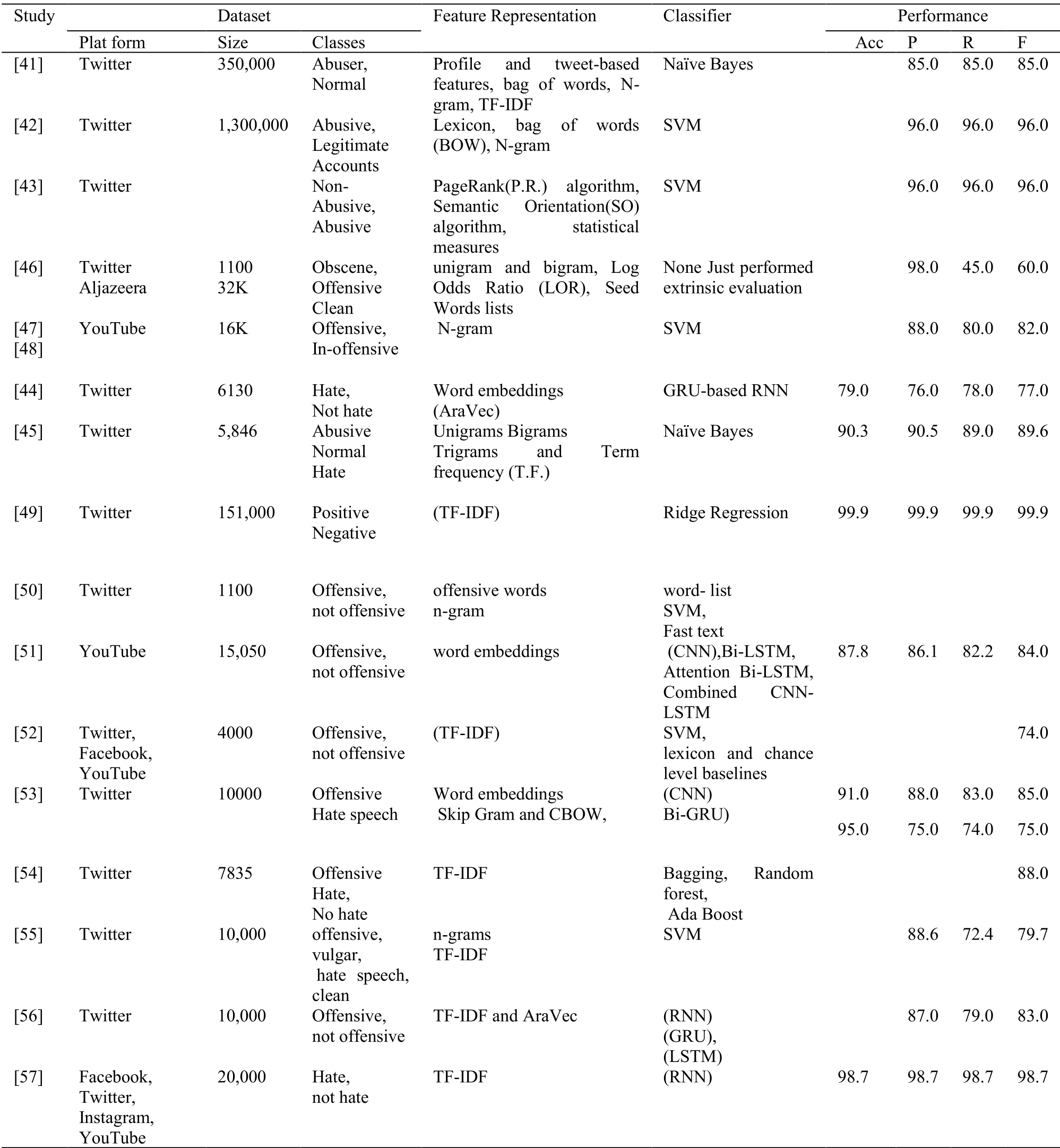 Figure 2: Summary of Offensive Language detection studies, showing a trend toward larger datasets and recurrent neural networks (RNN).
Critical Insight: The "Data Imbalance" Trap
A recurring theme in the survey is that many "High Accuracy" results (90%+) might be misleading. In reality, cyberbullying is a "needle in a haystack" problem. If a dataset is 99% clean and 1% toxic, a model that predicts "clean" every time will be 99% accurate—but it is useless. The paper advocates for SMOTE (oversampling) or specialized weighting to handle this imbalance.
The Road Ahead: Recommendations
The authors conclude with a roadmap for the next generation of AI safety tools:
- Longitudinal Data: We must look at the stream of messages between users, not just one tweet.
- Psychological Grounding: Datasets need to be labeled not just by linguists, but by psychologists who understand the dynamics of harassment.
- Dialect Robustness: Models need to be "dialect-agnostic," capable of understanding North African, Levantine, and Gulf Arabic simultaneously.
Conclusion
Automatic detection in Arabic has moved past the "dictionary" phase into the "neural" phase. However, until we bridge the gap between offensive language (a single act) and cyberbullying (a repeated behavior), our digital safety tools will remain only partially effective.