
Robokind R25: Bridging the Social Gap in ASD Therapy with Machine Learning
Automatic Emotion Recognition in Robot-Children Interaction for ASD Treatment
This paper introduces an automated clinical framework for Autism Spectrum Disorder (ASD) therapy using the Robokind R25 humanoid robot. The core contribution is a machine learning-based Facial Expression Recognition (FER) engine utilizing HOG descriptors and SVMs to provide an objective metric for evaluating children's emotion imitation skills, achieving a SOTA accuracy of 98.9% on the CK+ dataset.
TL;DR
Autism Spectrum Disorder (ASD) remains a significant challenge for social interaction development. This paper presents a pioneering system that uses the Robokind R25 humanoid robot as a social mediator. By deploying a high-performance Facial Expression Recognition (FER) engine powered by HOG and SVM, researchers have turned subjective therapy sessions into objective, measurable data, achieving superior accuracy over previous SOTA methods.
Background: Why Robots for ASD?
Individuals with ASD often find the social world unpredictable and overwhelming. However, they frequently show a strong affinity for the physical, predictable nature of technology. Robots act as a "social bridge"—they are less intimidating than humans but can still model social behaviors. The missing link has always been objective evaluation: How do we measure if a child is truly improving their imitation skills without relying on a therapist's "gut feeling"?
The Pain Points of Facial Recognition
Prior works in FER often fell into two traps:
- Sequence Dependency: Many algorithms assume an expression starts from a "neutral" state, which rarely happens in a natural clinical setting.
- Computational Load: High-fidelity "Component-Based" methods (tracking specific facial landmarks) are often too slow for the real-time feedback required to keep a child engaged.
Methodology: The HOG + SVM Pipeline
The authors opted for a Global Approach, focusing on the overall "appearance" of the face rather than minute geometric points.
1. Pre-processing and Registration
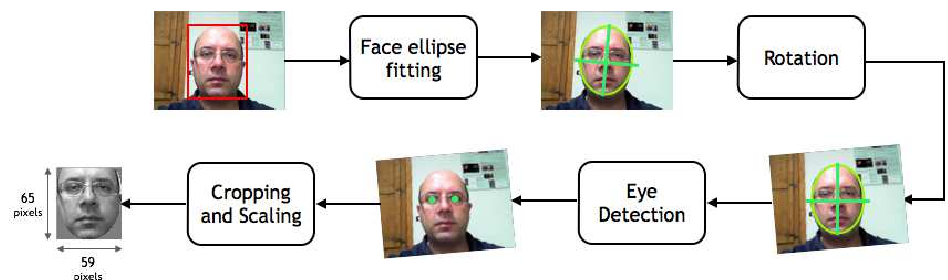
Before analysis, the system detects the face, fits an ellipse to correct the rotation (ensuring a vertical pose), and scales the image to a standard pixel block. This ensures that the HOG descriptor operates on a consistent spatial reference.
2. Feature Extraction (HOG)
The system calculates the distribution of local intensity gradients. By dividing the face into cells and accumulating gradient orientations into histograms, the model becomes robust to lighting variations and small shifts in movement.
3. Classification and Temporal Smoothing
Using a multi-class SVM with a Radial Basis Function (RBF) kernel, the system classifies the expression. To prevent "flickering" results, a temporal consistency rule is applied: an emotion is only officially recognized if it appears in at least 4 out of 5 consecutive frames.
Experimental Excellence
The proposed method was tested against the Cohn-Kanade (CK+) benchmark. It didn't just compete; it outperformed:
- Accuracy: 98.9%
- Average Recall: 95.8% (beating the reference work by Happy et al.)
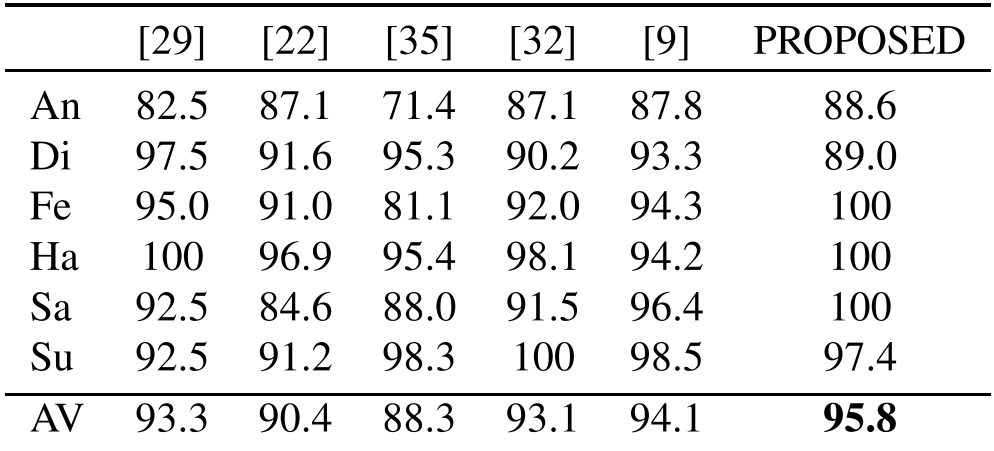
Interestingly, the system achieved 100% recall for Happiness, Fear, and Sadness, only seeing a slight dip in "Disgust" (89%) due to its visual similarity to "Anger"—a common hurdle in computer vision.
"On-Field" Reality Check
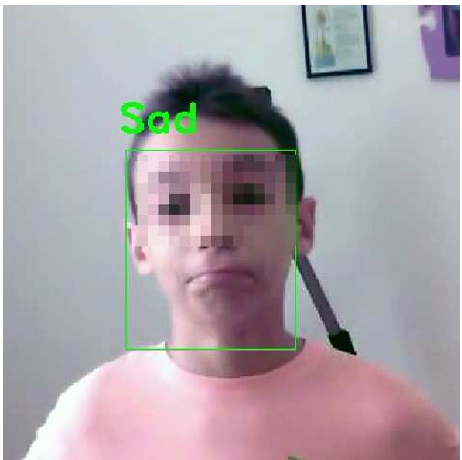
Testing with ASD children revealed the system's practical value. The robot would model an emotion (e.g., "Sadness"), and the FER engine would listen to the robot's eye-camera to see if the child imitated it.
- Success: The system effectively provided real-time vocal rewards when the child succeeded.
- Insights: Failures were often due to the child being distracted by the robot's mechanics (motors) or head rotation, highlighting that face tracking robustness is just as important as classification accuracy.
Conclusion & Critical Analysis
This work marks a shift from "technology for technology's sake" to clinically useful AI. By providing a protocol management module that stores metadata (response times, success rates), therapists can now view "progress graphs" over months of treatment.
Limitations: The system still relies on external processing (MacBook Pro) for the 25 fps speed. Future iterations need to optimize the code for the robot's onboard ARM processor to make the system fully autonomous and portable.
Final Takeaway: The marriage of HOG-based edge analysis and robotic social mediation provides an objective, reliable, and scalable metric for ASD therapy that was previously impossible.