
High-Accuracy Face Annotation: Leveraging Adaptive Boosting in Social Networks
An Automatic Face Annotation System Featuring High Accuracy for Online Social Networks
This paper introduces an automatic face annotation system for Online Social Networks (OSNs) that utilizes a Fused Face Recognition (FFR) unit. By employing the AdaBoost algorithm to ensemble multiple base classifiers (KPCA, KFLD, Bayesian, FLDA, and PCA), the system achieves state-of-the-art accuracy in uncontrolled real-life photo environments.
Executive Summary
TL;DR: This research addresses the challenge of accurately tagging faces in personal photo collections shared on platforms like Facebook. By introducing a Fused Face Recognition (FFR) unit powered by the AdaBoost algorithm, the system intelligently combines multiple recognition engines to handle the "noise" of real-world photography (lighting, poses, expressions).
Background: Within the landscape of Online Social Networks (OSNs), this work acts as a significant "SOTA upgrade" for personalization. It shifts the paradigm from using a single static classifier to a dynamic, ensemble-based personalized recognizer that learns from an individual user's unique social circle and photo history.
Problem & Motivation: The Chaos of "In-the-Wild" Photos
Most traditional Face Recognition (FR) systems are designed for controlled environments (like ID badge photos). However, social network photos are chaotic.
- Prior Work Limitations: Single FR classifiers (like PCA or FLDA) are fragile; they fail when a subject turns their head or stands in a shadow.
- Context Neglect: Many systems ignore the "Social Context"—the fact that you are much more likely to appear with your "Friends" than with random celebrities.
- Efficiency Gap: Previous fusion attempts were often too slow for real-time OSN use, sometimes requiring nearly 100 different engines to run simultaneously.
The authors' insight was simple yet powerful: Don't search for a single perfect classifier; instead, adaptively weight the strengths of several classic classifiers based on the specific user's data.
Methodology: The Fused Face Recognition (FFR) Unit
The core of the system is the FFR unit, which operates in two phases: Training and Testing.
1. Feature Extraction & Confidence Scoring
The system utilizes five base classifiers: PCA, FLDA, KPCA, KFLD, and Bayesian. Instead of a raw "yes/no," each classifier outputs a distance score, which is transformed via a Sigmoid function into a confidence score .
2. The AdaBoost Fusion
The system doesn't treat all engines equally. Through an iterative training process, it assigns a weight to each classifier. If a classifier performs well on the user's localized "Test Bed" (their friends and family), its weight increases.
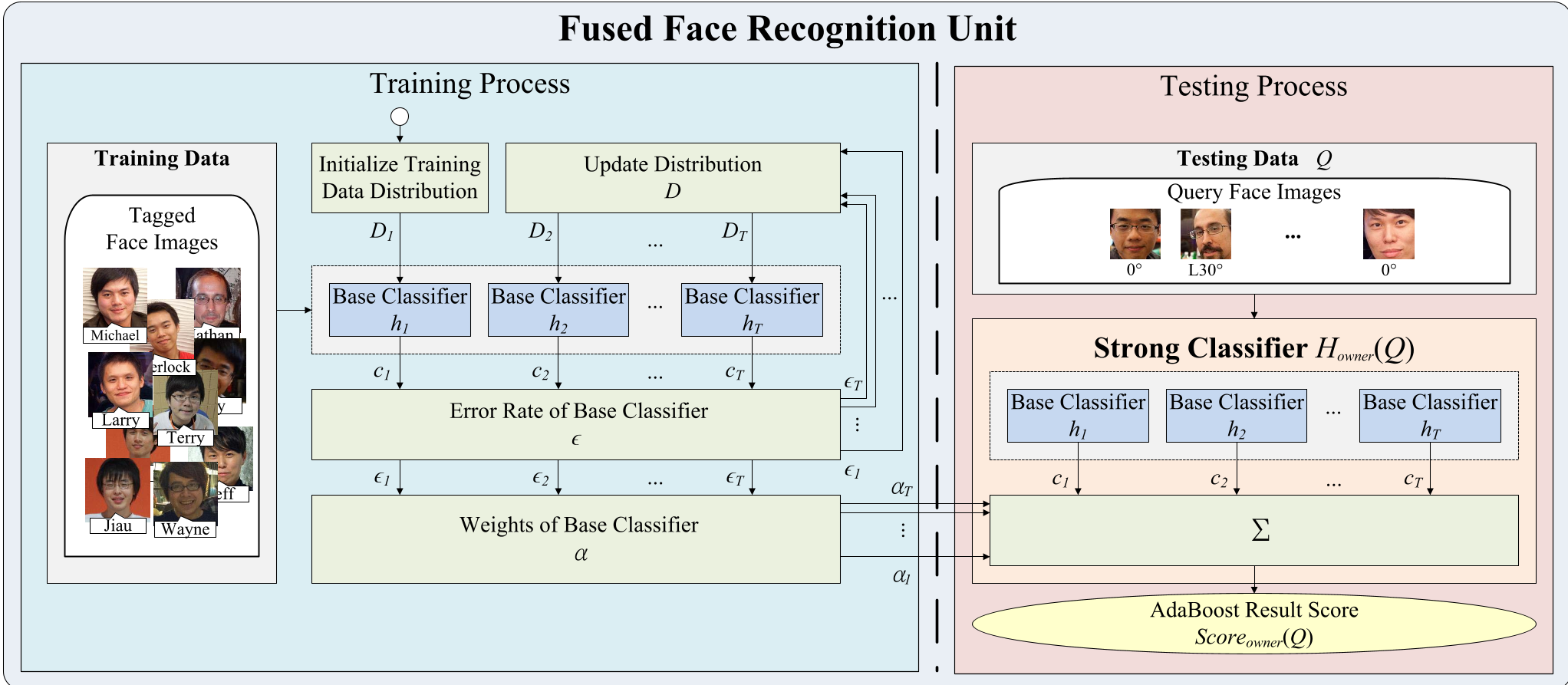 Figure 1: The architecture shows how training data samples are weighted to focus the ensemble on "hard-to-classify" faces.
Experiments & Results: Dominating the Baseline
The authors tested their system using real Facebook data from four volunteers, encompassing hundreds of thousands of photos and thousands of labeled identities.
Quantitative SOTA Comparison
The proposed method was compared against CMVF (Confidence-based Majority Voting) and BDRF (Bayesian Decision Rule Fusion). The improvements were not incremental; they were transformative:
- F-Measure: Up to 57.99% higher than prior methods.
- Similarity: Up to 54.23% higher accuracy.
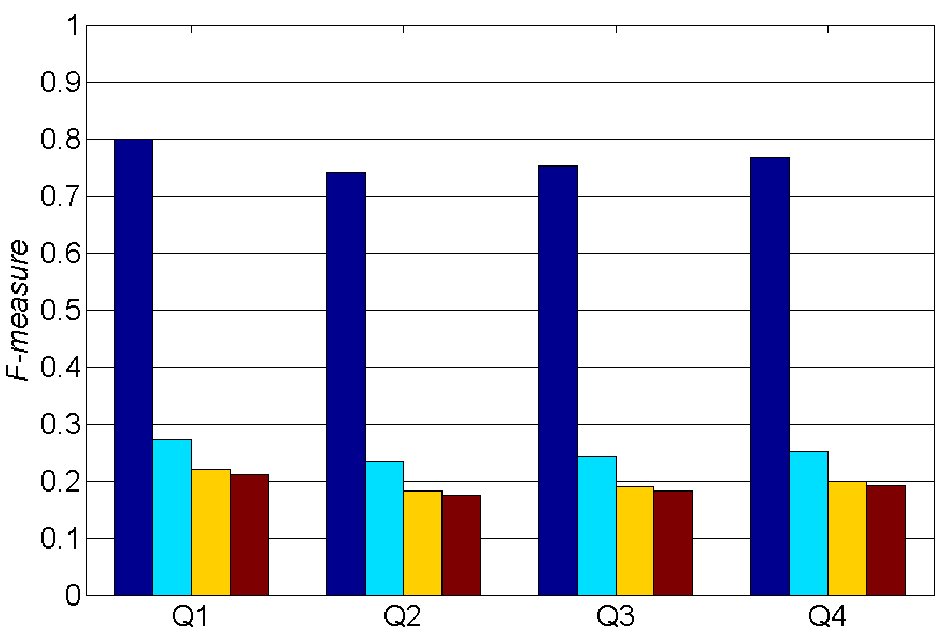 Figure 2: Performance graphs (Precision, Recall, F-measure) across different query sets (Q1-Q4) consistently show the FFR method (red line) at the top.
Critical Analysis & Conclusion
Takeaway
The success of this system highlights that Personalization > Generalization in OSN contexts. By training the FFR unit on the owner's specific social graph, the system effectively ignores the "distractors" of the billions of other faces on the internet, focusing its computational power on the specific subset of humans relevant to the user.
Limitations & Future Work
While the system uses classical descriptors (PCA/KPCA), the modern era of Deep Learning (CNNs/Transformers) offers even more robust feature extractors. A natural next step would be to replace these "base classifiers" with pre-trained facial embeddings (like FaceNet or ArcFace) while retaining the AdaBoost fusion logic to maintain personalization.
Another limitation is the reliance on a manually labeled ground truth for initial training; future iterations could explore Self-Supervised Learning to further reduce the need for user intervention.