
From Novice to Pro: Automating Agent Populations for Game Balancing
Automatic Generation of a Sub-optimal Agent Population with Learning
This paper introduces a method for the automatic generation of sub-optimal agent populations using Reinforcement Learning (RL) to facilitate multiplayer game balancing. By sampling and storing agent policies at different evolutionary stages of training, the authors create a diverse "surrogate population" of varying skill levels to provide training data for meta-game balancing frameworks.
TL;DR
Balancing a multiplayer game is a "meta-game" problem: how do you adjust rules so that players of different skill levels have a fair shot? This paper proposes a clever shortcut: instead of designing bots with different "difficulty settings," simply save the brain (policy) of a Reinforcement Learning agent at every stage of its training. The result? A ready-made population of agents ranging from clueless beginners to seasoned pros.
Context & Motivation
In the multi-billion dollar gaming industry, player retention is king. Retention depends largely on the balance between challenge and skill (the "Flow" state). However, gathering data to test this balance is a nightmare. You either need thousands of human beta testers or a way to simulate "bad," "average," and "good" players.
The authors view balancing as a meta-game. In their framework, a meta-agent learns to tweak the rules of a base game. To train this meta-agent, it needs to see millions of matches played by diverse agents. This paper solves the "Cold Start" problem: where do these diverse agents come from?
The Core Insight: Learning as a Spectrum
The fundamental idea is elegant: An RL agent is inherently sub-optimal during its training phase. By treating the training process not as a path to a single "solved" state, but as a factory for agents, the authors can sample a population that naturally spans the skill spectrum.
The Difficulty of Pitfalls
Training isn't always smooth. In games like FrozenLake, if an agent falls into a hole (a pitfall), it might never see the goal, and thus never learn. To fix this, the authors introduced Mask Blinding.
Mask Blinding: When an agent fails, the specific action that led to the pitfall is artificially penalized in the Q-table (). This pushes the agent to explore other paths sooner, ensuring that even sub-optimal agents eventually reach the goal, making them "useful" sub-optimal agents rather than "broken" ones.
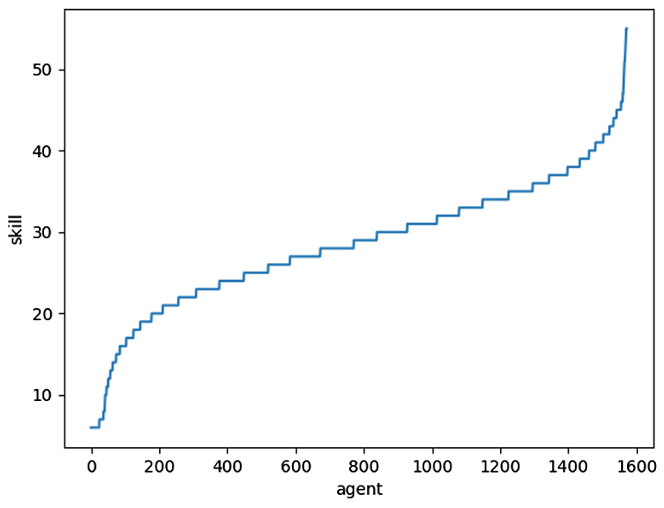 Fig 1: Population traces in FrozenLake. The curves represent "Skill" (steps to goal) vs "Agent ID" (chronological training stage). Note how stochastic environments (slippery floors) create smoother, more varied populations.
Experiments: Discrete vs. Continuous
The researchers tested their methodology on several OpenAI Gym benchmarks:
- FrozenLake (Discrete): Used to test deterministic vs. stochastic logic.
- CartPole & MountainCar (Continuous): Used to test Deep Q-Networks (DQN).
Key Metrics: and
- (Skill Gap): The difference between the best and worst performing agent.
- (Skill Density): How many unique skill levels exist in the population.
The results showed that in CartPole, the methodology produced a very rich diversity of agents (high ). However, in MountainCar, the population was less diverse because the agent either "gets it" or "doesn't," leading to a steeper skill curve.
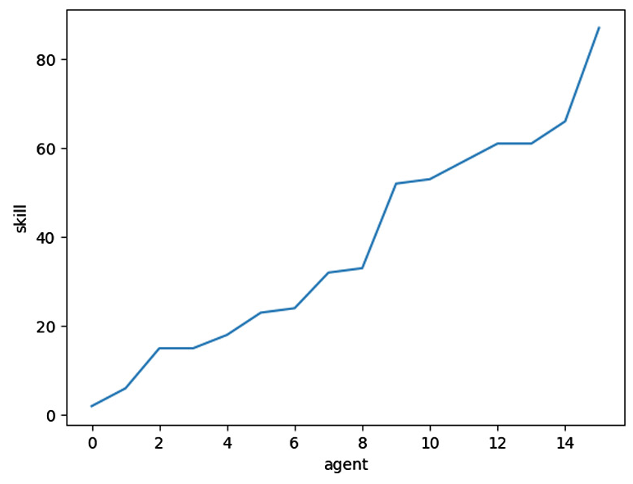 Fig 2: Population trace comparisons across different environments. The left graph (CartPole) shows a much more gradual and usable skill distribution for game balancing.
Critical Analysis & Future Outlook
The beauty of this approach is its generality. It doesn't care if the game is discrete or continuous, or if the environment is stochastic.
Limitations:
- Strategic Games: The authors admit a major hurdle—in games like Rock-Paper-Scissors, skill isn't linear. A "Rock-only" bot isn't strictly better than a "Scissors-only" bot. This non-transitive skill ranking remains an open problem.
- Mask Blinding Scalability: While effective for Table Q-Learning, applying "Mask Blinding" to Deep Neural Networks is non-trivial and requires further research into policy gradient smoothing.
Conclusion
This work provides a foundational step toward Automated Game Balancing. By leveraging the "by-products" of RL training, developers can generate thousands of unique test subjects for their games with zero manual coding. As the industry moves toward more complex, socially-driven "Serious Games" (e.g., for rehabilitation), these automated populations will be essential for creating personalized, engaging experiences.