
Automatic Hate Speech Detection: Navigating the Minefield of Online Discourse
Automatic Hate Speech Detection on Social Media: A Brief Survey
This paper provides a comprehensive survey of Automatic Hate Speech Detection on Online Social Networks (OSNs). It evaluates various Natural Language Processing (NLP) methodologies, ranging from traditional lexicon-based approaches to modern Machine Learning and Deep Learning classifiers like SVM, Random Forest, and LSTM.
TL;DR
As Online Social Networks (OSNs) become the primary medium for global communication, the lack of content constraints has fueled a rise in hate speech. This paper surveys the evolution of NLP techniques—from simple word counting (Bag-of-Words) to complex neural architectures (LSTM)—highlighting that the key to success lies not in finding "bad words," but in understanding linguistic context and intent.
The Core Conflict: Free Speech vs. Safe Spaces
The paper establishes a critical distinction: Free Speech is a cornerstone of democracy, but Hate Speech—defined as language attacking individuals based on attributes like race, religion, or sexual orientation—violates fundamental human rights. The technical challenge arises because the line between the two is often blurred by:
- Sarcasm and Nuance: Words that appear neutral can be weaponized in specific contexts.
- Adversarial Tactics: Users deliberately misspell words (e.g., "j@e@w@") to evade filters.
- Cultural Evolution: Slang and offensive terms evolve faster than static dictionaries can be updated.
Methodology: The Three Pillars of Detection
The survey categorizes the technical arsenal into three distinct strategic layers:
1. Token Frequencies (The "What")
These tools focus on the presence and frequency of words.
- N-grams: Sequential word sets (Unigrams, Bigrams, etc.). While N-grams are highly predictive, the paper notes that higher-order grams (tri-grams) perform significantly better by capturing local context.
- TF-IDF: Measures word importance relative to a corpus, helping to filter out common functional words and highlight specific hateful terminology.
2. Linguistic Pre-processing (The "How")
This layer looks at the structure and role of words.
- Part-of-Speech (POS): Identifying if a word is a pronoun or adjective helps detect patterns (e.g., "VB_PRP" sequences often found in direct attacks).
- Typed Dependencies: Analyzes the grammatical relationships between words to understand who is doing what to whom.
3. Content Analysis (The "Why")
- Sentiment Analysis: Acts as an auxiliary feature. High negative polarity is often a precursor to identifying hateful intent.
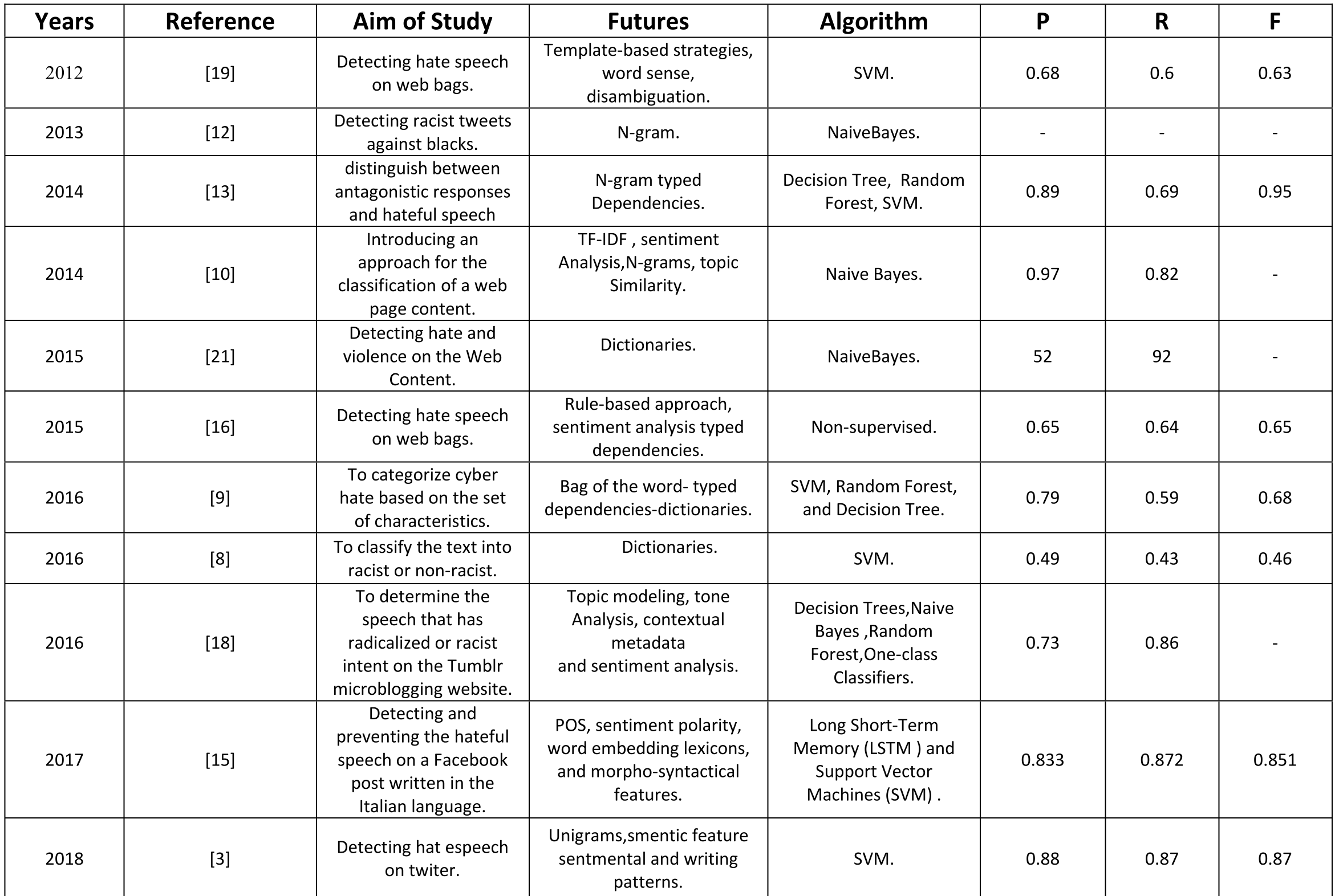 Table 1: Comparison of various studies, showcasing the shift from SVM to LSTM and the impact on Precision/Recall.
Evolution of the Architecture
The paper highlights a transition from Rule-Based Approaches (manually crafted linguistic rules) to Machine Learning (SVM, Random Forest) and eventually Deep Learning (Word2Vec, LSTM).
A particularly interesting method discussed is the Template-Based Strategy. Instead of looking for single words, it centers on "Stereotypes" around a specific word, calculating "log-odds" ratios to determine if a template is more likely to appear in positive or negative contexts.
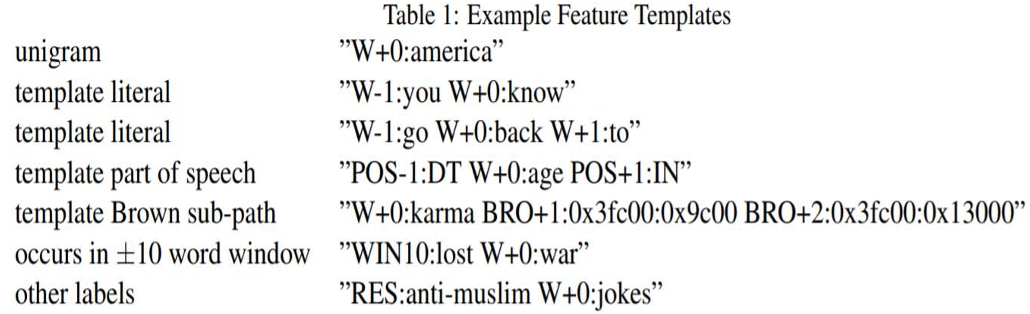 Fig 1: Examples of how templates are structured around central offensive keywords to capture context.
Critical Analysis: Why This Matters
The survey concludes that while we have made massive strides—with some models reaching 0.95 F-measure—significant gaps remain:
- The "Language" Bias: Most research is English-centric, leaving Arabic, French, and Spanish communities underserved.
- Siloed Intelligence: There is a lack of open-source datasets and standardized benchmarks, making it hard to compare "SOTA" claims across papers.
- The Human Factor: A striking takeaway is that human annotators only agreed on "racist" tweets 33% of the time. If humans can't agree, can we truly expect a machine to be the ultimate arbiter?
Future Outlook
The next frontier in this field isn't just better classifiers; it's contextual resilience. The industry is moving toward "adversarial robustness"—building models that can see through "l33t speak" and punctuation-hidden slurs—and "cross-lingual transfer," where models trained in English can protect users in other languages.
For developers and researchers, the message is clear: Stop building better dictionaries; start building better context engines.