
AHROGA: Revolutionizing E-Recruitment with Automatic HR Ontology Generation
Automatic Human Resources Ontology Generation from the Data of an E-Recruitment Platform
This paper introduces <strong>AHROGA</strong>, a method for the automatic generation of a Human Resources (HR) ontology using data from the Algerian e-recruitment platform <em>Emploitic.com</em>. By integrating Natural Language Processing (NLP) and the Louvain community detection algorithm, the authors successfully mapped professional domains, occupations, and skills into a structured hierarchy.
TL;DR
Building an HR ontology manually is a Herculean task. AHROGA (Automatic Human Resources Ontology Generation) automates this by mining 300,000 user profiles. By combining NLP, graph-based community detection, and domain-constrained clustering, it creates a structured map of the labor market that is both accurate and scalable, achieving a 95% skill validation accuracy.
The Scalability Wall in HR Knowledge Representation
In the digital recruitment era, the gap between "job titles" and "actual skills" is vast. While manual repositories like ESCO provide high-quality semantic links, they cannot keep up with the "skills of tomorrow." Conversely, automated tools often struggle with the "noise" of user-generated content—like users listing "Internet" or "PC" as core professional skills.
The authors identify a critical flaw in previous automated works (like HOLA): they treat the labor market as one giant graph, which leads to "semantic bleeding" where unrelated jobs are grouped together just because of shared common-but-vague skills.
Methodology: Precision through Domain Constraints
The core innovation of AHROGA lies in its multi-stage pipeline, which ensures data purity before building the knowledge graph.
1. The Preprocessing Shield
The authors implemented a rigorous cleaning phase to handle the nuances of the Algerian job market (mostly in French). They used:
- Jaro-Winkler Metric: To calculate edit distances between job titles, linking "Web Developer" to "Mobile Developer" based on lexical similarity.
- Naïve Bayes Classifier: To distinguish "Real Skills" from "Noisy Meta-data."
2. Domain-Centric Community Detection
Rather than running a clustering algorithm on the entire dataset, the authors first split the data into 27 Professional Domains. This acts as an Inductive Bias, ensuring that a "Project Manager" in construction is not confused with a "Project Manager" in IT.
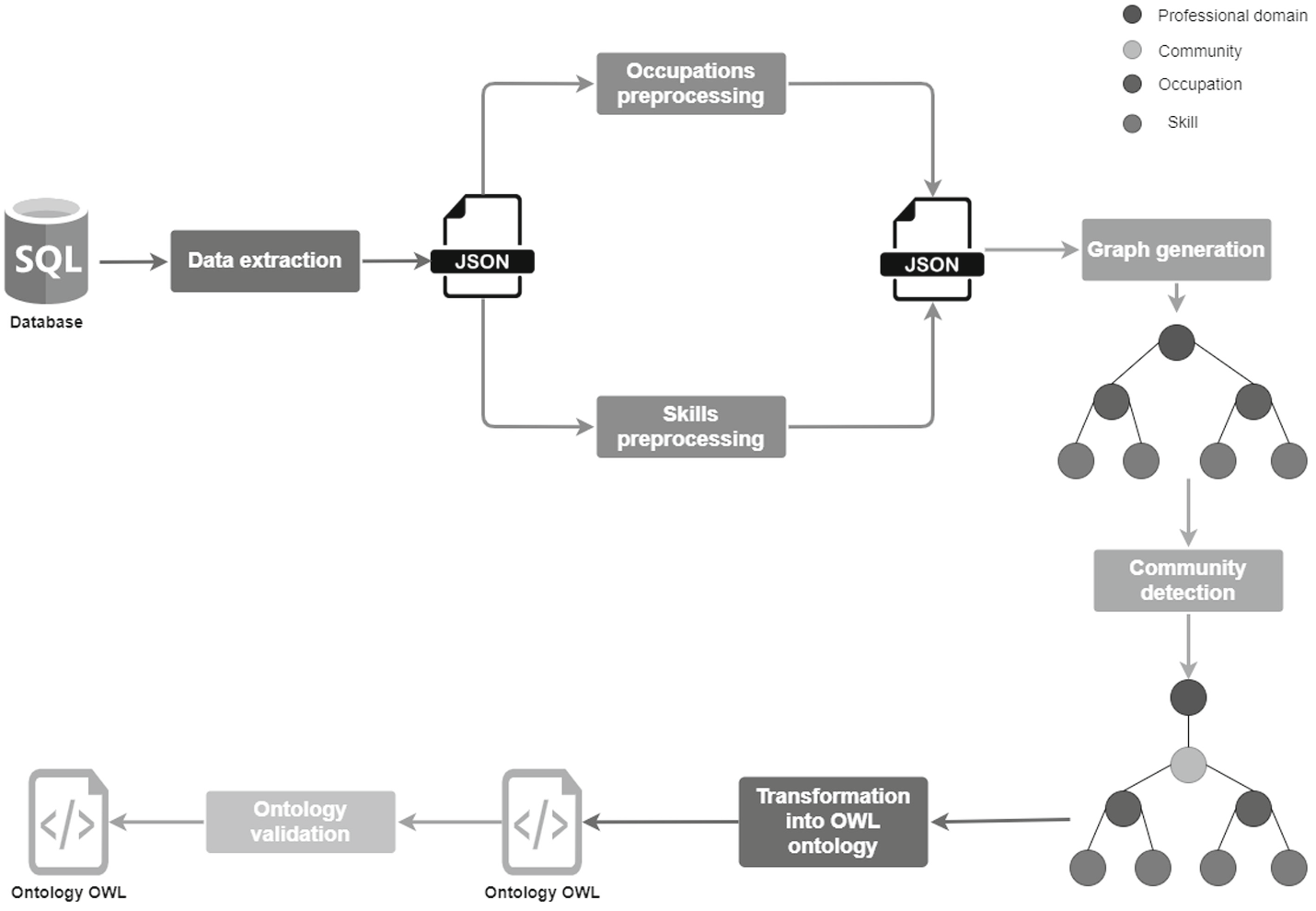
They compared the Louvain algorithm with the Label Propagation Algorithm (LPA). The Louvain algorithm emerged as the winner because it maximizes modularity—effectively grouping occupations that share a significant density of specific skills.
Experimental Validation: Expert vs. Machine
The evaluation of AHROGA was two-fold:
- Automatic Mapping: 73.61% of generated occupations were found in the ESCO standard, validating the model's accuracy.
- Human Expertise: HR experts analyzed three specific domains (IT, Construction, Telecommunications). As shown in the table below, the IT domain achieved a high 74% skill validation rate.
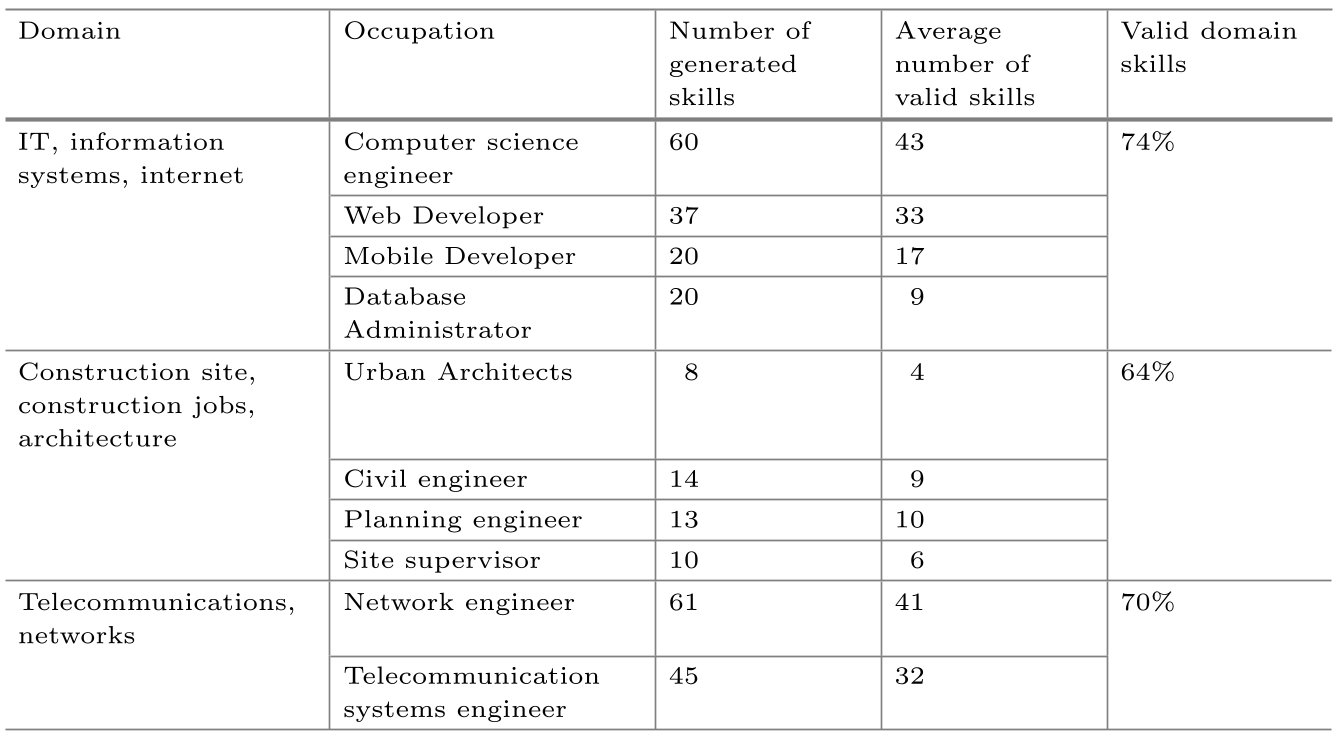
A critical comparison with the HOLA approach (Table 5 in the paper) reveals that AHROGA produces much more "coherent" communities. While HOLA might group a "Dentist" with a "Call Center Operator" due to shared generic interpersonal skills, AHROGA keeps the "Dentist" firmly within the medical domain.
Critical Insight & Future Outlook
The success of AHROGA proves that structure matters more than raw data. By enforcing a domain-first hierarchy, the authors solved the "noise" problem inherent in professional social networks.
Limitations: The current model is heavily focused on the French language and relies on frequency thresholds, which might exclude rare but emerging "niche" skills.
The Road Ahead: The integration of Multilingual support (Arabic and English) and the inclusion of "Education Qualifications" as nodes in the graph could make AHROGA a global standard for automated talent matching. For recruiters, this means moving away from keyword matching and towards true semantic profile-job alignment.
Disclaimer: This analysis is based on the research paper "Automatic Human Resources Ontology Generation from the Data of an E-Recruitment Platform" (2020).