
Transforming Social Networks into Classrooms: Personalized Learning via LDA
Automatic Predictions Using LDA for Learning through Social Networking Services
This paper introduces a prototype Facebook application that utilizes Latent Dirichlet Allocation (LDA) to provide automatic predictions and peer recommendations for personalized English language learning. By analyzing student preferences and characteristics through a generative probabilistic model, the system facilitates collaborative learning within a social networking environment.
TL;DR
This research presents a novel Facebook-integrated application that uses Latent Dirichlet Allocation (LDA) to predict student interests and recommend ideal study partners. By moving beyond simple social interaction and applying probabilistic topic modeling to user preferences, the authors create a personalized "Intelligent Tutoring System" within the world's largest social network.
Background & Motivation: The Social Learning Gap
While Social Networking Services (SNS) like Facebook are ubiquitous among students, their potential as formal learning environments remains underutilized. The core challenge is two-fold:
- Data Complexity: The sheer volume of student interaction data makes manual processing by educators impossible.
- Recommendation Quality: Existing collaborative filtering often ignores the specific "knowledge level" of users, treating all peer ratings as equal.
The authors argue that for language learning (specifically English as a second language), students need more than just content—they need the right peers.
Methodology: The Core Engine
The system architecture is a multi-tiered client-server model where the Facebook application acts as the interface, and a dedicated application server handles the heavy lifting of LDA processing.
1. LDA for Group Identification
LDA is a generative model that explains observations (user ratings/interests) through unobserved groups (latent topics). In this context, it allows the system to:
- Automatically discover clusters of similar students without manual tagging.
- Handle the dynamic nature of social media data by regrouping users every time a new student joins.
2. The "Importance" Metric
A standout feature of this research is the mathematical refinement of user similarity. Instead of relying solely on the similarity of ratings (), the authors introduce an Importance Function:
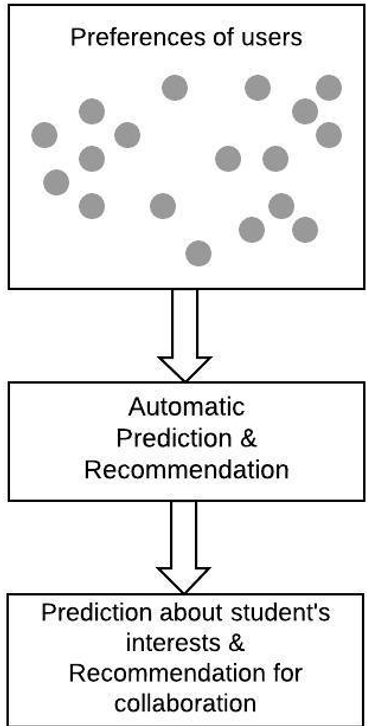 Fig 1: The flow from collecting student preferences to generating automatic predictions and collaboration recommendations.
The formula for similarity, , incorporates the arithmetic mean of scores (academic tests). This ensures that a recommendation isn't just based on shared hobbies, but also on compatible academic levels, creating a balanced collaborative environment.
Experimental Insights
The prototype was tested with a group of 40 users. The system demonstrated a clear ability to:
- Profile Users: Map complex social behaviors into a structured interest matrix.
- Automate Personalization: Generate "Top-N" lists of recommended peers for collaboration.
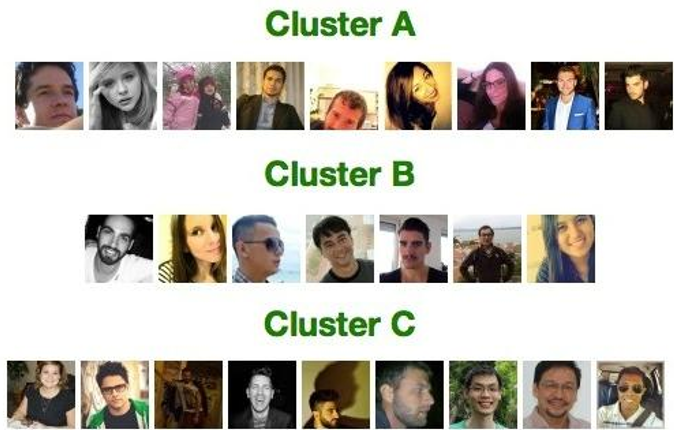 Fig 2: The Facebook Application interface showing the automated recommendation list for the active user.
Critical Analysis & Conclusion
Key Contribution
The primary value of this work lies in its hybridization. It takes a proven NLP algorithm (LDA) and applies it to a social graph specifically for pedagogical purposes. By integrating this directly into Facebook, it lowers the friction for students to engage in "incidental learning."
Limitations & Future Work
- Scale: The preliminary study used 40 participants; the performance of the T-score weighting mechanism needs validation on a larger, more diverse dataset.
- Cold-Start: As with many LDA-based systems, new users with no history may receive sub-optimal recommendations until they provide initial ratings.
Final Takeaway
This paper serves as a blueprint for the next generation of Intelligent Tutoring Systems. It suggests that the future of education isn't in isolated LMS platforms, but in the intelligent layer we build on top of the social networks where students already spend their time.