
Bridging Law and Logic: Automatic Socio-semantic Networks for Regulatory Analysis
Automatic Building of Socio-semantic Networks for Requirements Analysis - Model and Business Application.
This paper introduces a novel Decision Support System (DSS) that automatically constructs Socio-semantic Networks for requirements and regulation analysis. By combining traditional linguistic metrics (TF-IDF, Jaccard index) with Social Network Analysis (SNA) measures, it visualizes complex dependencies between official legal documents and technical terms.
TL;DR
Navigating thousands of official government regulations is a nightmare for consultants. This paper presents a system that transforms static legal corpora into dynamic, visual Socio-semantic Networks. By treating documents and terms as "social entities," it uses Social Network Analysis (SNA) metrics to highlight the most critical regulations and concepts without requiring experts to build a manual ontology.
Background: The Maintenance Trap
In fields like Occupational Health and Safety, experts are overwhelmed by 4.5 GB of text across 200,000 documents. Previously, the industry relied on:
- Full-text Search: Good for finding a specific word, but bad at showing how regulations overlap.
- Ontologies: Highly accurate but extremely expensive to maintain as laws change.
The authors argue that the "social" relationship between terms (co-occurrence) and documents (shared topics) can be mathematically modeled to provide a "birds-eye view" of regulatory requirements.
Methodology: Documents as Social Actors
The core innovation lies in the Socio-semantic weighting mechanism. Instead of simple counts, the authors implement enhanced linguistic statistics directly into the database engine.
1. The Weighting Equations
The system calculates two primary types of weights:
- Similarity (): A refinement of the Jaccard Index that measures how much two texts overlap in their conceptual space.
- Predominance (): A sophisticated variation of TF-IDF that quantifies the relative importance of a specific term within a specific text.
2. The Keyword Network Architecture
The system generates a heterogeneous graph on-demand based on a user's query. The graph consists of:
- Key-texts: Resources directly matching the keyword.
- Similar-texts: Documents related to the key-texts.
- Terms: Predominant tokens that define the semantic bridge.
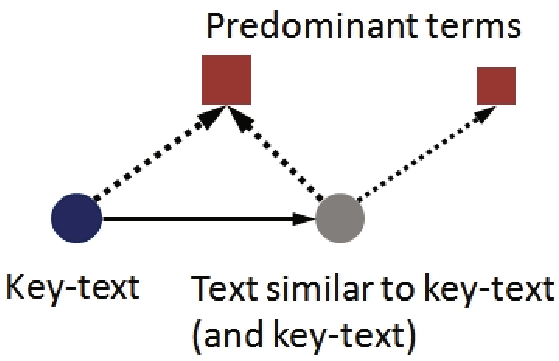 In this schema, directed arcs represent the "flow" of semantic meaning from documents to terms and between related texts.
Real-World Experiment: The "Asbestos" Case Study
To validate the model, the researchers tested it on a French regulatory dataset. By searching for "amiante cancer" (asbestos cancer), the system identified central "unavoidable" terms like exposition, substance, and affection.
SNA Centrality vs. Semantic Weight
One of the paper's most interesting insights is applying Betweenness Centrality to semantic nodes.
- Structural Insight: Centrality identifies the "brokers" of information—words that connect different regulatory clusters.
- Topical Insight: Direct semantic weights identify the most relevant specific notices.
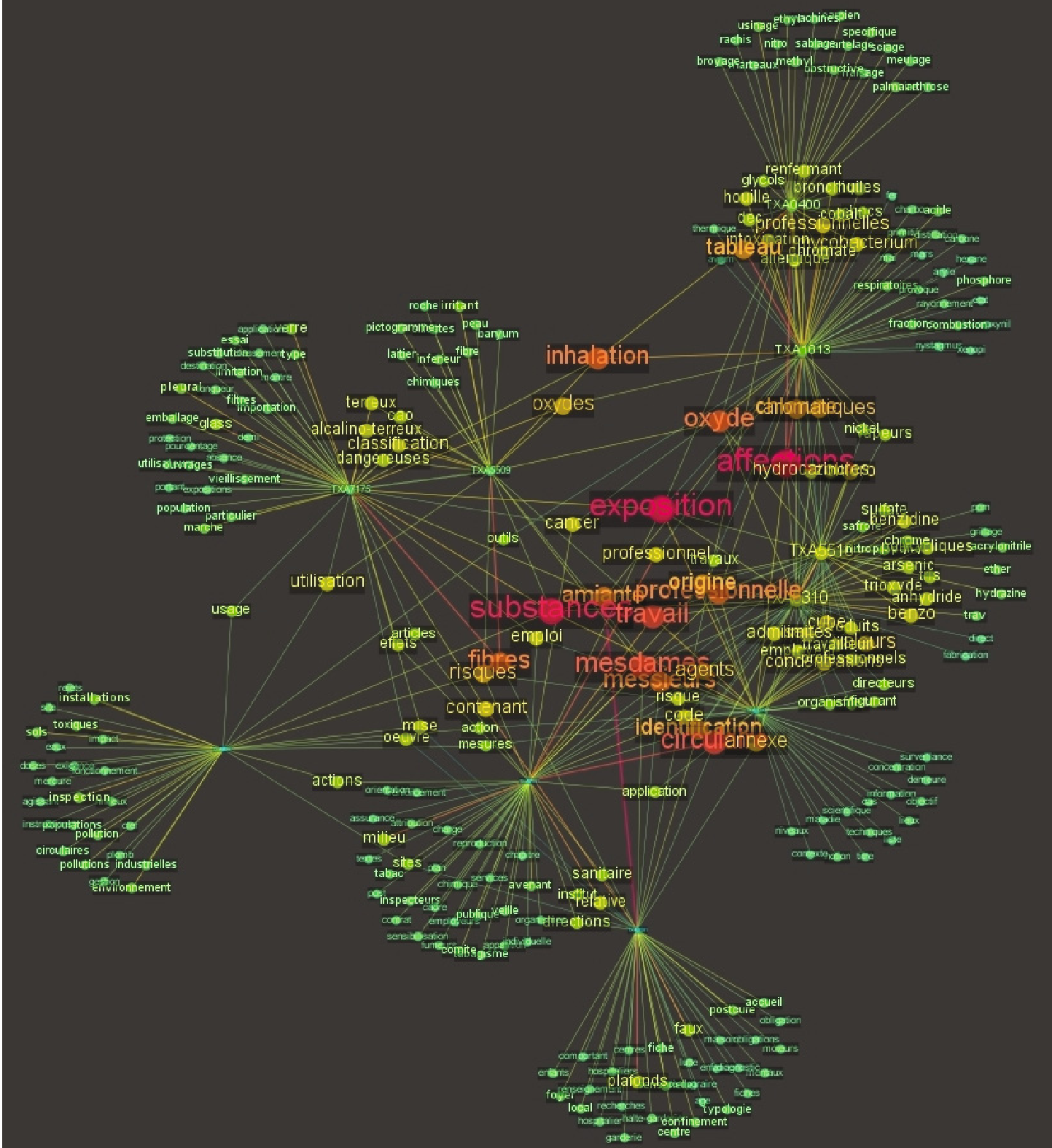 Figure: A socio-semantic network where node size represents Betweenness Centrality, highlighting 'exposition' and 'substance' as the conceptual pillars of asbestos regulation.
Expert Validation and Results
The system's ranking was put to the test against human domain experts. For the "Asbestos" query, the system ranked text TXA7175 (a critical notice on artificial mineral fibers) as the #1 most relevant document. Experts agreed, noting that while it didn't contain the exact keyword extensively, its semantic neighborhood made it the most vital warning for current industry practices.
Critical Analysis & Conclusion
Takeaway
The shift from "Information Retrieval" to "Network Analysis" represents a significant jump in how experts process massive corpora. By leveraging the graph topology, we see not just what a document says, but where it sits in the hierarchy of legal importance.
Limitations
- Language Specificity: The current stems and noise lists are heavily tuned for French (using Morphalou). Scaling to a global, multi-lingual legal framework would require more robust NLP pre-processing.
- Compute Latency: While weights are calculated "on-the-fly," very large queries on dense graphs might still face performance bottlenecks.
Future Work
The authors envision applying this to Social Media and Smart Cities, using the same socio-semantic logic to analyze public opinion and social interactions. In a world of generative AI, this graph-based foundational structure could serve as a powerful grounding mechanism for LLMs to prevent "hallucinations" in legal contexts.