
From Raw Traces to Gold Standards: A Self-Training Approach to Automated IP Traffic Labeling
Automatically building datasets of labeled IP traffic traces: A self-training approach
The paper proposes a self-training framework for automatically labeling IP traffic traces to create datasets for Intrusion Detection Systems (IDS). It leverages Dempster-Shafer theory to fuse outputs from multiple unsupervised Base-IDS (B-IDS) and iteratively integrates a supervised learner to achieve performance comparable to hand-labeled datasets.
TL;DR
Building labeled datasets for network security is a logistical nightmare. This paper presents an ingenious self-training framework that converts raw tcpdump traces into high-quality labeled datasets. By using Dempster-Shafer theory to fuse unreliable sensors and an iterative S-IDS integration loop, the authors prove that we can train supervised models that are just as effective as those trained on expensive, hand-labeled data.
The Labeling Paradox in Network Security
Modern Intrusion Detection Systems (IDS) face a catch-22: to accurately detect sophisticated attacks, they need supervised learning; but supervised learning requires massive, accurately labeled datasets. In the real world, "ground truth" is a luxury. Human experts cannot feasibly label millions of packets, and adversarial attackers do their best to blend in with normal traffic. Relying on old datasets like KDD 99 is no longer viable as the threat landscape evolves.
Methodology: The Core of Self-Training
The authors propose a multi-stage architecture that resolves the lack of ground truth through expert-informed fusion.
1. The Bank of Base-IDS (B-IDS)
The process starts with unsupervised detectors—signature-based systems (like Snort) and anomaly-based PR systems (like SVM or RPCL). Since these don't require training data, they act as the initial "noisy" teachers.
2. Dempster-Shafer (D-S) Fusion
Unlike Bayesian logic, which struggles with "unknown unknowns," D-S theory explicitly models uncertainty. The system assigns a Basic Probability Assignment (BPA) to each B-IDS based on its structural strengths (e.g., Snort is highly trusted for attacks but less so for "normal" declarations).

3. The Reliability Index (RI)
The breakthrough is the RI, a metric defined as: This allows the system to identify "Guard Regions"—packets that are too ambiguous to include in a training set. Only samples with high are used to train the next stage.
Iterative Refinement: Integrating the S-IDS
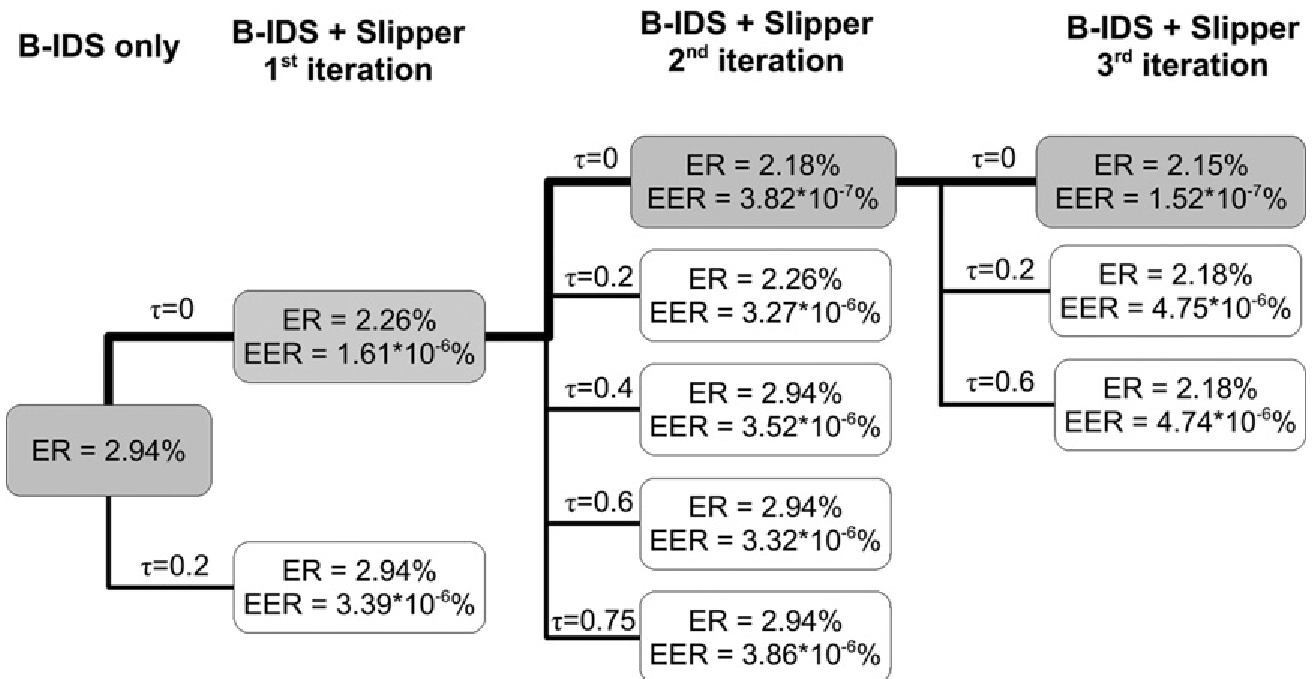
A Supervised IDS (S-IDS), like the SLIPPER rule-builder, is trained on the high-confidence labels produced by the B-IDS bank. Once trained, the S-IDS is not just a product—it is integrated back into the fusion bank as another "expert." This iterative process continues until the Estimated Error Rate (EER) stabilizes.
Experimental Validation
The authors tested the framework on both the DARPA 99 benchmark and real LAN traffic traces.
- Automated vs. Manual: On DARPA traces, the automatically labeled dataset produced an S-IDS with an error rate of 0.07%, significantly better than a model trained on 20% of hand-labeled data.
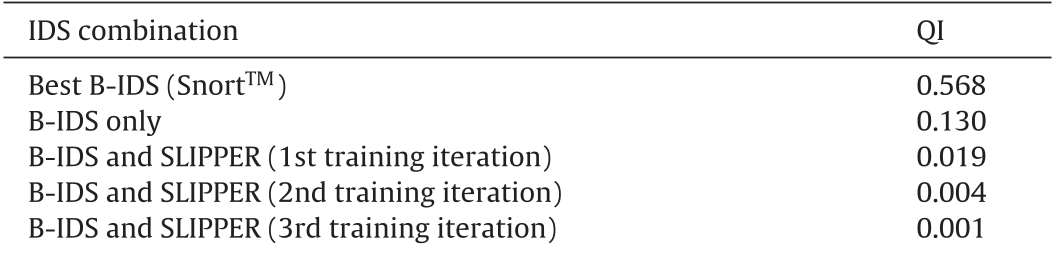
- Quality Index (QI): The labeling quality improved drastically through iterations. On real traffic, the QI dropped from 0.430 (B-IDS only) to 0.087 after three iterations of self-training.
Critical Insight & Conclusion
The power of this paper lies in its Inductive Bias management. By acknowledging that different sensors have specific "expertise" and "blind spots" (e.g., anomaly detectors find Zero-days; signature detectors find known exploits), the D-S fusion creates a sum greater than its parts.
Takeaway: This methodology demonstrates that we don't need "perfect" labels to start. By intelligently filtering for high-confidence samples and using a "soft" labeling approach, we can automate the most expensive part of the AI pipeline in cybersecurity.
Future Outlook: While effective, the computational cost of iterative training on massive traffic traces remains a hurdle. Future research could explore "online" versions of this self-training loop to handle high-speed 100Gbps links.