
Mining the Metaverse: Automated Discovery of Social Hubs and Networks in Virtual Worlds
Automatically Detecting Points of Interest and Social Networks from Tracking Positions of Avatars in a Virtual World
This paper presents a framework for automatically detecting Points of Interest (POIs) and social networks in virtual worlds like Second Life using avatar tracking data. By analyzing over 230 million records, the authors utilize a multi-layered approach—spatial, temporal, and linguistic—to visualize user density via heat maps and infer social relationships through co-location proximity scoring.
TL;DR
Researchers from Graz University of Technology have developed a system to "audit" the metaverse. By tracking millions of avatar movements in Second Life, they’ve created a way to automatically identify where people gather (Points of Interest) and who they talk to (Social Networks) using spatial heat maps and a refined social proximity algorithm that even accounts for the languages avatars speak.
## Background: The Ghost Town Problem
For years, virtual worlds have struggled with the "nobody is there" perception. While millions might be registered, finding the actual "hotspots" where social and economic activity occurs is difficult. This paper moves beyond simple headcounts to provide a deep, multi-layered analysis of how users navigate and bond in 3D digital environments.
Problem & Motivation
Most previous attempts to study avatar behavior were restricted by small datasets or inefficient "random walk" bots. If you want to place an advertisement or build a virtual storefront, you need to know not just how many people pass by, but who they are, what language they speak, and whether those gatherings are random or represent established social circles. The authors recognized that the physical rules of social interaction (like standing close to friends) translate to the digital realm, providing a signal that can be mathematically decoded.
Methodology: High-Precision Tracking
The authors used two primary methods for data harvesting:
- In-World Sensors: Scripts placed at specific locations that scan for avatars every 60 seconds (within a 96m radius).
- Protocol Interception: Specialized "bots" that intercept client-server communications to scan entire "simulators" (regions) every 11 seconds.
The Refined Proximity Algorithm
The core innovation lies in how they determine if two avatars are "friends." Instead of just counting total time spent in a room, they use a formula that rewards physical closeness (interpersonal distance) and linguistic compatibility.
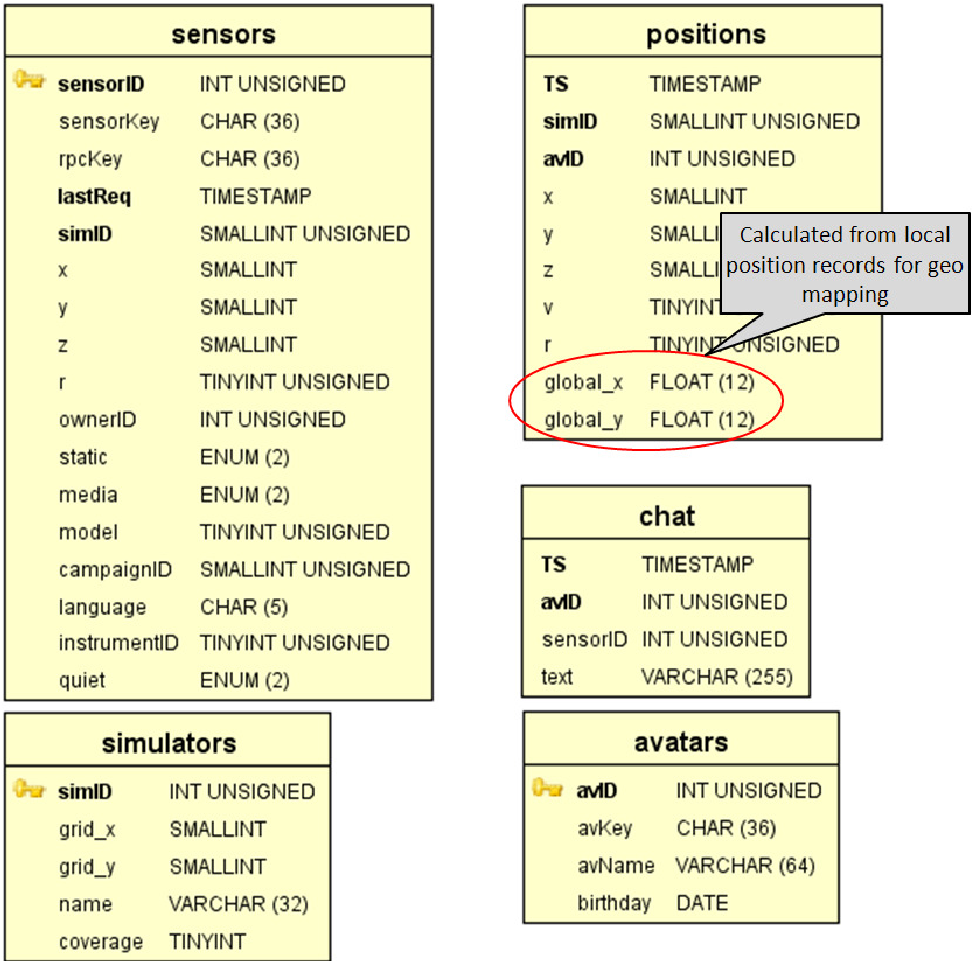 Figure 1: The data schema used to integrate spatial coordinates, timestamps, and avatar metadata.
The proximity score is calculated as: Where is a language weight factor (doubled if languages match) and represents the spatial distance. This allows the system to filter out random passersby and focus on intentional social interactions.
Experiments & Results: Visualizing the Crowd
By processing over 230 million data samples, the researchers generated heat maps—visual overlays that show density of use.
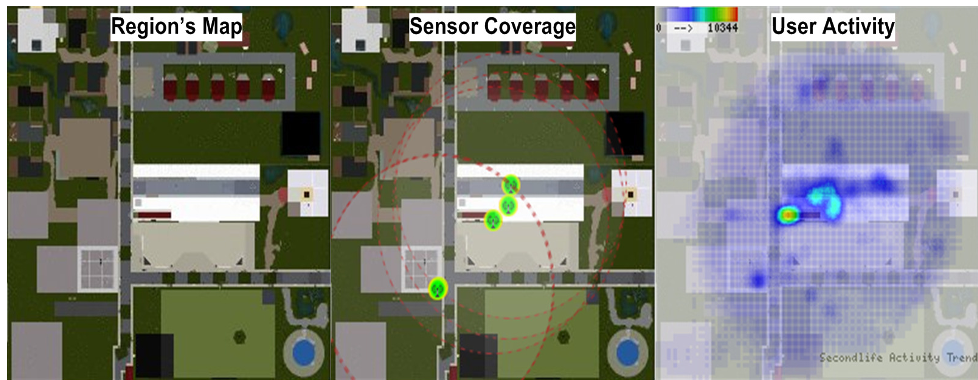 Figure 3: Evolution of a region (Berlin City) from a plain map to a sensor-covered view, and finally to a user-activity heat map.
The analysis revealed clear clusters of engagement. For example, in a "Berlin City" simulator, the heat map highlighted specific zones where German-speaking users congregated, allowing for "ethnic labeling" of virtual regions. Furthermore, the social network analysis successfully visualized "friend circles" by connecting avatars with high proximity scores.
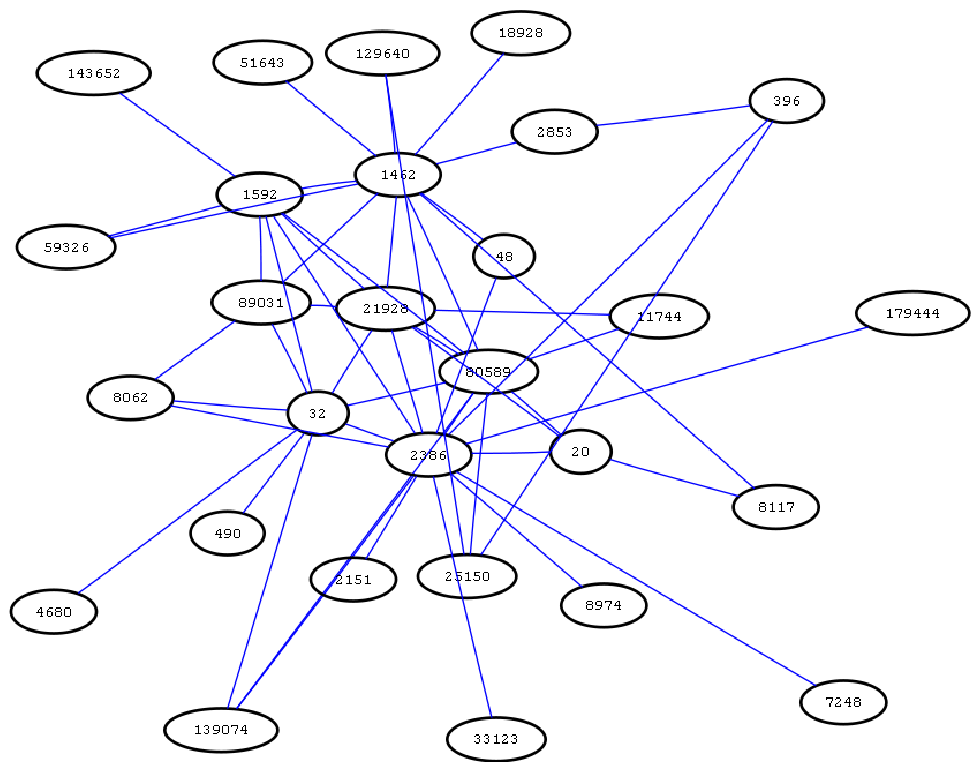 Figure 8: A detailed cluster within the derived social network, showing the interconnectedness of 28 specific avatars.
Critical Insight & Future Outlook
This work proves that the "metaverse" isn't just an unorganized collection of 3D assets; it is a structured social ecosystem. By combining geospatial data (where you are) with proxemics (how close you stand) and linguistics (how you speak), we can reconstruct human social structures without needing access to private user profiles.
Limitations: The study relies on sensors that have a limited number of detections (16 avatars per scan), which might under-sample extremely crowded events. Future work should focus on validating these "inferred" friendships against actual in-game friend lists to further tune the exponential decay parameters of the proximity formula.
Conclusion: For developers and marketers, this is a blueprint for "Metaverse Analytics." Understanding these patterns is the first step toward turning virtual world ghost towns into thriving digital economies.