
Graph Embedding Approach: Unmasking Sophisticated Bots in Social Networks
Detecting Automatically Managed Accounts in Online Social Networks: Graph Embedding Approach
This paper introduces a graph-based framework for bot detection on the VKontakte social network, utilizing Node2Vec and Attri2Vec to encode both structural connectivity and user attributes. The authors distinguish between simple "technical bots" and "sophisticated accounts" (often semi-automated or sold), achieving a state-of-the-art ROC AUC of 0.867 for sophisticated accounts.
TL;DR
Detection of social media bots has evolved into an arms race between automated scripts and platform security. While "technical bots" are easy to spot by their empty profiles, sophisticated bots—often managed semi-automatically or sold on exchanges—are nearly indistinguishable from humans. This paper utilizes Graph Neural Networks (Node2Vec and Attri2Vec) to analyze the friendship structures of accounts on the VKontakte network, proving that who you know is a more reliable indicator of authenticity than what you say in your bio.
Problem & Motivation: The Identity Crisis in Social Networks
Most bot detection research categorizes accounts into simple binary buckets: Human vs. Bot. However, the authors argue for a more nuanced taxonomy:
- Technical Bots: Software-controlled, recently created, poorly filled profiles.
- Sophisticated Accounts: Semiautomatic, often purchased from black markets, and visually identical to legitimate users.
Prior work (Feature-based) fails here because these "sophisticated" bots fill out every field perfectly. Existing Graph-based methods often assume bots don't interact with humans, but in the real world, bots "infiltrate" human clusters. The research intuition here is that even a sophisticated bot's friendship topology (the latent structure of its network) contains anomalies that manual oversight cannot fully mask.
Methodology: The Core of Graph Embeddings
The authors propose a pipeline that bypasses content analysis (ignoring text/images) to focus strictly on structural and profile metadata.
1. The Dataset
They collected a unique dataset from VKontakte, focusing on "sold" accounts from underground exchanges. This provides a "ground truth" for sophisticated bots that is often missing from other academic datasets.
2. Embedding Strategies
The heart of the method lies in two embedding techniques:
- Node2Vec: Uses random walks to map the friendship graph into a d-dimensional space. It treats the network like a language, where nodes that appear in similar "walks" are positioned closely together.
- Attri2Vec: Marries the graph structure with node attributes. By mapping attributes into a subspace that preserves network context, it ensures that nodes with similar neighbors and similar profile traits are clustered.
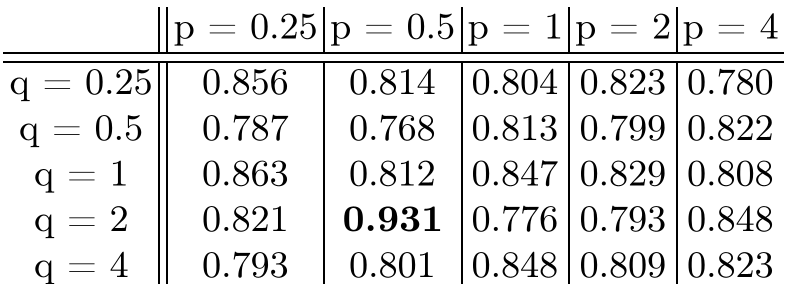 Table 1: Node2Vec performance on technical bots across different p/q parameters.
Experiments & Results
The authors tested their approach using various classifiers (Logistic Regression, SVM, Random Forest) on the generated embeddings.
- Technical Account Success: For simple bots, Attri2Vec reached a staggering 0.988 AUC, essentially solving the detection problem for low-tier automation.
- Sophisticated Account Breakthrough: The hardest task—detecting accounts sold on exchanges—saw its best performance (0.867 AUC) when Node2Vec structural embeddings were concatenated with raw profile features.
 Table 4: Comparative analysis showing a 4.5% improvement over previous SOTA methods.
Key Insight: The Limitations of Structure Alone
Interestingly, while technical bots could be identified purely by their graph structure (Node2Vec), sophisticated bots required a hybrid approach. This suggests that professional bot herders are getting better at building "natural-looking" social circles, necessitating the inclusion of profile attributes to crack their disguise.
Critical Analysis & Conclusion
Takeaway
The paper confirms that graph embeddings are superior to manual feature engineering. By focusing on the Largest Connected Component (LCC) of the network, the authors managed to isolate structural signatures that differentiate human-like bots from actual humans.
Limitations
- Computational Cost: Generating random walks for a graph of nodes is immense. While the authors used a framed graph, scaling this to a full social network in real-time remains a challenge.
- Missing Modalities: By ignoring text and time-series data (e.g., when a user posts), the model might miss "cyborg" accounts that behave like humans during the day but bot-out at night.
Future Outlook
The next frontier is likely Temporal Graph Embeddings. Instead of looking at a static snapshot of friends, future models should look at how these connections are formed over time—masking a network structure is easy, but masking a growth pattern is much harder.
Author Note: This work was presented as part of an effort to clean social networks by leveraging the inherent mathematical patterns of human sociality.