
Beyond Code: Automating Business Logic with Ontology-Driven Machine Learning
Automating Implementation of Business Logic of Multi Subject-Domain IS on the Base of Machine Learning, Data Programming and Ontology-Based Generation of Labeling Functions
This paper introduces a model-centric architecture for Multi Subject-Domain Information Systems (MSIS) that implements business logic using Machine Learning (ML). It leverages a data programming approach with an innovative technology for the automated generation of labeling functions (LFs) based on domain ontologies to accelerate the creation of training sets.
TL;DR
Implementing business logic in complex, large-scale systems is often a losing battle against changing requirements. This paper proposes a paradigm shift: instead of hard-coding rules, we should use Machine Learning as a universal approximator for business logic, fueled by a Data Programming approach that automatically generates training data from existing Domain Ontologies.
Background: The Crisis of Multi-Domain Systems
In regional management, Information Systems (MSIS) face a "heterogeneity trap." Users, data sources, and functional requirements vary wildly across strategic and operational levels. Traditional methods like Domain-Driven Design (DDD) or Model-Driven Architecture (MDA) simply shift the burden of formalization from programmers to model designers—they don't eliminate the manual labor.
The authors argue that we should treat business logic as a "black box" that approximates responses to input data. To make this work, we need Machine Learning, but we lack the high-quality labeled data to train it for specific niche domains.
The Core Insight: Data Programming & Ontologies
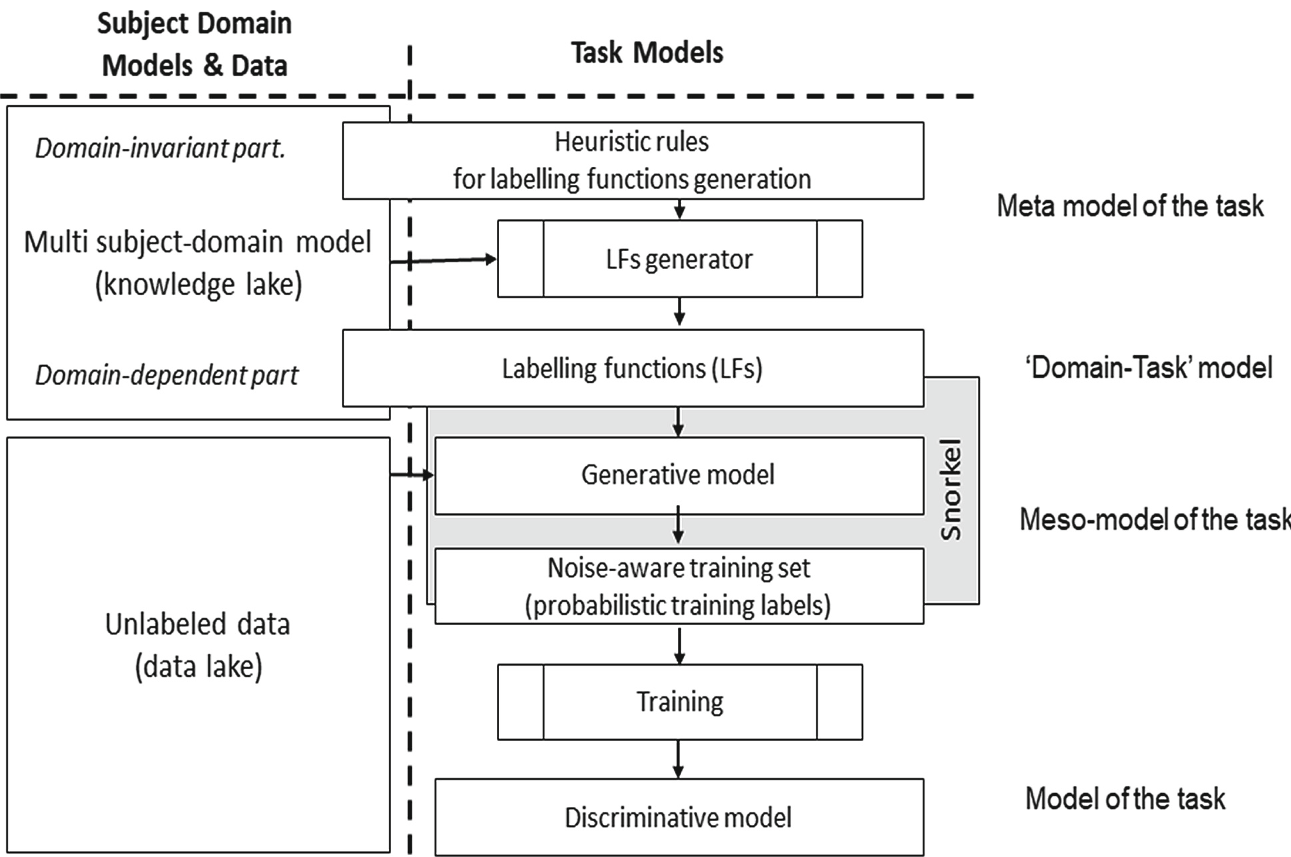
The paper introduces a Model-Centric Architecture based on Weak Supervision. Instead of experts labeling thousands of data points, they write Labeling Functions (LFs)—simple code snippets that encapsulate heuristics.
The breakthrough here is the Automated Generation of LFs. By extracting knowledge from OWL (Web Ontology Language) ontologies, the system can automatically create LFs that recognize entities, relationships, and context without manual coding.
Methodology: How the Generation Works
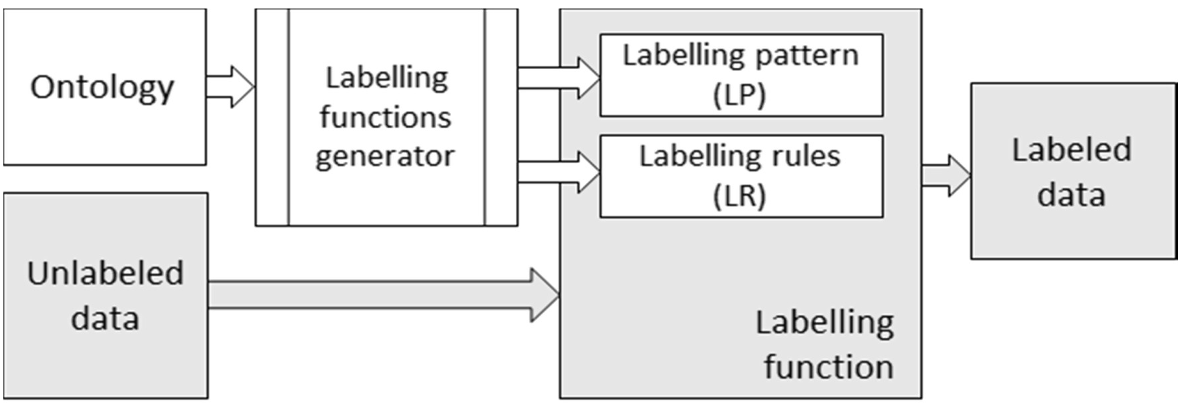
The system utilizes a meta-model to transform ontology fragments into Labelling Patterns (LP).
- Universal Generators: Use basic OWL structures (Classes, Individuals, Object Properties) to create general lookup rules.
- Domain-Specific Generators: Leverage Content Ontology Design Patterns (CODP). For instance, an "Object-Role" pattern can generate syntactic patterns like "X is used as Y" or "The function of X is Y."
- The Pipeline: These patterns are wrapped into Python-based LFs compatible with the Snorkel framework, which then reconciles conflicting labels using a generative model to create a "noise-aware" training set.
Experimental Validation: The Arctic Activity Case
The authors tested this on a Named Entity Recognition (NER) task involving "Economic activity in the Arctic"—a domain where standard training sets (like Wikipedia) fail miserably.
- The Problem: A standard multilingual spaCy model performed poorly (Precision: 0.12) because it didn't understand Arctic-specific entities.
- The Solution: LFs generated from a domain ontology automatically labeled a specialized corpus.
- The Result: The precision jumped to 0.97. While recall (0.42) shows room for improvement (likely requiring more text data), the leap in accuracy proves that ontologies can effectively "teach" ML models niche logic.
Critical Analysis & Future Outlook
This approach elegantly bridges the "statistical" and "cognitive" gap in AI. However, it isn't a silver bullet:
- The Data Requirement: You still need a large volume of unlabeled data.
- Pattern Recognition Limits: The logic must be representable as pattern recognition.
- Ontology Complexity: Creating high-quality ontologies is itself a complex task.
Conclusion
The transition to "Programming without Programming" is closer than it appears. By converting formalized domain knowledge into the "fuel" for machine learning, we can build information systems that adapt as fast as the domains they represent. For industry practitioners, the message is clear: invest in your knowledge graph (ontology), as it will eventually write your software's business logic.