
ASKNEXT: Automating Social Knowledge Exchange via Intelligent Email Agents
Automation of social networks with QA agents
This paper introduces ASKNEXT, a multiagent protocol designed to automate collective knowledge search within social networks. It leverages email-based agents to act as intermediaries between users, effectively bridging the gap between automated retrieval and human expertise.
TL;DR
The paper introduces ASKNEXT, a protocol that enables software agents to navigate social networks on behalf of humans to find answers. By utilizing email as an asynchronous backbone, these agents query other agents and eventually humans, using a mathematical framework to ensure efficient search termination and scalability. It marks an early and significant step towards Collective Search—a synergy of human imagination and agent automation.
Problem & Motivation: The Knowledge Bottleneck
In 2010, the "social web" was booming, but knowledge sharing was inefficient. Users were either manually searching through forums or being spammed with irrelevant requests. The authors identified a crucial gap: humans are the best at understanding complex problems, but they aren't efficient at the routing of questions.
The motivation behind ASKNEXT was to create a "seamless change of paradigm." Instead of humans linking and spamming information, they would train agents to act as filters and routers. The core insight was that a multiagent system could crawl through both structured data and human networks to fetch the best possible answer without overwhelming the participants.
Methodology: The ASKNEXT Protocol
The core of the system is a structured escalation process based on trust-ranked contact lists (Agent Contacts and Human Contacts).
1. The Query Logic
When an agent is tasked with a question, it follows a strict hierarchy:
- Level 1: Query immediate Agent Contacts (AC).
- Level 2: If no answer by a deadline, query immediate Human Contacts (HC).
- Level 3: If still no answer, ask ACs to query their own social circles.
2. The Physics of Stopping
A critical technical contribution of the paper is the mathematical modeling of "Search Termination." To prevent the network from being flooded with stale queries, the speed of sending an answer () must be higher than the speed of forwarding a question ().
The authors provide a fundamental equation for the time required to stop a search: Where is the distance in the network. This ensures that the "answer signal" eventually catches up with the "query wave."

Experiments & Results
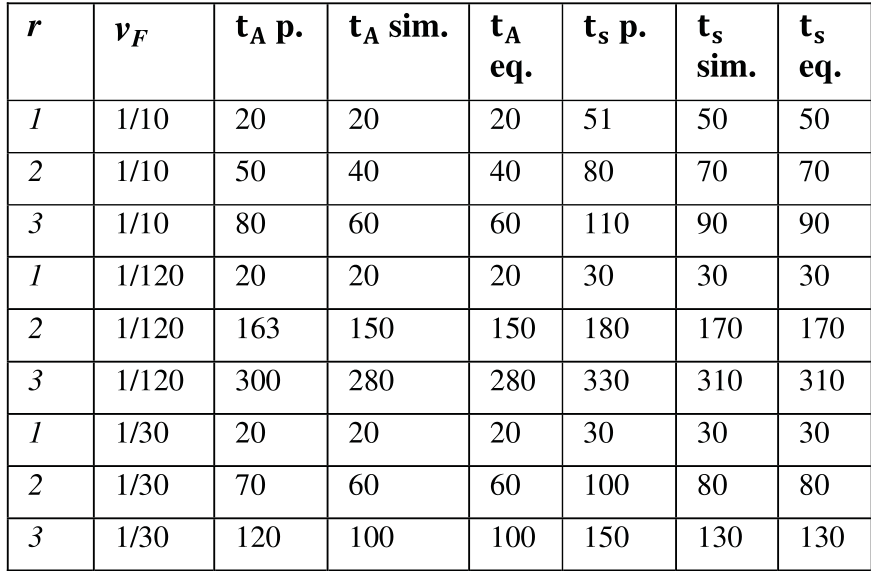
The researchers tested the ASKNEXT model using a prototype and computer simulations. They varied the depth of the network (up to 3 levels) and the forwarding rates ().
Performance Metrics
The results showed a remarkable correlation between the theoretical equations and the actual performance of the prototype.
- Accuracy: The deviation between predicted time ( eq.) and simulated time ( sim.) was minimal, primarily caused by minor network latencies like email polling delays.
- Scalability: The system proved that a questioner could potentially reach a massive number of entities while only receiving a manageable number of direct responses (proportional to their initial contact list size).
Critical Analysis & Future Perspective
Takeaway: ASKNEXT demonstrated that social networks could be "automated" by turning contact lists into an executable knowledge graph. It moved the burden of search from the human to the agent.
Limitations:
- Asynchronicity: While email is reliable, its inherent delays (minutes to hours) make this protocol unsuitable for real-time needs.
- Expertise Identification: The paper assumes agents know who to ask, but the "Search for Expertise" mechanism was left for future work.
Future Outlook: In the era of LLMs, the ASKNEXT protocol is more relevant than ever. Imagine "Personal AI Agents" that don't just search the web, but negotiate with their "friend agents" across LinkedIn or GitHub to find the one human expert who has the specific solution to a niche coding bug. This paper laid the mathematical foundation for such a future.
- Title: ASKNEXT: Bridging the Social Gap with Autonomous QA Agents
- Keywords: Multiagent Systems, Social Networks, Knowledge Exchange, Protocol Design.