
AutoPrivacy: Balancing Social Visibility and Privacy through Proactive Protection
AutoPrivacy: Automatic privacy protection and tagging suggestion for mobile social photo
AutoPrivacy is an automated system for mobile social images that integrates real-time privacy protection for unintended human subjects and tagging suggestions for intended ones. It utilizes a combination of sensor signatures, spatial-temporal visual features, and Ciphertext-Policy Attribute-Based Encryption (CP-ABE) to achieve a 91% recognition accuracy and secure, reversible image concealment.
TL;DR
AutoPrivacy is an automated system designed for mobile devices that distinguishes between people you intend to photograph and accidental bystanders. By fusing mobile sensor data with spatial-temporal image analysis, it automatically suggests tags for your friends and encrypts the faces of strangers using reversible, role-based encryption (CP-ABE), ensuring privacy without losing data utility.
Problem & Motivation: The Social Media Dilemma
In the era of Facebook and WeChat, mobile users upload millions of photos daily. This presents two massive bottlenecks:
- Privacy Fatigue: Manually blurring the faces of bystanders to protect their privacy is a "dauntingly time-consuming" task.
- Management Chaos: Searching through thousands of untagged local photos is inefficient, yet manual tagging is tedious.
Existing solutions are often "all-or-nothing." They either blur everything (destroying the photo's context) or use irreversible methods that prevent authorized recovery. AutoPrivacy seeks to solve this by asking: Can we let the phone "sense" who is supposed to be in the frame?
Methodology: How AutoPrivacy "Thinks"
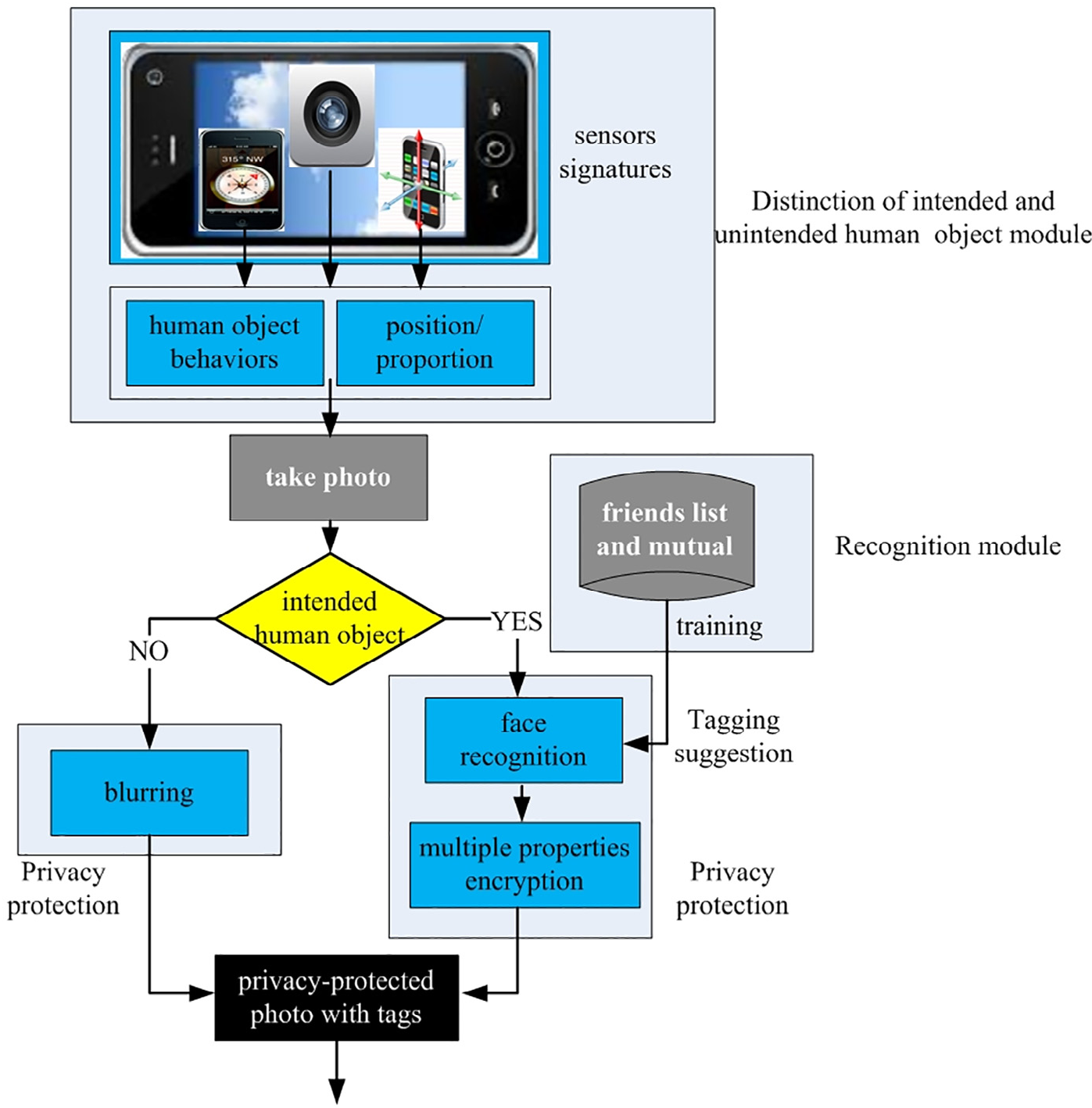
The system's core innovation lies in its three-stage pipeline that looks beyond just pixels.
1. Sensing the Posing Signature
Before the shutter even clicks, AutoPrivacy uses the phone's accelerometer and compass. When a user prepares to take a photo, these sensors enter a "stillness" state. By detecting this specific sensor signature, the system knows exactly when to trigger its distinction algorithms.
2. Distinction via Spatial-Temporal Logic
How do you tell a friend from a stranger? The authors use two key insights:
- Temporal (Behavior): Intended subjects usually stay still and face the camera. Bystanders are often moving across the frame. AutoPrivacy uses Active Shape Models (ASM) to track eye and face movement.
- Spatial (Composition): Photographers naturally center their friends and ensure they occupy a larger portion of the frame. The system evaluates object size and position to filter out background humans.
3. Reversible Privacy via CP-ABE
Instead of permanently "blacking out" a face, AutoPrivacy encrypts the sensitive region. Using Ciphertext-Policy Attribute-Based Encryption (CP-ABE), the photo owner can set policies:
- Friends can see the intended faces.
- Authorities (via a specific key) can decrypt the bystanders' faces if a crime occurred.
- Public users see only the blurred/encrypted version.
Experimental Performance
The system was prototyped on an Android platform and tested against a dataset of 1,000 photos retrieved via the Facebook API.
- Accuracy: The distinction module achieved a 91% success rate in correctly identifying intended vs. unintended human objects.
- Efficiency: Despite the complex encryption and tracking, face detection averaged around 1.8 seconds, proving feasible for on-device processing.

Critical Insight: The Shift to "Context-Aware" Security
The true value of AutoPrivacy isn't just in the face recognition—it's in the sensor-fusion. Most AI models today rely purely on visual data. AutoPrivacy proves that "out-of-band" data (how the user is holding the phone) provides a powerful inductive bias that makes visual recognition much more accurate and contextually relevant.
Limitations & Future Work
While robust, the system faces challenges in high-motion scenarios (sports) or with low-quality photos. The authors' future roadmap includes integrating eye-gaze estimation to further refine the distinction between "who you are looking at" and "who just happened to be there."
Conclusion
AutoPrivacy represents a sophisticated step toward "Autonomous Privacy." By moving protection from a manual post-processing step to an automated, sensor-driven capture step, it effectively scales privacy to the requirements of the modern social media landscape.