
AD-LDA: Boosting Emotion Estimation in Tweets via Auxiliary Lexicons
Using an auxiliary dataset to improve emotion estimation in users’ opinions
This paper introduces Auxiliary Dataset-Latent Dirichlet Allocation (AD-LDA), an unsupervised topic-modeling extension designed to estimate nine distinct emotions (e.g., anger, joy, trust) in Twitter data. By incorporating a lexicon as prior knowledge during the parameter estimation process, it significantly outperforms traditional LDA in capturing the emotional nuances of short texts.
TL;DR
Researchers have developed AD-LDA (Auxiliary Dataset-Latent Dirichlet Allocation), a model that enhances emotion detection in tweets by using a specialized "auxiliary dataset" of words with known emotional weights. Unlike basic sentiment analysis (Positive/Negative), AD-LDA tracks nine specific emotions, achieving a 64% improvement in semantic coherence over standard LDA and nearly 80% accuracy in word-emotion learning.
The Motivation: Why Binary Sentiment isn't Enough
Most existing systems simplify human opinion into a boring trinity: Positive, Negative, or Neutral. However, deciding between a movie (#BlackPanther) and discussing a social movement (#MeToo) involves vastly different emotional spectra—ranging from Anticipation and Joy to Disgust and Fear.
The challenge is that Supervised Learning is expensive (requiring human-labeled tweets) and Unsupervised Learning (like traditional LDA) often gets lost in the noise of short, 280-character messages. The authors' insight was simple: Why not give the unsupervised model a "cheat sheet" of fundamental words with known emotions?
Methodology: Anchoring Local Logic in Global Knowledge
The core of the AD-LDA model is the integration of an auxiliary dataset during the Collapsed Gibbs Sampling (CGS) phase.
1. The Generative Process
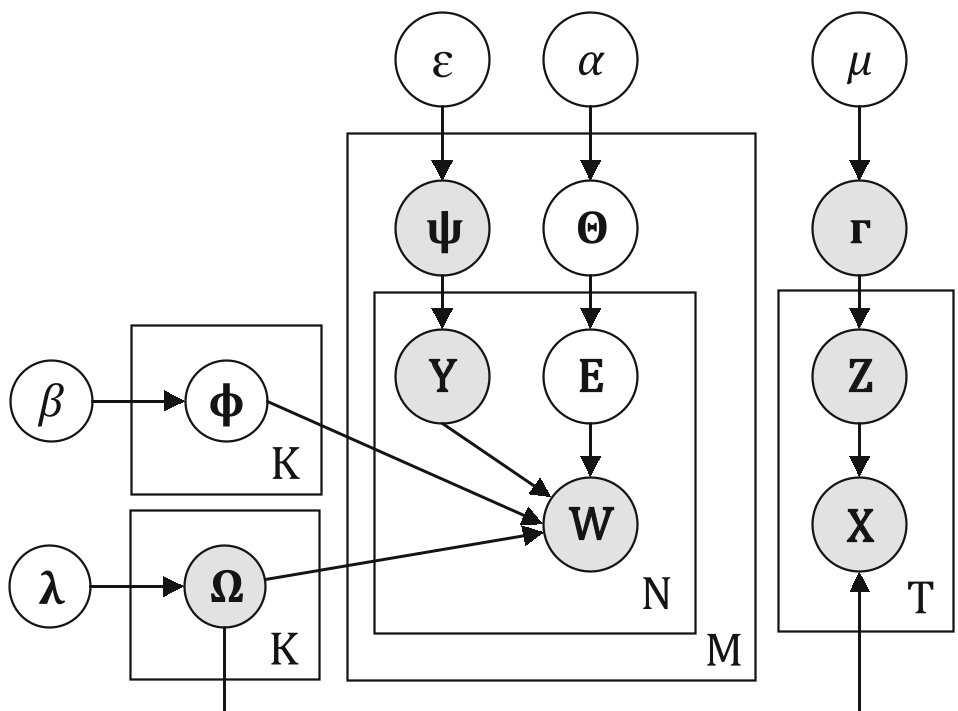
The model treats every tweet as a mixture of emotions and every emotion as a mixture of words. It distinguishes between:
- Vocabulary A: Words with a fixed, known emotion (from the auxiliary dataset).
- Vocabulary D: New or ambiguous words whose emotions must be learned from context.
2. Model Architecture
During the learning process, when the algorithm encounters a word from the auxiliary dataset, its emotion is kept constant. This "anchor" helps the model correctly guess the emotional load of surrounding unknown words.
Experiments: Analyzing the Pulse of Trends
The researchers tested AD-LDA on four major hashtags from 2017: #MeToo, #BlackPanther, #BoweBergdahl, and #MondayMotivation.
Key Findings:
- Semantic Coherence: The "Coherence Score" (how well the words in a group actually relate to each other) skyrocketed by an average of 64.15%.
- Emotion Distributions:
#BlackPantherwas dominated by Anticipation (22.3%), naturally reflecting the hype for a future movie release.#BoweBergdahl(a military court case) saw high levels of Fear (22.8%) and Disgust (17.6%).#MondayMotivationpredictably focused on Joy and Trust.

SOTA Comparison: AD-LDA vs. Conventional LDA
In the table above, we see that AD-LDA's coherence scores are much closer to zero (more positive) across all hashtags. In standard LDA, the "emotion" clusters were often a jumbled mess of unrelated terms. AD-LDA, by contrast, successfully grouped words like "hit" and "badass" under Anger, or "trailer" and "marvel" under Joy/Anticipation.
Critical Analysis & Future Outlook
Limitations: While AD-LDA is powerful, it still relies on a static auxiliary dataset. Language on social media evolves rapidly (memes, sarcasm, new slang), and a static lexicon might eventually become obsolete without dynamic updates.
The Road Ahead: The authors propose that the next step is replacing the traditional parameter estimation with Deep Learning methods and incorporating Emojis—which are essentially universal "emotion labels" already provided by users—directly into the probabilistic framework.
Takeaway
AD-LDA demonstrates that you don't always need massive labeled datasets to get high-quality results. By combining the statistical rigor of LDA with the targeted "nudge" of a small lexicon, we can gain a much more granular understanding of the public's emotional heart.