
Collective Intelligence in WSNs: Leveraging Social Choice for Robust State Estimation
A Comparison of Axiomatic Distance-Based Collective Intelligence Methods for Wireless Sensor Network State Estimation in the Presence of Information Injection
This paper evaluates axiomatic distance-based Collective Intelligence (CI) methods for state estimation in Wireless Sensor Networks (WSNs). By adapting consensus ranking and rating models—specifically SepDev, FM, and RR—it demonstrates robust signal strength recovery even when networks face significant data incompleteness and malicious false information injection.
TL;DR
Wireless Sensor Networks (WSNs) are often plagued by "noise" and "lies"—technically termed incompleteness and information injection. This research investigates whether the "Wisdom of the Crowd" (specifically axiomatic Collective Intelligence models like SepDev, FM, and RR) can outperform traditional signal processing in recovering ground truth from compromised, highly incomplete datasets.
Background: The Reliability Crisis in Distributed Networks
In an ideal world, sensors provide a continuous stream of perfect data. In reality, sensors fail, batteries die (systemic downtime), or adversaries inject false coordinates/signals to mislead the system.
The core challenge is that as data becomes more sparse or maliciously biased, standard imputation (guessing missing values) or redundancy (averaging) breaks down. The authors position this work as a bridge between Social Choice Theory—where we decide on a "winner" from conflicting votes—and Signal Estimation, where we decide on a "true value" from conflicting sensor readings.
Methodology: The Three Pillars of Aggregation
The paper compares three mathematical optimization models that treat sensor readings like "rankings" or "ratings" in a social election:
- SepDev (Separation-Deviation): A model that minimizes both the distance from individual readings (deviation) and the disagreement in the intensity of differences between pairs of readings (separation).
- FM (Fishbain-Moreno): Designed for uncalibrated networks, it uses the Normalized Projected Cook-Kress (NPCK) distance to find a consensus that respects the relative differences sensors report.
- RR (Ranking and Rating): A sophisticated hybrid that jointly aggregates ordinal (rank-based) and cardinal (value-based) data, theoretically capable of handling more general information types.
The Optimization Core
The general objective function for these models seeks to minimize the total axiomatic distance between the "true" estimated vector and the observed sensor vectors :

(Equation 6: The RR model objective combining cardinal and ordinal distances)
Experimental Analysis: Random vs. Systematic Failure
The researchers tested these models under two brutal scenarios:
- Arbitrary Incompleteness: Random data loss (up to 75%).
- Systematic Incompleteness: Sensors going offline for blocks of time (simulating maintenance or jamming).
- Adversarial Injection: 20% to 60% of sensors reporting "fictitious" distances or signals.
Key Findings
- FM is the "all-rounder": Without prior calibration, the FM model is remarkably consistent for random noise.
- SepDev + Calibration = Gold Standard: When the authors added a calibration step (to resolve the absolute magnitude of the signal), the SepDev model outperformed all others in systematic failure scenarios.
- The RR Model's Paradox: Surprisingly, the RR model (the most complex) showed a bimodal distribution of estimates and higher variance, suggesting that purely cardinal models (FM/SepDev) are currently more stable for this specific physics-based task.
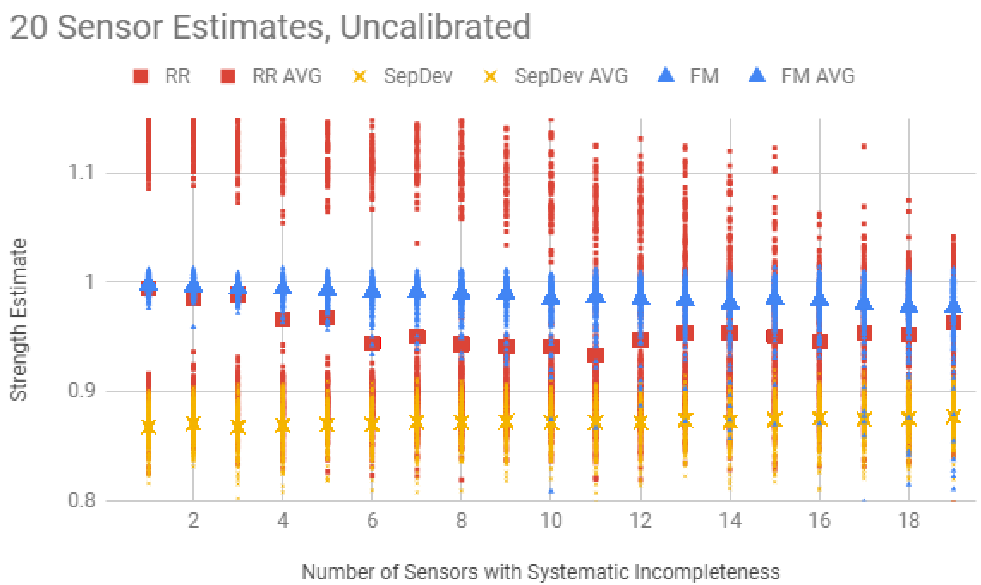
Fig 1: FM model (large symbols) shows tightest clustering around the ground truth of 1.0W compared to uncalibrated SepDev and RR.
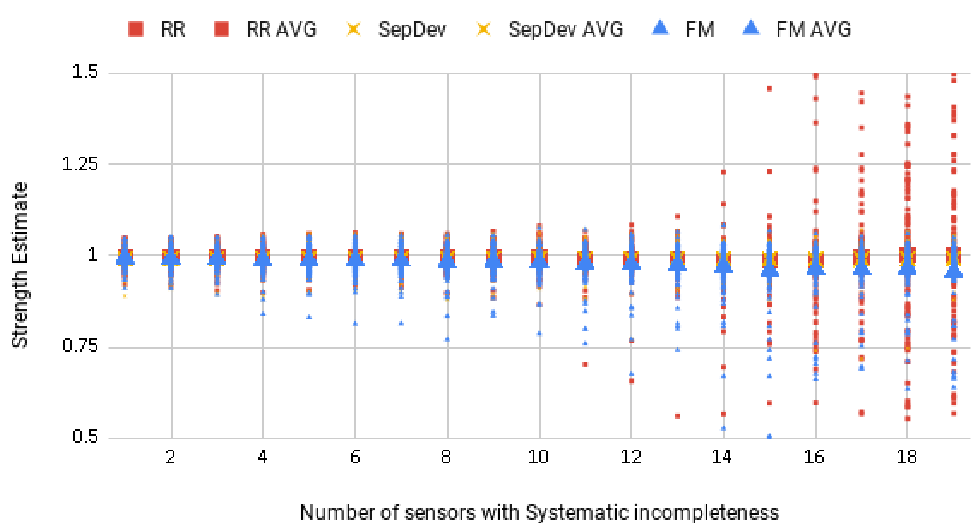
Fig 6: In the face of 60% sensor corruption, calibrated SepDev remains extremely stable compared to the fluctuating FM estimations.
Critical Insight: Why Does This Work?
The effectiveness of these models stems from their Axiomatic Foundation. Unlike a simple average, which is easily skewed by a single malicious outlier (an "influenceable" mean), these distance-based methods behave more like a multi-dimensional median. They look for the "consensus manifold" of the data. When an adversary injects false data, it increases the "distance" to the consensus, and the optimization naturally weighs those contributions down.
Conclusion & Future Directions
The paper proves that Collective Intelligence is not just for human voting or movie ratings; it is a mathematically robust framework for "hard" engineering problems.
- Value: High accuracy even with 75% data loss.
- Efficiency: Models are solvable in polynomial time using standard solvers like CPLEX/Gurobi.
- Next Steps: Testing in 3D environments and exploring "Optimal Downtime Scheduling"—using these models to predict how many sensors can safely be turned off to save battery without losing state estimation accuracy.
Final Takeaway
In the battle against information injection, the logic of Axiomatic Distance provides a "shield of truth" by identifying the most consistent consensus among distributed nodes, regardless of how many of them are failing or lying.