
Balance Pass: Combatting the "Freshman 15" through Seamless Service Design
Balance pass: service design for a healthy college lifestyle
Balance Pass is a service design framework aimed at improving the nutritional habits of female college freshmen. It integrates a handheld recommender system with existing university ID card payment infrastructures to provide real-time dietary feedback and localized meal suggestions.
TL;DR
Balance Pass is a holistic service design intervention targeting female college freshmen to promote healthy eating. By intercepting the existing campus meal plan infrastructure, the system provides real-time, context-aware nutritional feedback via a handheld device, transforming a simple ID card into a personal health coach. It moves health tracking from "laborious manual entry" to "automated environmental feedback."
The "Vicious Cycle" of Campus Dining
The transition to college is often the first time young adults manage their own diets. Without parental guidance, students frequently optimize for speed and cost—leading to what researchers identify as the "laziness route" to nutrition. For young women specifically, these habits are often exacerbated by social pressures and misinformation (e.g., skipping meals to "save" calories for social events).
The core problem identified by the Carnegie Mellon team isn't a lack of information—the USDA Food Pyramid exists—it's a lack of actionable, contextualized feedback. Current SOTA solutions, such as wearable sensors or photo-based dietitian apps, are either too expensive or too high-maintenance for a busy student schedule.
Methodology: Designing for the Path of Least Resistance
The authors didn't just build an app; they designed a service ecosystem. Through ethnographic interviews and "Contextual Inquiry" (observing students in their actual living environments), they mapped out the typical purchase decision model.
1. System Integration
Instead of asking students to change how they buy food, Balance Pass hooks into the University ID Card system. By tracking what is purchased at campus vendors, the system automates the most hated part of dieting: data entry.
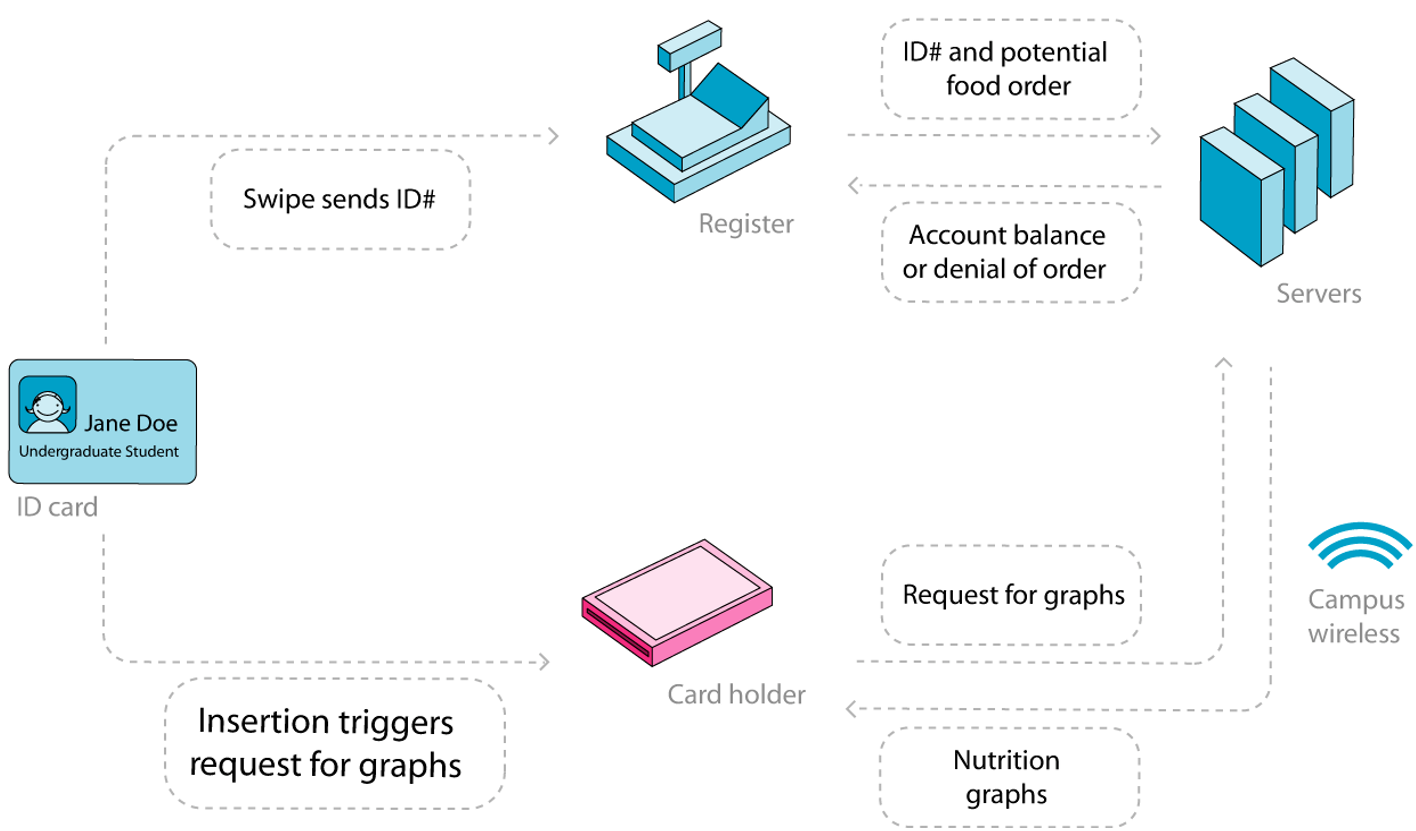 Figure: The system diagram illustrating how the service triggers upon swiping the campus ID card.
2. The Feedback Loop
The service operates on a dual-mode interaction:
- Push: When a student swipes their card, the system sends an immediate nutritional summary to their handheld device.
- Pull: When hungry, a student can search for meals. The system filters options by distance, price, and—crucially—how well that specific meal balances their current daily intake.
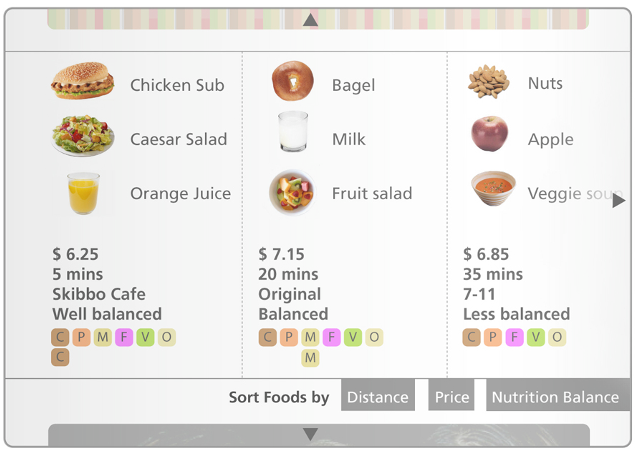 Figure: Mobile interface allowing students to sort local meal options by nutritional balance.
Experiments and Behavioral Insights
Through "Think Aloud" protocols and iterative testing, the authors discovered that motivation is the secondary barrier. While the feedback was useful, the researchers added a Reward System. By choosing "suggested healthy meals," students accumulate points redeemable for non-food rewards like movie tickets. This effectively gamifies the "healthy choice" without making it feel like a chore.
Limitations and Reality Checks
The authors are refreshingly honest about the system's inductive biases:
- Consumption Assumption: The system assumes "purchased" equals "consumed."
- Off-Campus Gaps: It cannot track cash purchases or meals eaten at off-campus restaurants unless manually entered.
- Social Bias: It doesn't yet account for group-eating dynamics, where peer pressure often overrides individual health goals.
Deep Insight & Conclusion
Balance Pass represents a shift in HCI (Human-Computer Interaction) from tool-centric design to service-centric design. The technical "magic" isn't in a complex algorithm, but in the seamless integration into an existing financial touchpoint (the ID card).
For future health-tech developers, the takeaway is clear: the most effective way to change a user's behavior is not to give them a new task to perform, but to provide a "mirror" to the tasks they are already doing. Balance Pass proves that "just-in-time" feedback is more powerful than a library of nutritional knowledge.