
BDoTTuDA: Balancing Time-Constrained Tasks in MCS via Truthful Double Auctions
A Balanced Dissemination of Time Constraint Tasks in Mobile Crowdsourcing: A Double Auction Perspective
The paper introduces BDoTTuDA, a Mobile Crowdsourcing (MCS) framework that combines interval partitioning scheduling with a double auction mechanism. It aims to disseminate time-constrained tasks across non-overlapping time slots to ensure balanced workload distribution among executors while maintaining economic truthfulness.
TL;DR
Mobile Crowdsourcing (MCS) faces a dual challenge: how to schedule overlapping, time-sensitive tasks efficiently and how to incentivize agents to participate honestly. This paper presents BDoTTuDA, a framework that uses interval partitioning to organize tasks into non-overlapping slots and a double auction mechanism to ensure fair, truthful pricing. The result is a system where task executors are never overburdened, and strategic manipulation is mathematically discouraged.
Context & Positioning
In the landscape of Mobile Crowdsourcing, most research focuses on either Incentive Mechanisms (how to pay users) or Task Allocation (who does what). BDoTTuDA sits at the intersection of both. It treats MCS as a market where task requesters (buyers) and task executors (sellers) interact. Its novelty lies in addressing "time constraints" as a scheduling problem before applying economic theory, ensuring the system is both physically feasible and economically robust.
Problem & Motivation: The Conflict of Overlaps
When tasks arrive with specific start and finish times, they often overlap. If two tasks occur simultaneously, a single executor cannot perform both. Prior works often ignored these temporal conflicts or failed to provide a "truthful" environment—one where agents are incentivized to report their true costs and valuations.
The authors identify two core needs:
- Workload Balancing: Distributing tasks so that sellers are not "overburdened" by overlapping assignments.
- Strategic Stability: Preventing "manipulative" agents from gaming the system by inflating costs or lowballing valuations.
Methodology: The Two-Step BDoTTuDA Pipeline
1. Interval Partitioning (The Scheduling Phase)
The system first acts as a scheduler. Using a greedy approach, it sorts all tasks by their start times. By utilizing a Heap data structure to track the finish times of tasks in active slots, it assigns each incoming task to a non-overlapping slot (). This ensures that within any single slot, all tasks can be executed sequentially or independently without conflict.

2. Double Auction (The Economic Phase)
Once slots are formed, a double auction is conducted:
- Sellers (Executors) submit bids () representing their cost.
- Buyers (Requesters) submit valuations () representing their maximum willingness to pay.
- Winning Condition: The mechanism finds the largest index where the buyer's valuation exceeds the seller's cost.
- Truthfulness: Through a specific payment rule (Lemma 2), the authors prove that any deviation from true valuations results in zero or negative utility gain, effectively "forcing" honesty.
Experimental Validation
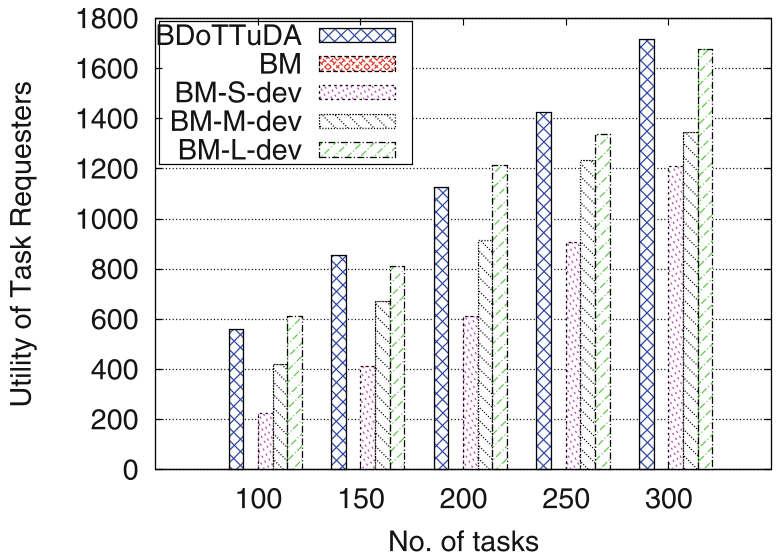
The authors compared BDoTTuDA against a Benchmark Mechanism (BM) that is vulnerable to manipulation.
Key Findings:
- Utility for Honesy: In BDoTTuDA, honest agents receive positive utility (Profit), whereas in traditional pay-as-bid models, utility is often zero for honest players.
- Resistance to Manipulation: As shown in the figures below, in BDoTTuDA, agents cannot gain by deviating from their true value. In contrast, the BM shows that manipulative agents (S-Dev, M-Dev, L-Dev) gain utility only by harming the system's overall budget and feasibility.
Critical Analysis & Conclusion
BDoTTuDA provides a mathematically rigorous way to handle the "messiness" of real-world crowdsourcing, where time matters just as much as money.
Takeaways:
- Scalability: complexity makes it suitable for large-scale MCS deployments.
- Fairness: By proving , the authors show that tasks are distributed evenly across slots in expectation.
Limitations & Future Work: The current model assumes all sellers are equally capable. Future iterations could integrate Location Awareness (Spatio-temporal constraints) and Data Quality Metrics, ensuring that the "truthfulness" extends not just to the price, but to the honesty of the data collected.