
Bayesian Concept Learning: Making Optimal Decisions from Crowdsourced Noise
Learning complex concepts using crowdsourcing: A Bayesian Approach
The paper introduces a Bayesian framework for learning complex latent concepts (modeled as conjunctions) using noisy feedback from crowdsourced experts. It proposes methods to simultaneously estimate concept definitions and expert reliability (types) to recommend an instance that maximizes the probability of concept satisfaction (MAPSAT).
TL;DR
This research addresses a fundamental challenge in crowdsourcing: how do you build a complex concept (like a recipe or a visa process) when the "experts" you ask might be wrong, ignorant, or only partially informed? The authors propose a Bayesian framework that doesn't just learn the concept, but learns how much to trust each expert while aiming to find a "good enough" solution as quickly as possible.
Problem & Motivation: The Noise of the Crowd
Crowdsourcing platforms like Mechanical Turk are powerful but messy. If you ask a crowd for the ingredients of a "Tiramisu," some might forget the mascarpone, others might insist on irrelevant items, and some might provide random data.
The core difficulty lies in two areas:
- Unknown Reliability: You don't know who the "true experts" are beforehand.
- Decision-Optimal Learning: You don't need to know every possible way to make Tiramisu; you just need to find one valid recipe that satisfies constraints (like budget or ingredient availability).
Prior work often treated label aggregation and expert reliability as separate problems or focused solely on classification. This paper links these through Bayesian inference aimed at decision-making.
Methodology: The Core Engine
The authors model concepts as conjunctions of literals (e.g., "Ingredient A is needed" AND "Ingredient B is NOT needed").
1. The Graphical Model
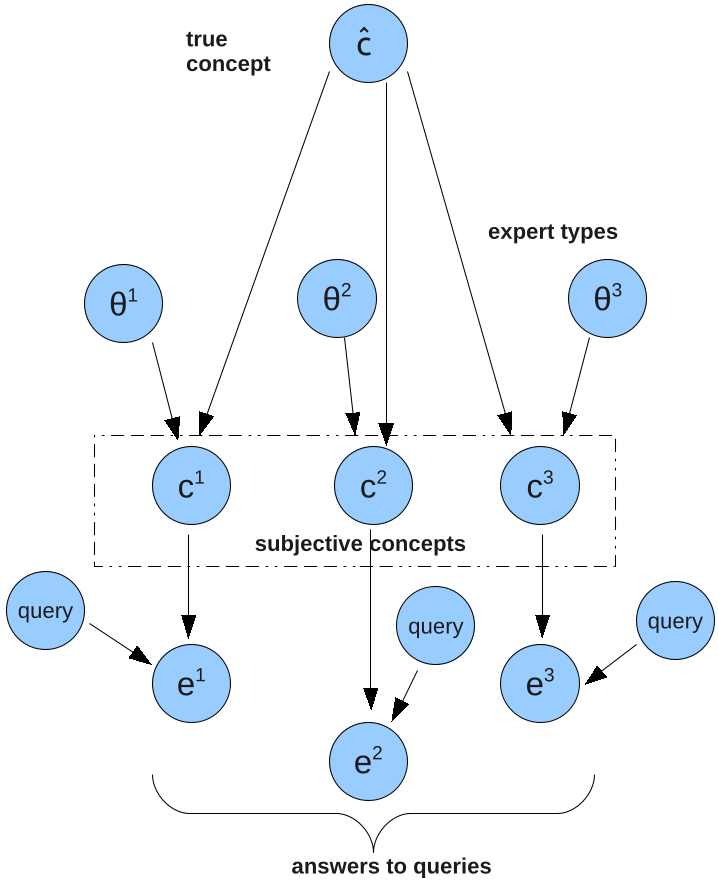
The system maintains a joint distribution over the True Concept () and Expert Types (). Experts aren't just "right or wrong"; they have "subjective concepts" influenced by their type (knowledgeable vs. ignorant).
2. Decision Making via MAPSAT
Instead of simple voting, the system uses Maximum A Posteriori Satisfaction (MAPSAT). When constraints exist (e.g., a total cost limit), the authors show that finding the best configuration can be converted into a Linear Integer Program by taking the log-probabilities of individual feature satisfaction.
3. Query Strategies: EVPI and Exploration
To choose the best question to ask, the authors use Expected Value of Perfect Information (EVPI).
- Exploitation: Ask about features that resolve the most uncertainty regarding the final decision.
- Exploration: Ask questions to "test" experts and figure out who is knowledgeable. The "Explore-Exploit" strategy balances these by switching between asking about critical features (to decide) and certain features (to evaluate experts).
Experiments & Results
In a setting where only 20% of experts are knowledgeable, the Bayesian approach (Exact, Naive, or Monte Carlo) reached a satisfying configuration much faster than "Most Popular" voting or random querying.
Performance in Large Spaces
In a complex 30-feature environment, the minval heuristic (a surrogate for EVPI) proved highly effective at narrowing down the concept. Interestingly, even a Naive Bayes approximation performed surprisingly well compared to computationally expensive exact inference.
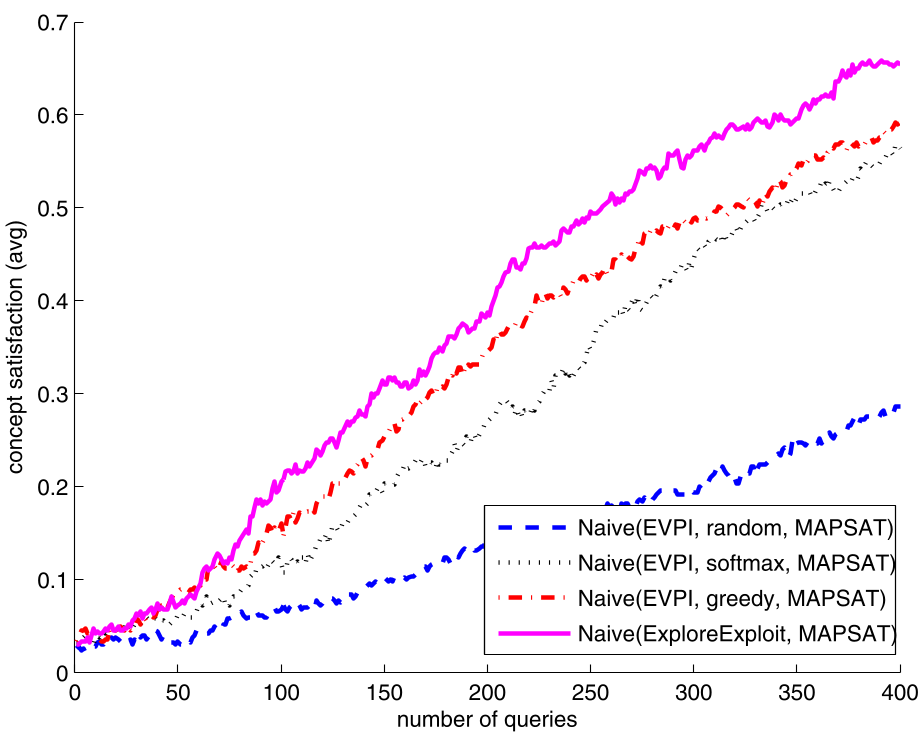 Figure 6: The combined Explore-Exploit strategy (blue line) identifies a satisfying configuration with significantly fewer queries than random or greedy strategies.
Critical Analysis & Conclusion
Takeaways
- Efficiency over Accuracy: The paper proves that for practical applications, learning the exact boundaries of a concept is a waste of resources. Learning just enough to satisfy the user's constraints is the optimal path.
- Trust is Latent: Treating expert reliability as a hidden variable that is updated alongside the concept is a robust way to handle the "bad" crowd.
Limitations & Future Work
- Conjunction Constraint: The current model focuses on conjunctions. While powerful for "recipes," it struggles with "OR" logic (disjunctions), where multiple unrelated ingredients could serve the same purpose.
- The Cold Start: The model relies on a Dirichlet prior. In highly niche domains, an informative prior might not be available.
In conclusion, this work provides a rigorous mathematical bridge between crowdsourcing and decision theory, offering a blueprint for systems that must navigate the high-noise environment of human computation.