
PHG Model: Enhancing Social Network Security through Bayesian Deception
Bayesian Game Based Pseudo Honeypot Model in Social Networks
The paper introduces a Bayesian Game-based Pseudo Honeypot (PHG) model designed to mitigate Distributed Denial of Service (DDoS) attacks in Social Networks (SNs). By integrating "pseudo honeypots"—services that mimic real operations while trapping attackers—the authors establish a formal game-theoretic framework to identify Bayesian Nash Equilibriums (BNEs) that optimize defensive posture against rational attackers.
TL;DR
Social Networks (SNs) are prime targets for DDoS attacks. This paper introduces a Pseudo Honeypot Game (PHG) model based on Bayesian game theory. Unlike traditional traps, pseudo honeypots serve both as legitimate portals and traps, effectively deceiving rational attackers while preserving system energy and service quality.
Problem & Motivation: The Rational Attacker Dilemma
In the context of Social Networks, DDoS attacks are not just "blind floods"; they are often orchestrated by rational agents who observe defender strategies. Traditional defenses suffer from:
- High Overhead: Monitoring all traffic (All Monitor model) drains energy rapidly.
- Predictability: Standard honeypots are often distinguishable, allowing attackers to bypass them.
- Collateral Damage: Strict filtering often drops legitimate packets along with malicious ones.
The authors' research intuition is that by introducing a "Pseudo Honeypot"—a hybrid state that acts like a real server until an attack is initiated—they can create an information asymmetry that favors the defender.
Methodology: The Architecture of Deception
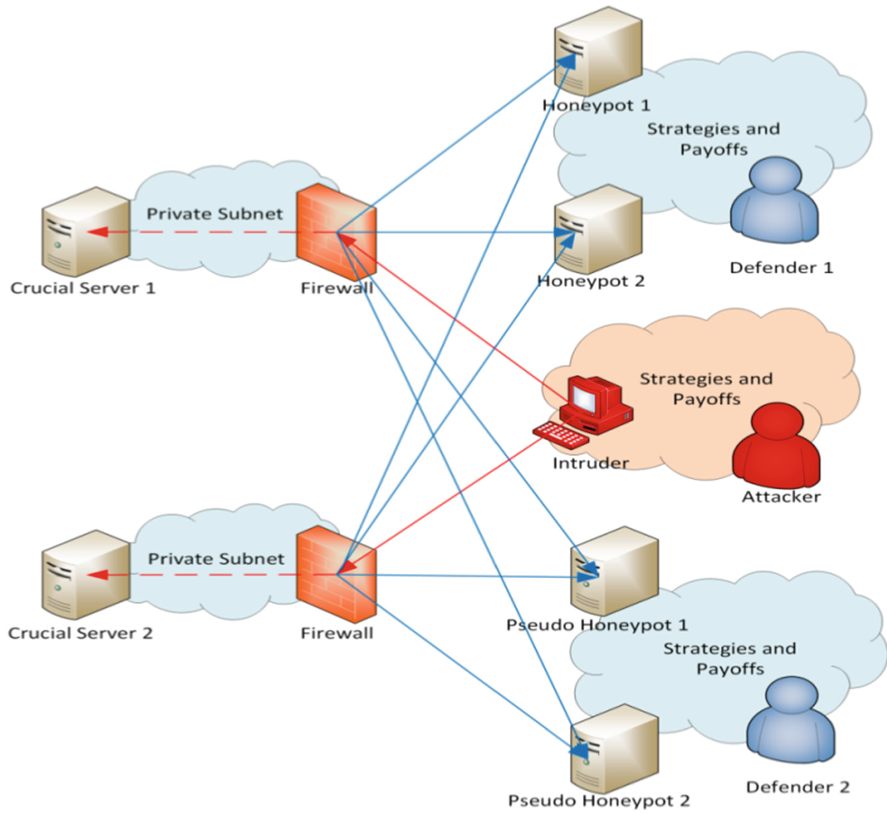
The PHG model is defined as a Bayesian Game where players (Service-side vs. Visitors) have incomplete information about each other's types.
The Strategy Space
- Service Entities (): Real Service (), Honeypot (), and Pseudo Honeypot ().
- Visitors (): Legitimate Users () and Attackers ().
The "Pseudo Honeypot" is the critical innovation. It provides a payoff (normal service) to legitimate users but triggers a decoy factor against attackers. This creates a more complex game tree where the attacker must guess the server type based on prior probabilities ( and ).
Bayesian Nash Equilibrium (BNE)
The paper rigorously proves that a BNE exists. The equilibrium is reached when the probability of deployment () and the decoy effectiveness () satisfy specific inequality constraints. Essentially, if the defender maintains a specific ratio of pseudo honeypots, the rational attacker's best move becomes less damaging or entirely deterred.
Experiments & Results: Efficiency through Deception
The researchers simulated a 400m x 400m network with 500 nodes to compare the PHG model against traditional Honeypot (HG), All Monitor (AM), and Cluster Head (CH) models.
1. Energy Efficiency
As shown in the charts, the AM model consumes energy linearly and rapidly. While the PHG model does consume more than a single HG as frequency increases, it stays significantly more efficient than full monitoring, because "deception" is computationally cheaper than "packet inspection."
2. Safety Performance (Service Flow)
The most striking result is the stability of legitimate user payoffs. In scenarios with a high "attack damage factor," the PHG model maintains a significantly higher service flow for real users because the pseudo honeypots successfully absorb malicious traffic without shutting down services.
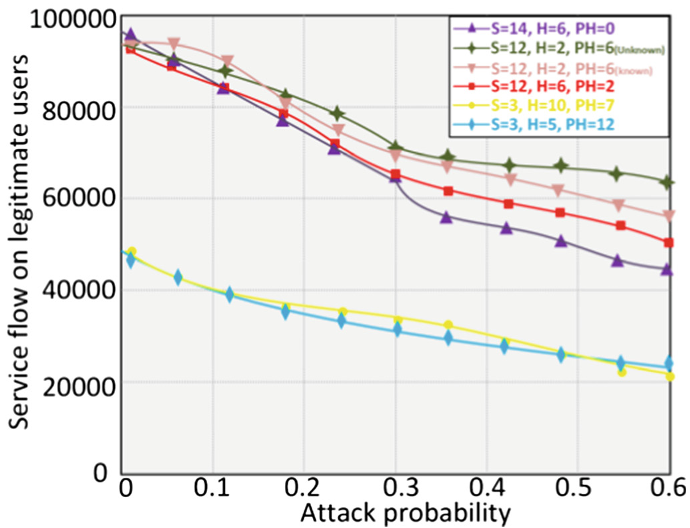 (Performance of Service flow on legitimate users under varying attack probabilities)
Critical Analysis & Conclusion
Takeaway
The PHG model shifts the defensive paradigm from detection to deception. By making the server's identity a "hidden variable" in a Bayesian Game, the defender can control the attacker's expected utility, effectively forcing them into a sub-optimal strategy.
Limitations
- Parameter Sensitivity: The model relies on accurate estimation of the "decoy factor" (), which might be difficult to quantify in diverse, real-world SN traffic.
- Static Probabilities: The current game assumes relatively static prior probabilities; a truly dynamic adaptive game would be needed for rapidly evolving attack botnets.
Future Outlook
The application of Bayesian Game Theory in security is just beginning. Moving forward, integrating these models with Reinforcement Learning could allow the "Pseudo Honeypot" to adjust its deceptive mask in real-time as attack patterns shift.