
BH-CRM: Bridging the Gap Between Community Discovery and Role Assignment in Social Networks
A Bayesian Hierarchical Approach for Exploratory Analysis of Communities and Roles in Social Networks
The paper introduces BH-CRM (Bayesian Hierarchical Community-and-Role Model), an unsupervised learning framework that integrates community discovery and role assignment into a single generative process for social network analysis. By representing nodes as distributions over communities and communities as distributions over roles, it achieves SOTA performance in link prediction on real-world datasets like Enron and Small World.
Executive Summary
TL;DR: Most social network analysis treats "where you belong" (community) and "what you do" (role) as separate problems. BH-CRM is a novel Bayesian hierarchical model that fuses these two dimensions, allowing nodes to have "soft memberships" in multiple communities and play different roles depending on the context.
Academic Context: This work moves beyond simple graph partitioning and the limitations of LDA-based graph models by introducing a nested hierarchy: Node → Community → Role → Interaction. It establishes a new SOTA for link prediction by capturing the functional nuances of connectivity.
Problem & Motivation: The "Hard Membership" Fallacy
In the real world, your social identity is fluid. You might be a "Manager" in your professional department (Community A) but a "Coach" in a local sports club (Community B).
Previous methods, both link-based (like Girvan-Newman) and probabilistic, often forced a hard membership—assigning a node to exactly one community. Furthermore, these methods ignored the internal hierarchy of communities. A community isn't just a dense cluster of links; it's a structural entity made of diverse roles. The authors argue that failing to model these roles makes our understanding of network connectivity shallow and less predictive.
Methodology: The Generative Intuition
The core of BH-CRM (Bayesian Hierarchical Community-and-Role Model) is its intuitive generative process. Instead of asking "Does a link exist?", it asks "What sequence of latent choices led to this link?"
The Hierarchy
- Nodes to Communities: Each node has a probability distribution () over communities.
- Communities to Roles: Each community has a distribution () over roles.
- Roles to Links: A link's existence depends on the interaction probability () between the specific roles of the two participating nodes.
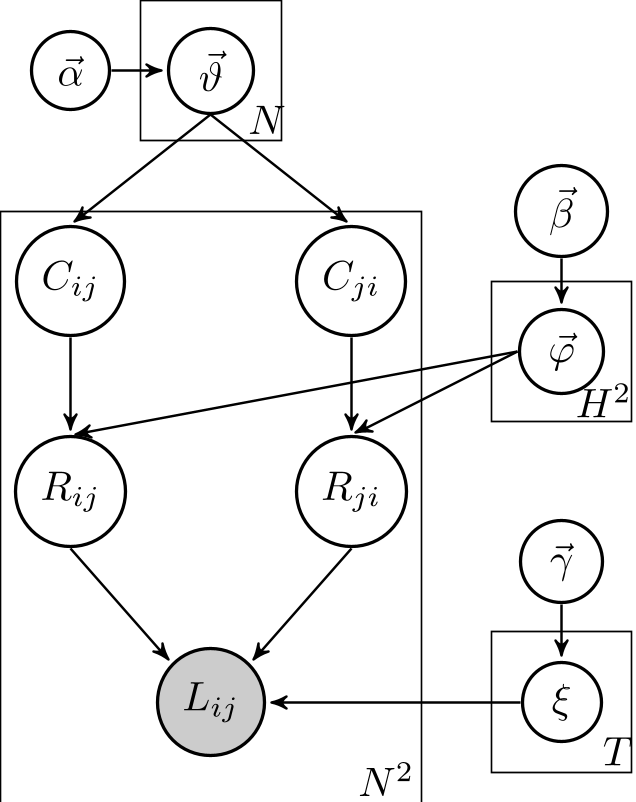
Inference via Gibbs Sampling
Because the exact posterior distribution is mathematically intractable (exponential search space), the authors employ collapsed Gibbs Sampling. This allows the model to learn the hidden parameters (the matrices) by iteratively sampling community and role assignments for every pair of nodes until the model converges to a stable representation of the network.
Experimental Validation: Predicting the Unseen
The model was tested on two distinct datasets: the Enron Email Corpus (organizational) and Small World (scientific citations).
1. Link Prediction Performance
The ultimate test of a network model is its ability to predict missing links (predictive power). BH-CRM outperformed the competition significantly:
| Dataset | BH-CRM (AUC) | LDA-G (AUC) | Girvan-Newman [6] |
|---|---|---|---|
| Enron | 80.4% | 75.7% | 67.3% |
| Small World | 91.0% | 86.1% | 73.8% |
2. Qualitative Insight: Role Distributions
In the Enron dataset, BH-CRM successfully mapped nodes to roles that resemble real-world corporate hierarchies (Senior Managers, Traders, etc.).
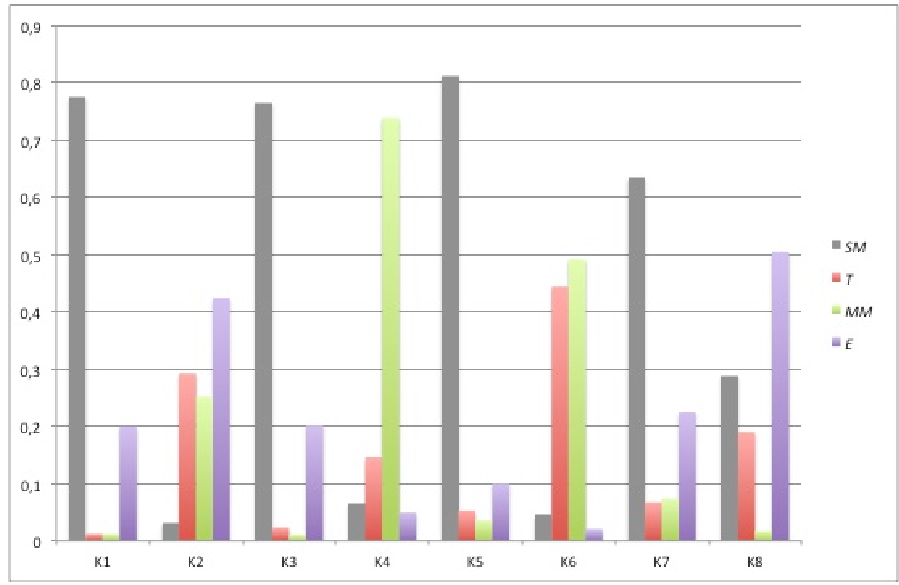 Visualizing how different communities in Enron exhibit distinct behavioral "fingerprints" through their role distributions.
Critical Analysis & Conclusion
Takeaway
BH-CRM proves that context matters. A node's behavior is a function of the community it is acting within. By modeling this hierarchy, we gain a tool that is not only better at predicting links but also provides a "human-readable" explanation of why those links exist.
Limitations & Future Work
While powerful, the current model assumes a static network. Social networks are dynamic; roles and communities shift over time. The authors note that incorporating temporal evolution and the actual content of interactions (e.g., the text of the emails) is the next frontier for this Bayesian approach.
Final Thought
For researchers in SNA (Social Network Analysis), BH-CRM offers a robust mathematical bridge between the structural "where" and the functional "what" of social connectivity.