
Deciphering Complexity: Using Bayesian Networks to Map Traffic and Mental Health
Application of Bayesian Networks in Consumer Service Industry and Healthcare
This paper explores the utility of Bayesian Networks (BN) for discovering causal relationships in complex systems, specifically applied to traffic volume analysis and veteran mental healthcare. Utilizing the BayesiaLab platform, the study demonstrates how unsupervised and supervised learning can extract actionable insights from both individual road-usage data and aggregated mental health survey statistics.
TL;DR
Researchers from Purdue University demonstrate that Bayesian Networks (BN) can reveal hidden causal ties in complex industries. By analyzing Indiana road traffic and veteran mental health through the BayesiaLab platform, the study proves that BNs can handle both individual and aggregated data to provide more nuanced probabilistic insights than traditional linear statistics.
Academic Positioning: This work serves as a practical methodology bridge, applying Probabilistic Graphical Models (PGM) to real-world datasets to validate existing socio-economic and medical theories through a "knowledge discovery" lens.
The Problem: The Limits of Factual Observation
In complex systems, variables rarely act in isolation. Traditional statistical models often designate one dependent variable and multiple independent ones. However, in the real world—such as the mental health of a veteran—factors like gender, combat exposure, and employment status are deeply intertwined in an "uncertain reasoning" web.
The authors identify two major pain points:
- Dependency Complexity: Traditional models struggle with "omnidirectional" inference where any node could potentially influence any other.
- Data Gaps: Healthcare data is often aggregated or incomplete, making it difficult for standard data mining algorithms to extract reliable causal patterns.
Methodology: The Bayesian Intuition
The study utilizes BayesiaLab, focusing on two distinct approaches:
1. Unsupervised Learning & Distance Mapping
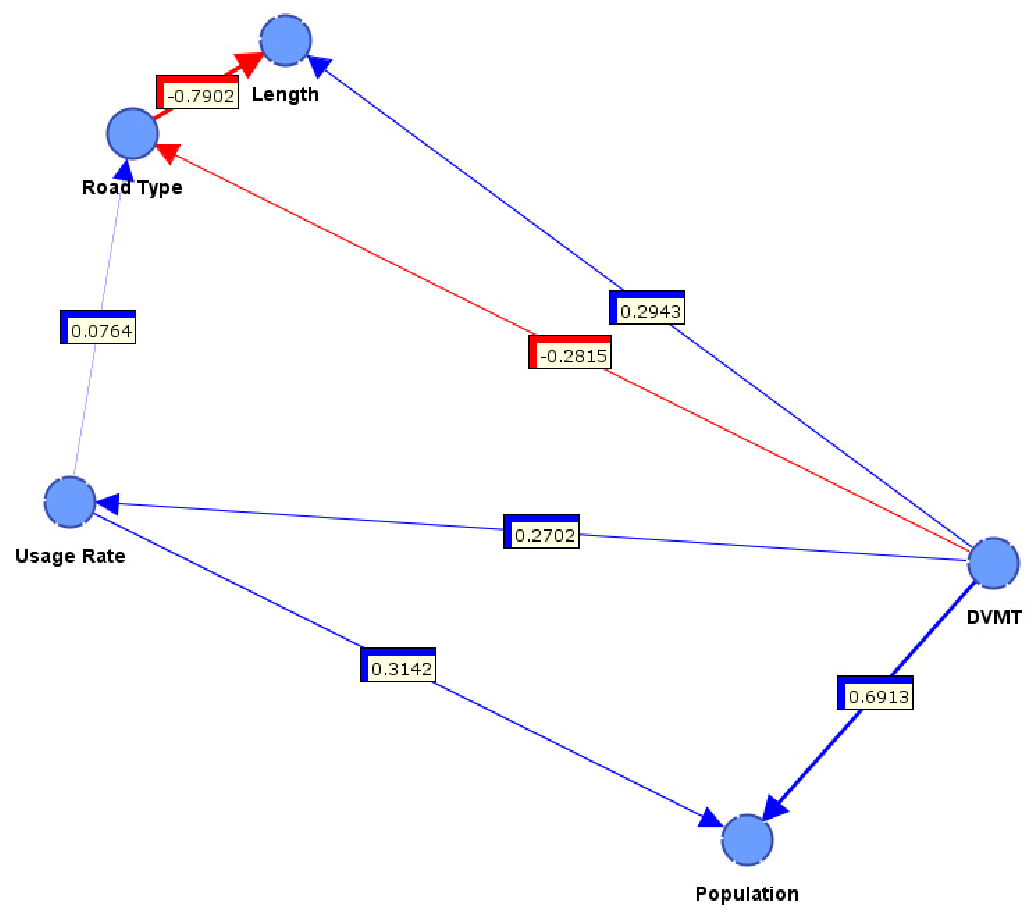
In Case Study One (Traffic Volume), the authors used unsupervised learning to let the data "speak for itself." By employing Mutual Information (MI) distance mapping, they visualized how closely nodes like Road Type and Usage Rate are related based on information gain.
2. Supervised Learning (Augmented Naive Bayes)
For deeper analysis, the authors set a "Target Node" (e.g., Usage Rate or Mental Health). They applied the Augmented Naive Bayes (ANB) algorithm, which relaxes the strict independence assumptions of a standard Naive Bayes model, allowing for a more realistic representation of data dependencies.
Case Study 1: Why Some Roads "Feel" Clogged
Analyzing Daily Vehicle Miles Traveled (DVMT) in Indiana, the model revealed a significant insight: while county population correlates with total volume, the Road Type is the ultimate determinant of "Usage Rate."
- Interstates: Shortest total miles but highest probability of high usage.
- City/County Roads: Longest total length but lowest density. The model effectively removed the "size bias" of large counties to show that road function, not just local population, dictates traffic stress.
Case Study 2: Modeling the "Unseen Wounds" of Veterans
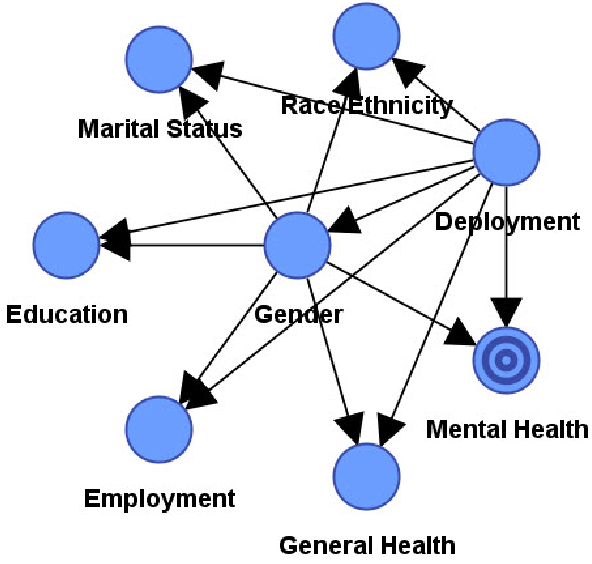
The most impactful application was in healthcare meta-analysis. Using aggregated data from the Behavior Risk Factor Surveillance survey, the authors modeled the probability of adverse mental health.
Key Findings:
- The Gender Gap: Female veterans (both deployed and non-deployed) showed significantly higher probabilities of mental distress (17-19%) compared to female civilians (13%).
- The Non-Deployed Paradox: Interestingly, the model showed that male non-deployed veterans had a slightly higher probability of adverse mental health (11%) than deployed veterans (9%), highlighting the need to look beyond "combat zones" as the sole source of trauma.
Critical Insight: Statistical Association vs. Causality
The authors provide a vital scholarly caveat: The direction of an arc in a Bayesian Network indicates statistical association, not necessarily direct physical causation. However, the power of this method lies in its ability to provide a "holistic" view. By adjusting one node (e.g., setting "Gender" to 100% Female), the entire network updates its probabilities instantaneously, allowing researchers to perform "what-if" simulations.
Conclusion & Future Outlook
This research demonstrates that Bayesian Networks are a valid and powerful tool for meta-analysis, especially when individual subject data is protected or expensive to obtain. By visualizing "hidden ties," BNs facilitate earlier diagnosis in healthcare and better resource allocation in infrastructure.
Future Work: The authors suggest further investigation into discretization methods (like KMeans vs. Manual Binning), as the way data is categorized significantly impacts the resulting probabilistic sensitivity.