
Agricultural Logistics: Solving the Information Needle-in-a-Haystack Problem with Bayesian Intelligence
A Bayesian Based Search and Classification System for Product Information of Agricultural Logistics Information Technology
This paper presents a specialized search and classification system for agricultural logistics information technology. It combines a domain-specific concept dictionary, a meta-search engine architecture, and a Bayesian-based Web text classification algorithm to deliver high-precision results for agricultural practitioners.
TL;DR
The rapid evolution of agricultural logistics technology—ranging from RFID tracking to automated cold-chain warehouses—has created an information glut. Researchers have developed a specialized meta-search and classification system that replaces generic web searches with a domain-aware pipeline. By leveraging a Bayesian classification algorithm and a Semantic Vector Space Model, the system achieves over 93% precision in identifying and categorizing logistics technologies.
The Motivation: Why General Search Engines Fail Agriculture
General-purpose search engines like Google are "jack of all trades, master of none." When a logistics manager searches for "Automated Warehouse," they are often flooded with generic e-commerce links, residential storage ads, or general construction news.
In the high-stakes field of Agricultural Logistics, the requirements are specific:
- Niche Terminology: Terms like "Cold Chain," "Container Unitization," and "Distribution Processing" have specific technical meanings.
- Data Fragmentation: Vital technical specs, pricing, and vendor details are scattered across obscure industry portals.
- Classification Needs: Users don't just need a link; they need information categorized by function (e.g., Handling vs. Packaging).
Methodology: The Three-Layer Architecture
The authors propose a systematic workflow to transform raw web data into actionable decision support.
1. Semantic Filtering via Vector Space Model
Before classification, the system must decide if a web page is even relevant. The researchers used a semantic vector matching method. Instead of simple keyword matching, they represent data items () and queries () as vectors in a concept space.
The weight calculation incorporates semantic similarity based on the shortest path and depth of concepts in a domain ontology: This ensures that "Warehouse Management System" and "WMS" are recognized as semantically close even if the strings differ.
2. Bayesian-Driven Automatic Classification
Once relevant pages are filtered, the system applies a Naive Bayes algorithm to sort them into one of six predefined categories: Transportation, Handling, Storage, Packaging, Distribution, and Information Processing.
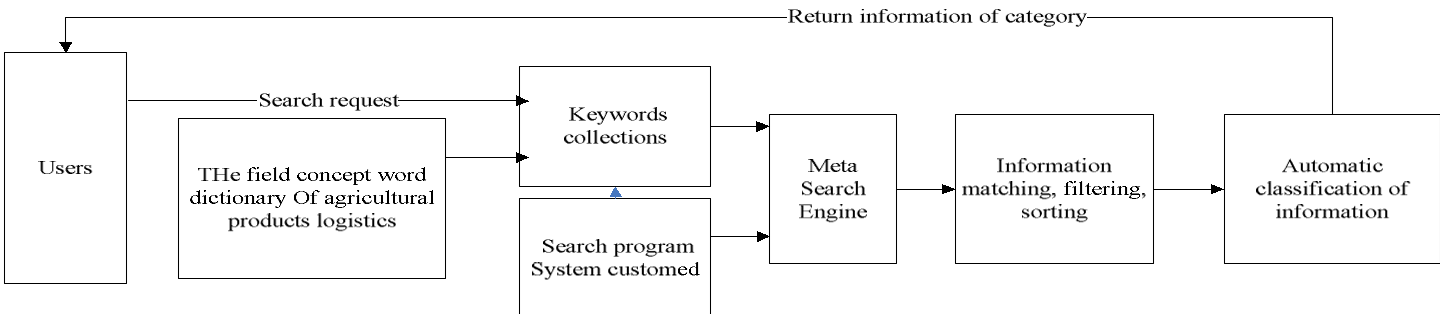 Figure 1: The logic flow from user query to classified result.
The core of the classification relies on calculating the conditional probability , determining which category most likely contains the text :
Experimental Results: Precision Matters
The system was tested against general search engines across three major logistics categories.
| Search Request | General Engine Precision | This System's Precision |
|---|---|---|
| Automatically Guided Machine | 90.3% | 92.5% |
| Automation Warehouse | 91.2% | 93.7% |
| Warehousing Management System | 90.5% | 93.2% |
The improvement (approx. 2.5-3%) is significant in a professional context because it reduces the "manual cleaning" time required by specialists. Furthermore, the classification accuracy was particularly high in Material Handling (95.2%) and Information Collection (94.7%), proving that Bayesian methods remain highly effective when trained on high-quality, domain-specific dictionaries.
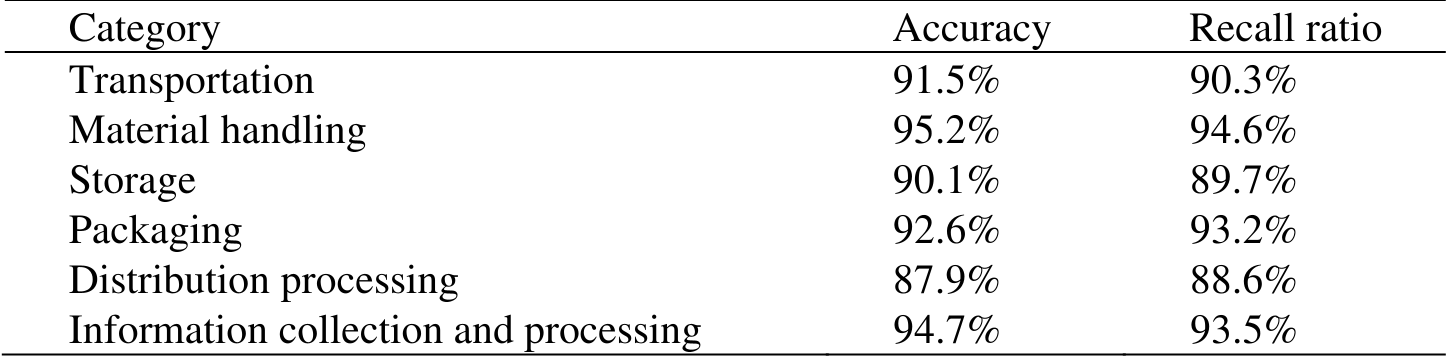 Table 2: Accuracy and Recall ratios across the six logistics functional categories.
Critical Analysis & Takeaways
Why It Works
The success of this system isn't just the Bayesian algorithm—it’s the Field Concept Word Dictionary. By defining the "world" of agricultural logistics upfront, the system creates an inductive bias that general engines lack. It knows what to look for before it begins searching.
Limitations
- Dynamic Language: Agricultural tech evolves rapidly. A static dictionary requires constant maintenance to include new terms like "Blockchain-based Traceability" or "IoT Sensors."
- Bayesian Independence Assumption: The algorithm assumes that features (words) are independent, which we know is linguistically untrue (e.g., "Cold" and "Chain" are highly dependent).
Future Outlook
This research highlights a shift from "Big Data" to "Smart Data." By wrapping a specialized semantic layer around general search infrastructure, we can create powerful tools for the "Internet of Agriculture." Integrating LLMs (Large Language Models) to update the concept dictionary autonomously would be the logical next step for this lineage of research.
Summary: This Bayesian system effectively bridges the gap between raw web noise and professional decision support, proving that specialized knowledge bases are the key to unlocking the true value of web mining in traditional industries.