
ERuDIte: Applying Data Science to Data Science Education
BD2K ERuDIte: the Educational Resource Discovery Index for Data Science
The paper introduces ERuDIte (Educational Resource Discovery Index), a platform designed to aggregate and organize heterogeneous data science learning materials. It integrates over 8,600 resources using a unified metadata schema and an automated tagging system based on a hierarchical data science ontology.
TL;DR
As data science becomes a cornerstone of biomedical research, the influx of educational materials has created a paradox of choice. ERuDIte (Educational Resource Discovery Index) addresses this by building a massive, organized index of learning resources. By leveraging automated scraping, JSON-LD integration, and machine learning-based tagging, ERuDIte transforms high-volume, heterogeneous web data into a structured discovery engine for learners.
The Problem: The "Wild West" of Online Learning
The "Big Data to Knowledge" (BD2K) initiative recognized a critical bottleneck: we have the data, but we don't have enough trained people to analyze it. While thousands of MOOCs, YouTube videos, and blog posts exist, they are:
- Heterogeneous: Varying formats (video vs. text) and quality.
- Unstructured: Lacking a unified taxonomy to bridge different platforms.
- Dynamic: Rapidly evolving, making manual curation impossible at scale.
Methodology: Building the Index with a Data Science Pipeline
The authors treated the creation of ERuDIte as a classic data science project, moving from collection to visualization.
1. Advanced Resource Collection
To bypass the limitations of simple web crawlers, the team built a modular framework using BeautifulSoup and Dryscrape, packaged in Docker. This allowed them to handle dynamic, JavaScript-heavy sites like Coursera and Udacity while scaling content extraction across multiple team members.
2. Integration and Metadata Standardization
Heterogeneity was solved by designing a unified schema incorporating standards like Dublin Core and Schema.org.
- Linked Data: By exposing metadata in JSON-LD, ERuDIte makes educational objects machine-readable and cross-referencable by other web services (like Google Search).
- Karma System: They used the Karma data integration tool to map relational database entries directly to structured Linked Data.
3. Automated Concept Tagging (The Core)
The "intellectual heart" of the paper is the automated tagging system. The authors developed a Data Science Education Ontology (DSEO) consisting of 117 hierarchical concepts across dimensions like "Data Science Process," "Programming Tool," and "Domain."
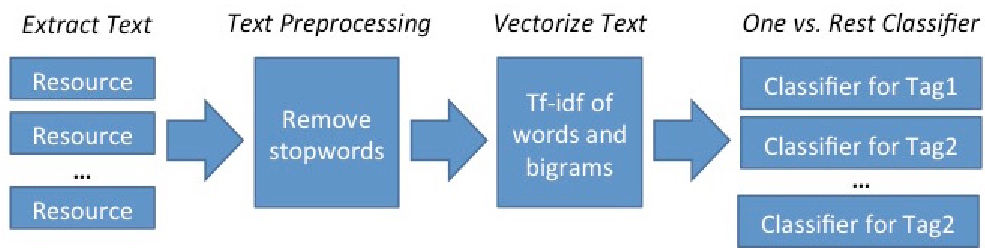
They compared several ML models (Random Forest, SVM, Logistic Regression) and Information Retrieval methods. A key insight was using the "Tag & Descendants" approach: training the model to recognize that a resource about "Neural Networks" should also be tagged with its parent category, "Machine Learning."
Experiments and Results: Precision in Organization
The experimental results proved that Logistic Regression was the most robust for this task.
| Classifier | Exact Tag (F1) | Tag & Descendants (F1) |
|---|---|---|
| Logistic Regression | 0.73 | 0.83 |
| Support Vector Machines | 0.73 | 0.81 |
| Multinomial Naive Bayes | 0.70 | 0.80 |
The jump from 0.73 to 0.83 in F1 score highlights the importance of leveraging the hierarchical structure of information—reflecting how humans naturally categorize knowledge.
Visualizing the Landscape
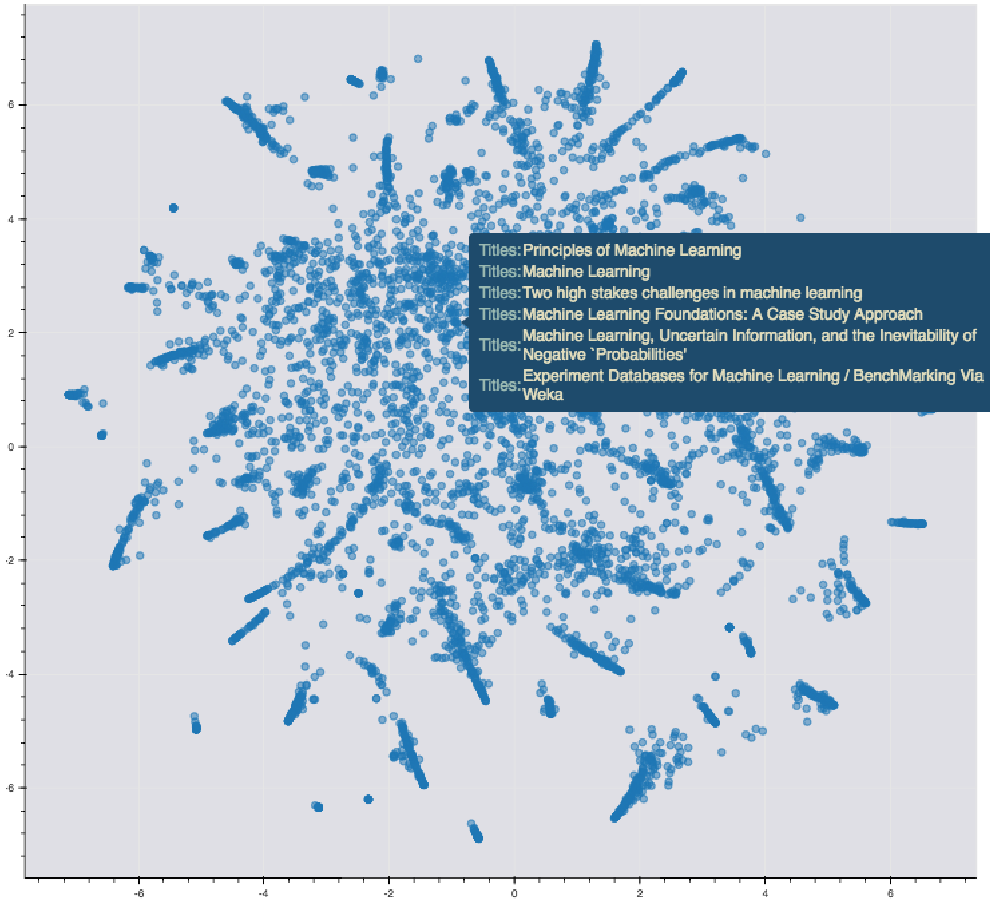
To help users find clusters of related topics, the authors used t-SNE (t-distributed Stochastic Neighbor Embedding) to project the resource vectors into 2D space. They found that using 75 NMF topics produced the clearest clusters, mirroring the domain-specific tags they had manually identified.
Critical Insight: Beyond a Simple Repository
ERuDIte is more than a list of links; it is a proof-of-concept for Self-Directed Learning Infrastructure.
Key Takeaways:
- Metadata is the Message: By focusing on JSON-LD and standard schemas, the project ensures it isn't a "data silo."
- The Hierarchy Advantage: Incorporating ontological relationships into ML training significantly boosts accuracy.
- Future Impact: The transition from manual selection to automated identification (like identifying quality data science videos on YouTube) will be the next frontier for this platform.
Limitations: Currently, the system relies heavily on textual metadata (titles/descriptions). The authors note that extracting information from "noisier" sources like video transcripts is still a work in progress.
Conclusion: ERuDIte provides a blueprint for how we can organize the world's academic knowledge, transforming the "Wild West" of the internet into a structured, navigable university for the digital age.