
BeTracker: Bridging Physical Sensors and Social Networks to Decode Human Behavior
BeTracker: A System for Finding Behavioral Patterns from Contextual Sensor and Social Data
BeTracker is a novel system for mining and tracking frequent human behavioral patterns by integrating physical encounter data from mobile sensors with online social indices from networks like Facebook. It introduces a temporal subgraph pattern mining algorithm that identifies "friend meets" (FM) and "non-friend meets" (NFM) across various relational structures and time sequences.
TL;DR
Human behavior is a complex interplay between physical presence and social relationships. BeTracker is a system designed to mine "temporal subgraph patterns"—recurring behavioral motifs that tell us who meets whom, when, and whether they are actually friends. By combining mobile sensor encounter records with Facebook data, it offers a sophisticated tool for tracking social dynamics with high computational efficiency.
Background & Motivation: Beyond Simple Proximity
In an era of ubiquitous mobile sensing, we can track exactly when two devices are within 10 meters of each other. However, a "contact" record doesn't tell the whole story. Are these two people friends grabbing coffee, or just strangers sitting on the same bus?
Prior works often addressed sensor events in isolation or focused purely on static social network topologies. The authors of BeTracker argue that context is king. By overlaying virtual social links onto physical encounter data, we can distinguish between a "Friend Meet" (FM)—likely a deliberate social interaction—and a "Non-Friend Meet" (NFM)—likely a coincidental or professional proximity.
Methodology: The Core Engine
The heart of BeTracker is its ability to transform a massive stream of sensor logs into a searchable transaction database of behavioral networks.
1. Data Transformation
Each day’s interactions are modeled as a graph where nodes are individuals and edges represent encounters. These graphs are then flattened into edge sequences sorted by timestamps.
- Edge Annotation: Each edge is labeled not just with time, but with a relationship type (FM vs. NFM) derived from online social networks.
2. Temporal Subgraph Pattern Mining
A behavior is defined as a sequence: {(u1, l1, v1, ts1, te1)...}. To find frequent behaviors, the system uses a depth-first search (DFS) approach on projected databases.
3. Efficiency via Closed Pattern Mining
Mining every possible frequent pattern is computationally explosive. BeTracker adopts Closed Pattern Mining, meaning it only keeps the most "complete" version of a frequent pattern. To speed this up, the authors use:
- Forward/Backward Checking: Pruning the search tree if a super-pattern has the same frequency.
- Structural Pruning: Reducing redundant candidates to ensure the system remains responsive even with low support thresholds.
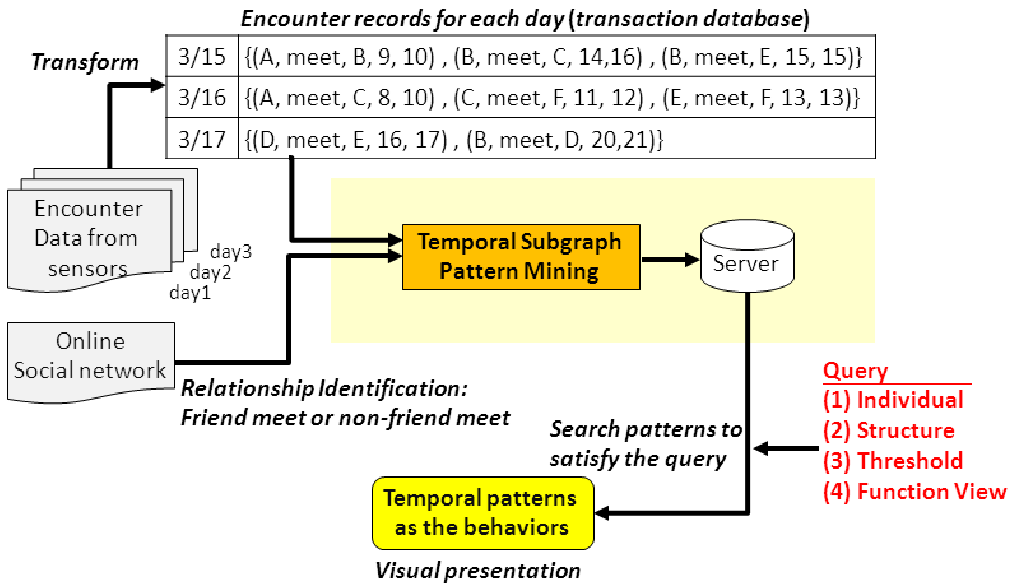 Figure 1: The BeTracker Framework—Integrating sensor logs and social graphs into a mining engine.
Diverse Perspectives: Five Functional Views
BeTracker isn't just an algorithm; it’s a queryable system. It provides five ways to look at behavioral data:
- Local View: What is Individual X’s daily routine?
- Pair View: How do X and Y interact (one-on-one or in groups)?
- Structure View: Does a specific "star" or "triangle" interaction (e.g., a manager meeting three subordinates) happen frequently?
- Source-Target View: Finding the shortest behavioral path for data routing.
- Global View: A birds-eye view of the entire network's daily evolution.
Experimental Validation
The system was tested using the CRAWDAD dataset, involving 27 devices carried by students and staff over 79 days.
The efficiency results (shown below) are particularly impressive. As the minsup (minimum support) threshold decreases, the runtime remains relatively stable. This is a testament to the effectiveness of the pruning strategies used in the closed pattern mining algorithm.
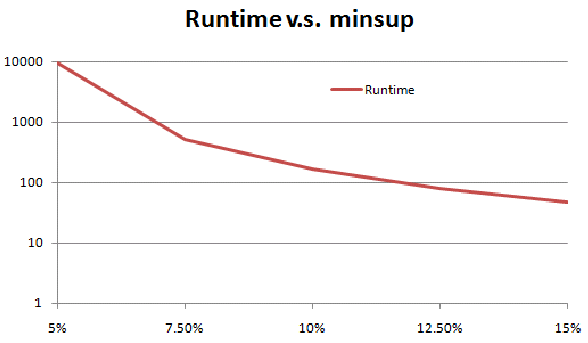 Figure 2: Runtime vs. Minsup—Demonstrating the scalability of the mining algorithm.
Deep Insights & Case Studies
The paper showcases fascinating behavioral patterns. For instance, it identified a "linear structure" where User 9 would spend 4 hours in proximity to User 15 (an NFM/co-worker relationship) before meeting their actual friend, User 5, in the evening. This level of granularity—separating work-life proximity from social-life interactions—is the primary strength of the BeTracker approach.
Limitations and Future Work
While BeTracker is powerful, it currently assumes sensor data is uploaded to a central base station, which might raise privacy concerns in a real-world deployment. Future iterations could explore Privacy-Preserving Data Mining (PPDM) or decentralized processing. Additionally, incorporating spatial data (GPS locations) alongside simple sensor encounters would likely add another layer of behavioral insight.
Conclusion
BeTracker represents a significant step forward in Socially-Aware Sensing. By treating human interactions as structured temporal patterns rather than random contacts, it enables better packet routing for mobile networks and deeper sociological insights into how our virtual and physical lives overlap.