
Beautiful and Damned: Decoding the Causal Links Between Image Quality and Social Ties
Beautiful and Damned. Combined Effect of Content Quality and Social Ties on User Engagement
This paper introduces a deep learning-based aesthetic scoring model to analyze the interplay between content quality and social network dynamics on Flickr. By applying this model to 15 billion images, the authors reveal how exposure to high-quality content ("beauty") and the quality-imbalance between users and their peers influence long-term engagement and content production.
TL;DR
Is being surrounded by beauty inspiring or intimidating? This study utilizes a deep learning model to score 15 billion Flickr photos, revealing that while following talented creators can improve your own skills (a +2% boost in quality), a massive gap between your "talent" and that of your social circle significantly increases the risk of you quitting the platform. The authors argue for a shift from popularity-based recommendations to quality-balanced ones.
Background: The Popularity Fallacy
In the world of social media, we often equate "good" with "popular." However, this paper identifies a stark "mismatch between talent and attention." While popularity follows a heavy-tailed distribution (the rich get richer), high-quality content production is more evenly distributed. This creates a class of "Forlorn Beauty"—talented photographers who produce professional-grade work but remain invisible to the network.
Methodology: Quantifying the Ineffable
To study this at scale, the researchers built a subject-aware aesthetic scorer.
1. The Aesthetic Neural Network
The authors fine-tuned a CNN (based on AlexNet architecture) originally trained for object detection. The intuition is that subject matter matters: the rules of beauty for a portrait are different from those of a landscape.
- The Formula: They derived a continuous beauty score by subtracting the probability of low quality () from high quality ():
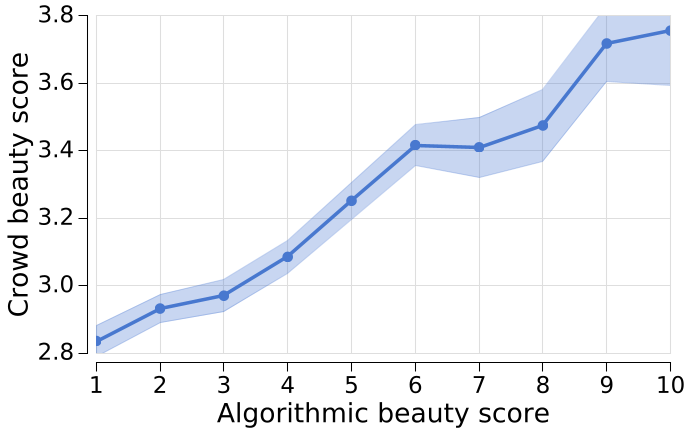
- Validation: The model achieved a 77.6% accuracy on the AVA benchmark, and crowdsourcing tests confirmed it aligns closely with human judgment (Spearman ).
Network Effects: The Majority Illusion
The paper uncovers a "Majority Illusion" regarding quality. Because high-quality producers tend to be more connected, users are exposed to a localized feed where the average beauty is significantly higher than the platform-wide average. This creates a psychological environment where "exceptional" feels "normal."
Causal Insights: The Double-Edged Sword of Quality
The most striking part of this research is the use of Matching Experiments to find causality in observational data.
Influence: Beauty Inspires Beauty
By comparing users who followed "better" photographers with a twin control group (statistically identical in every way except for who they followed), the authors found that exposure works. Users who followed high-quality accounts saw a measurable increase in the aesthetic score of their own subsequent uploads.
Imbalance: The Churn Trigger
However, Social Exchange Theory suggests that relationships thrive on reciprocity. When the "quality gap" () between a user and their neighbors exceeds 30%, the relationship becomes unstable.
- The Result: Users in high-imbalance environments are 20% more likely to become inactive.
- Why? Casual users feel overwhelmed by pros, while pros feel unappreciated by casual peers.
Solving the "Forlorn Beauty" Problem
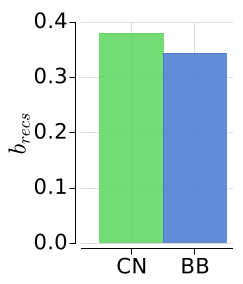
The authors propose a Beauty-Based Link Recommender. Instead of recommending the most popular "Superstars," the algorithm targets:
- Users at network distance 2.
- Users with high beauty scores.
- Users whose quality is within of the recipient to avoid the "imbalance" trap.
This strategy increases the visibility of the "Forlorn Beauty" class by 49% compared to traditional "Common Neighbor" approaches.
Critical Analysis & Conclusion
Takeaway
The health of a creative community depends on more than just "engagement." It depends on a delicate balance of quality. If you want to keep users active, don't just show them the best content on the site—show them the best content that is within their reach.
Limitations
- Explainability: The CNN-based score is a black box; it doesn't tell the user why their photo scored low (e.g., poor lighting vs. bad composition).
- Short-term Focus: The matching strategy is excellent for immediate causal effects (week-to-week) but may miss the long-term "slow burn" of artistic growth.
Future Outlook: As we move toward AI-curated feeds, embedding "Aesthetic Reciprocity" into algorithms could be the key to preventing the "burnout" often seen in high-pressure visual platforms like Instagram or TikTok.