
Collaborative Brokerage: Mastering Social Networks with Heterogeneous Allies
12320_Becoming gatekeepers together with allies collaborative brokerage over social networks.
This paper introduces the "Collaborative Brokerage" problem, a framework for selecting a minimal team of heterogeneous agents (strong vs. weak brokers) to monitor or cover a directed social network. It proposes an optimal Dynamic Programming (DP) solution for directed trees and multiple heuristic-based approximation algorithms for general directed graphs, achieving superior performance on synthetic and real-world datasets like Wiki-Vote and Bitcoin OTC.
TL;DR
Information is power, but controlling it usually requires a team. This paper moves beyond the "lone wolf" broker model to explore Collaborative Brokerage. It asks: how can a team with different influencing powers (e.g., a CEO and a manager) cover an entire social network with the fewest possible connections? The authors provide an optimal solution for trees and high-efficiency approximation algorithms for complex, real-world directed networks.
Problem & Motivation: The Limits of Uniform Influence
In social network theory, "brokers" are the gatekeepers who bridge gaps between isolated groups. Most research assumes brokers are equal. However, in reality, influence is heterogeneous. A senior executive might influence people three levels down the hierarchy, while a trainee only reaches their immediate peers.
The Collaborative Brokerage Problem addresses this reality. If we have a budget for "strong" brokers ( with radius ) and "weak" brokers ( with radius ), how do we pick the smallest combined team to "cover" every node in a directed graph? This is a massive combinatorial challenge, proven to be NP-hard for general graphs.
Methodology: From Trees to Complex Networks
1. The Dynamic Programming (DP) Approach for Trees
While the general problem is hard, the authors identify that Directed Trees (common in corporate hierarchies) allow for an optimal solution. They developed a DP algorithm that processes the tree from the leaves up to the root.
- Positional Advantage: The key insight is track not just if a node is covered, but how well it is covered (its distance to the broker), allowing parent nodes to make optimal decisions based on their children's status.
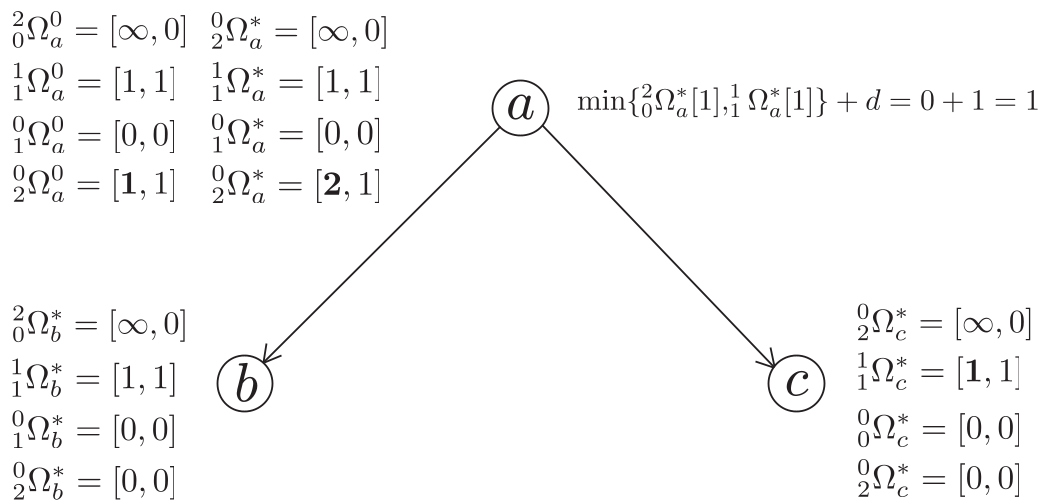 Fig 1: The recursive DP process calculating the optimal broker team for a hierarchical structure.
2. General Networks: The Power of Replacement
For arbitrary graphs (like Twitter or Citation networks), the paper proposes three strategies:
- STDP-k: Sampling multiple spanning forests and applying tree-based DP.
- Greedy: Using heuristics like "Maximum Outdegree" to grab the most influential nodes first.
- Replacement (REPL1 & REPL2): This is the most sophisticated method. It starts by finding a dominating set for one influence level and then strategically "replaces" nodes with more efficient combinations from the other level.
Experiments & Results: Real-World Dominance
The authors tested these algorithms on synthetic models (BA, ER, NSW) and three massive real-world datasets: Wiki-Vote, Bitcoin OTC, and arXiv Citations.
- Replacement Wins: Across nearly all tests, the REPL2 algorithm (which finds a weak team and then replaces groups of weak nodes with single strong nodes) achieved the smallest team size.
- Scale-Free Efficiency: In Barabási-Albert (BA) networks, which mimic social media structures, the algorithms effectively exploited "hubs" to drastically reduce the number of brokers needed as influence radius increased.
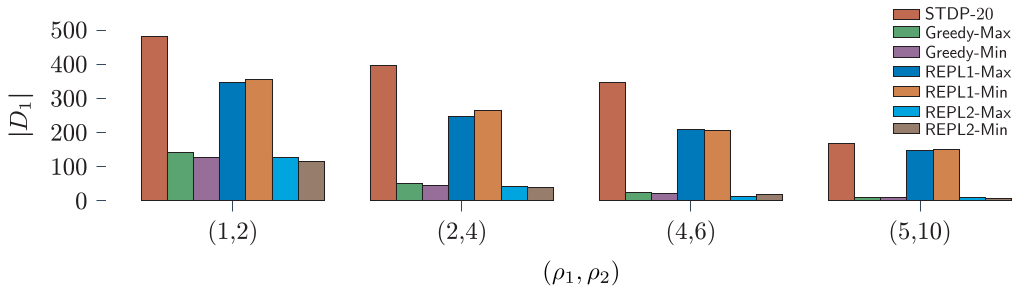 Fig 2: Performance comparison on Navigable Small World (NSW) networks, showing REPL2's superior efficiency.
Critical Analysis & Conclusion
The beauty of this work lies in its Practical Realism. By acknowledging that not all allies are equal, it moves academic graph theory closer to organizational reality.
Key Insights:
- Hierarchy is a Shortcut: If your network looks like a tree, you can find the perfect brokerage team.
- REPL2 is the Go-To: For practitioners looking to monitor a network (e.g., detecting fraud in the Bitcoin network), the REPL2 algorithm offers the best balance of speed and coverage.
Limitations: The current model focuses on only two levels of influence. Future iterations will likely extend this to -levels, reflecting even more complex social "castes." This work serves as a foundational step for anyone looking to optimize influence or information flow in a world defined by directed, unequal relationships.