
BEEINFO: Harnessing Swarm Intelligence for Efficient Vehicular Social Networking
BEEINFO: Interest-Based Forwarding Using Artificial Bee Colony for Socially Aware Networking
This paper proposes BEEINFO, a set of interest-based forwarding schemes (BEEINFO-D, BEEINFO-S, BEEINFO-D&S) for Socially Aware Networking (SAN). Inspired by Artificial Bee Colony (ABC) optimization, the method utilizes community density and social ties to achieve superior message delivery in vehicular social networks.
In the rapidly evolving landscape of Vehicular Social Networks (VSNs), the challenge of reliably delivering data without fixed infrastructure remains a significant hurdle. Traditional protocols often treat nodes as simple relays, ignoring the rich social fabric—interests, regularities, and relationships—of the humans carrying these devices.
In this paper, a team of researchers led by Feng Xia introduces BEEINFO, a bio-inspired forwarding framework that transforms mobile nodes into intelligent "bees" capable of learning and adapting to their social environment.
TL;DR
BEEINFO is a suite of routing protocols (BEEINFO-D, S, and D&S) that leverages the Artificial Bee Colony (ABC) algorithm to optimize data forwarding in Socially Aware Networking (SAN). By treating communities as nectar sources and interests as foraging targets, it achieves a 74%+ delivery ratio, significantly outperforming standard protocols like PRoPHET and Epidemic in high-mobility environments.
The Motivation: Why Social Awareness Matters
Existing Delay-Tolerant Network (DTN) protocols often rely on blind flooding (Epidemic) or simplistic probability models (PRoPHET). These methods fail because:
- Resource Waste: Flooding consumes excessive buffer and energy.
- Dynamic Blindness: They don't adapt quickly to the changing "density" of social groups.
- Detection Overhead: Traditional community detection algorithms are computationally expensive to run continuously on mobile devices.
The authors' key insight: Human mobility is not random. We move with purpose, driven by interests. Just as bees find the richest nectar sources via shared intelligence, mobile nodes can "perceive" the best community to deliver a message based on interest-driven densities.
Methodology: The Bee's Perspective
BEEINFO splits the routing process into two distinct phases, mimicking the foraging logic of a hive:
1. Environment & Social Tie Awareness
Nodes act as "scout bees." As they move, they detect the Density of different interest-based communities (Inter-community awareness) and the Social Tie strength with specific individuals (Intra-community awareness).
2. The Forwarding Logic
The framework offers three specialized schemes:
- BEEINFO-D: Uses community density to move messages toward the "neighborhood" of the destination.
- BEEINFO-S: Uses social ties to navigate the "final mile" within a specific community.
- BEEINFO-D&S: A hybrid approach using density for long-range routing and social ties for local delivery.
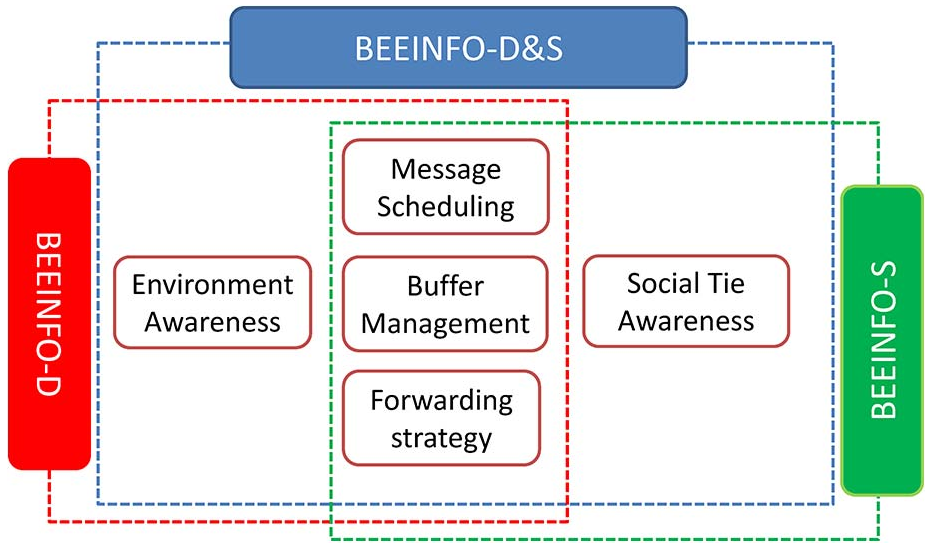 Figure 1: The architecture of BEEINFO, highlighting the interaction between environment awareness and forwarding strategy.
Mathematical Intuition
The model uses an exponential weighted moving average to predict future conditions: This formula allows the node to "remember" history while prioritizing recent encounters—essential for adapting to the dynamic traffic of VSNs.
Experimental Validation: Sashing the Status Quo
The authors tested BEEINFO against Epidemic and PRoPHET using THE ONE simulator, incorporating pedestrians, cars, and buses.
Key Results
- Delivery Success: BEEINFO-D achieved a 74.77% delivery ratio, a massive jump over PRoPHET's 56.4%.
- Efficiency: The overhead (ratio of redundant copies) was significantly lower, meaning BEEINFO uses the network's bandwidth far more efficiently.
- The Trade-off: The primary drawback is Latency. Because BEEINFO is highly selective about who it gives a message to, packets may sit in a buffer longer waiting for the "perfect" forwarder.
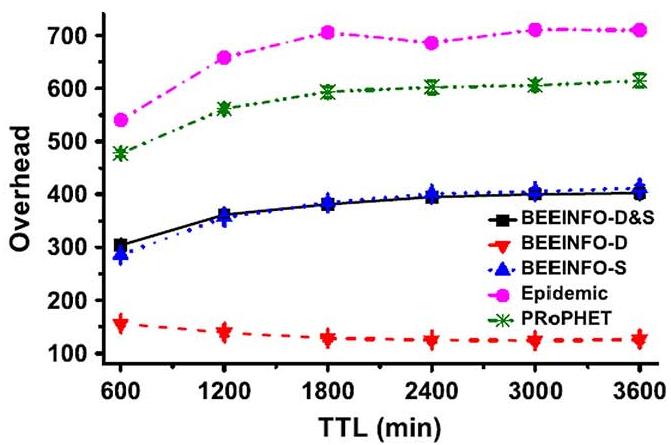 Figure 2: Performance comparison showing BEEINFO's superior delivery ratio and lower overhead as buffer size increases.
Critical Insight & Conclusion
BEEINFO proves that Swarm Intelligence isn't just for optimization problems—it's a powerful paradigm for networking. By transforming the "black box" of node mobility into a "map" of social interests, the authors have created a protocol that is both lightweight and highly effective.
Takeaway for the Future: The next step for SAN research lies in Privacy. As we share interests and social ties to route data, how do we prevent the "hives" from becoming a source of personal data leakage?
BEEINFO sets the stage for a more "human" way of routing data, where the network learns from us just as much as it serves us.