
Shocks to the System: Do Subreddit Bans Actually Change User Behavior?
Behavior Change in Response to Subreddit Bans and External Events
This study investigates the behavioral shifts of Reddit users following subreddit bans (regulatory shocks) and significant external events (external shocks) like elections or team relocations. Utilizing Bayesian Changepoint Analysis and Difference-in-Differences (DiD) tests, the authors find that while specific bans cause significant attrition, the vast majority of users (~90%) remain on the platform, often shifting their activity elsewhere.
TL;DR
When a social media community is banned or hit by a massive external event (like a political election), what happens to its members? This paper analyzes over 700 million Reddit posts to prove that while bans do push a small percentage of users off the platform (4-10%), the vast majority stay. However, their behavior changes fundamentally—often resulting in a significant drop in overall posting activity, suggesting that moderation works more by "chilling" behavior than by simple eviction.
The Moderation Dilemma: Exile or Reform?
In the cat-and-mouse game of online content moderation, "The Ban" is the ultimate weapon. Platforms like Reddit use it to prune toxic clusters, but critics argue it's a game of Whac-A-Mole: banned users might just create new "sleeper" communities or migrate to even less regulated fringes of the web.
The researchers behind this study sought to quantify this "displacement effect." They asked a critical question: Is a regulatory ban more disruptive than a massive real-world shock, like a Bitcoin crash or a beloved sports team moving to another city?
Methodology: The Quasi-Experiment
To answer these questions, the authors treated these events as "natural experiments." They identified two types of shocks:
- Regulatory Shocks: Bans of subreddits like
r/incels,r/fatpeoplehate, andr/greatawakening. - External Shocks: Events like the 2016 US Election, the Bitcoin crash of 2017, and the relocation of the NFL Rams.
To ensure the results weren't just noise, they created two sophisticated control groups using Mahalanobis Distance Matching, pairing "treated" users with similar Reddit users who weren't members of the banned communities.
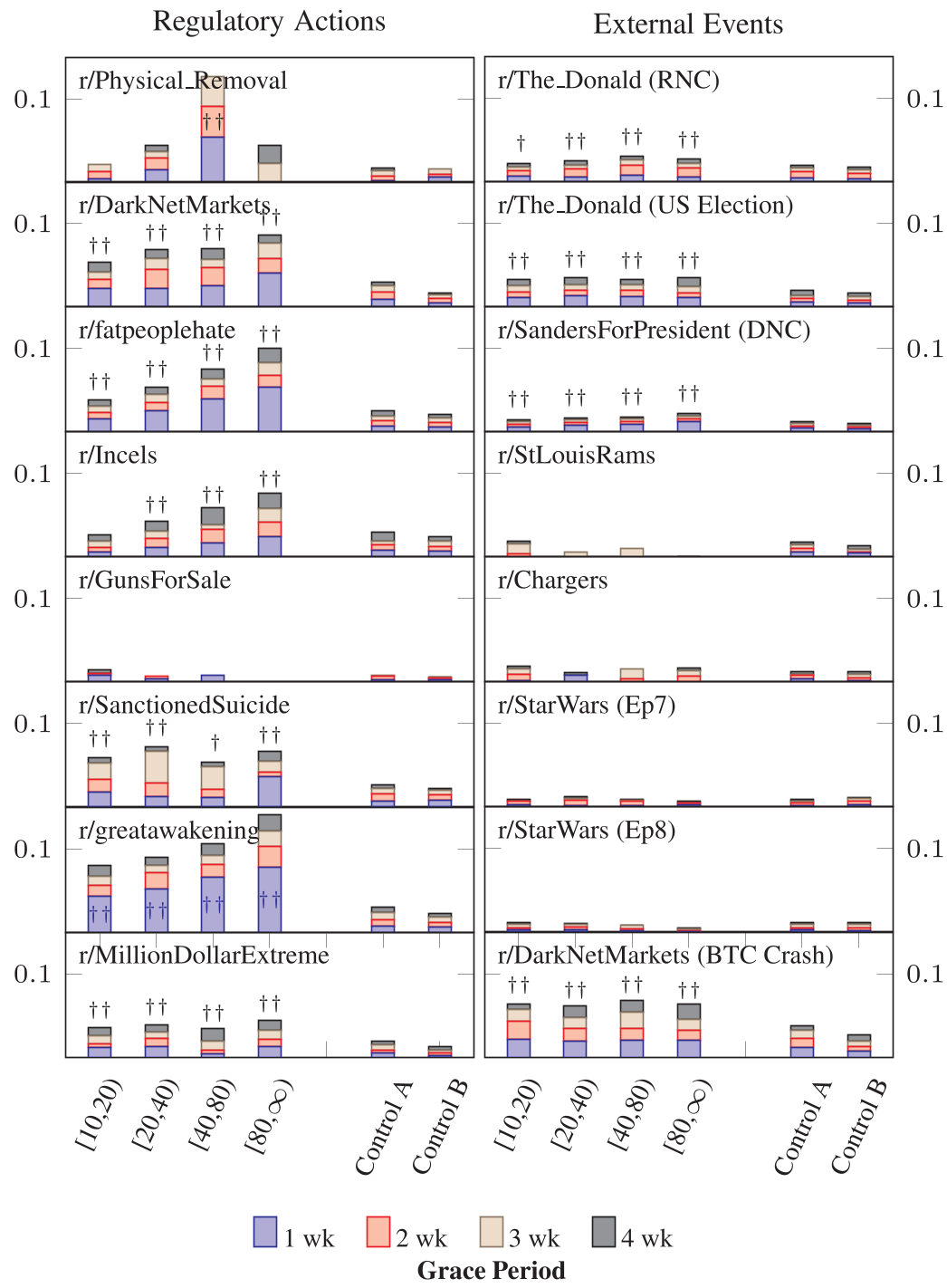 Figure 1: Statistically significant attrition is visible in banned communities (noted by †), yet it rarely exceeds 10% of the active user base.
Inside the Mind of a Banned User: Changepoint Analysis
One of the most innovative parts of this study is the use of Bayesian Changepoint Analysis. Instead of just looking at if a user posted, the algorithm looks at patterns. If a user suddenly stops posting in a sports sub and starts posting 50 times a day in a political sub, the model flags a "changepoint."
The findings were surprising:
- Changepoints are rare: Even in the wake of a ban, only about 2% of users undergo a massive shift in where or how much they post in any given week.
- The "Chilling Effect": Using a Difference-in-Differences (DiD) test, the authors found that for communities like
r/Physical_Removalorr/greatawakening, the activity levels of remaining users dropped significantly compared to the control group. The ban didn't just stop the toxic sub; it seemed to dampen the users' overall enthusiasm for the platform.
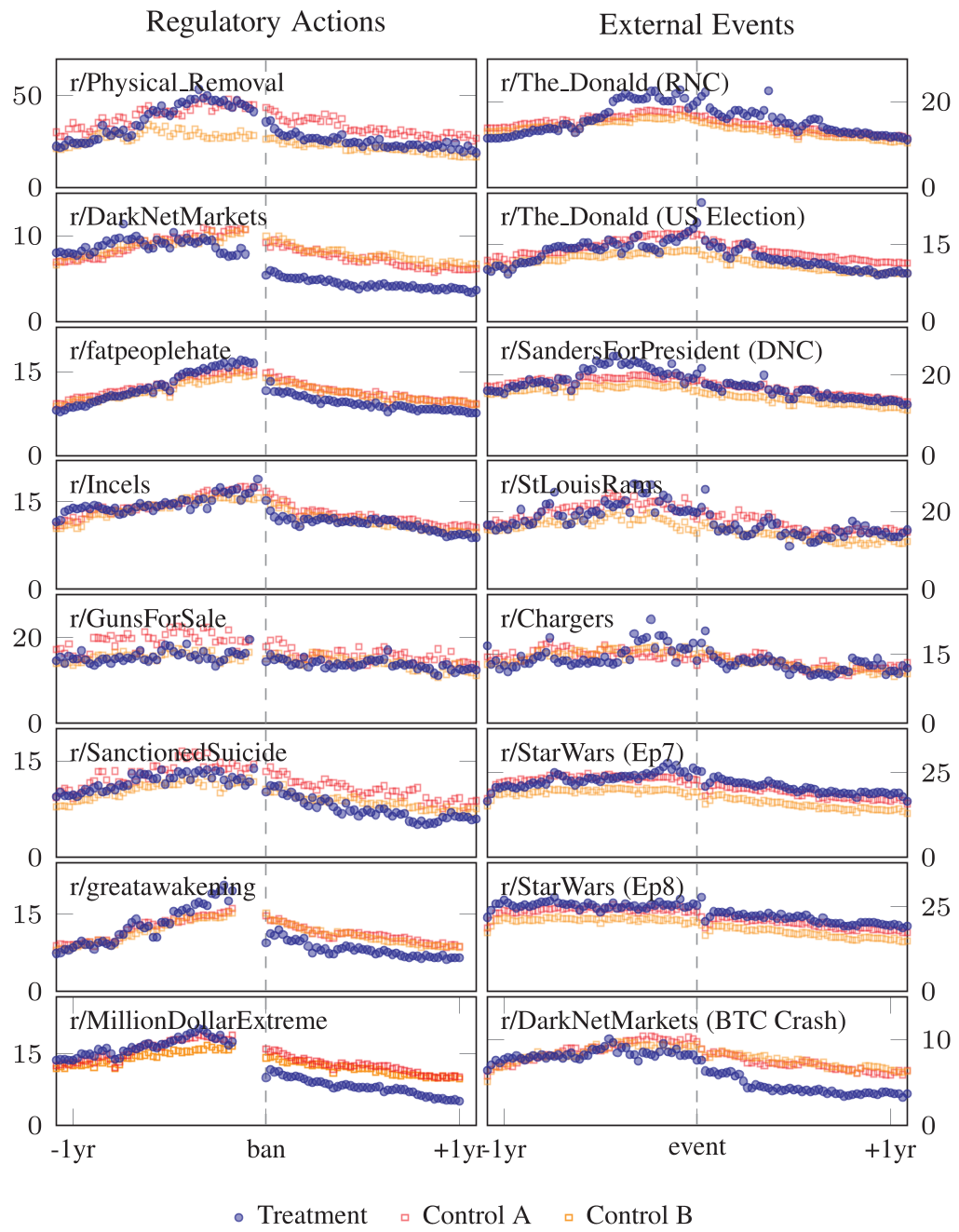 Table 2: DiD results showing a massive drop in activity for banned subreddits (bolded results) compared to relative stability for many external events.
Predicting the Exit: Can We Know Who Leaves?
The authors built a two-layer neural network to predict user attrition. By looking at which subreddits a user frequented in the six months before a shock, they could predict with fair accuracy (AUCs ranging from 0.62 to 0.81) whether that user would quit Reddit. Highly active users in "toxic" communities were naturally more likely to leave if their primary "home" was destroyed, but those with diverse interests tended to stay.
Deep Insights & Conclusion
The takeaway for platform designers and policy makers is clear: Banning works, but not the way you think.
- Moderation as Redirection: Bans are effective because they break the social infrastructure of a toxic group. While 90% of the users remain, they lose their specialized "echo chamber," and their subsequent activity often becomes less intense.
- Resilience of Identity: External shocks (like a team moving) can be just as disruptive to a community's identity as a ban, but they rarely cause people to leave the platform. This suggests users value the platform (Reddit) as a utility, even when their specific community fails them.
Limitations: The study doesn't analyze the content (text) of the posts. We don't know if the users who stayed became "nicer" or if they just learned to hide their toxicity better. Future research into the linguistic shifts post-ban is the next "Great Awakening" for social data science.