
Beyond Simple Links: How Event-Driven Dynamics and Behavior Evolution Shape Social Networks
Behavior Evolution and Event-Driven Growth Dynamics in Social Networks
This paper introduces EELAG (Evolution-aware Event-driven Locality and Attachedness based Growth), a novel framework for social network modeling that shifts from traditional node/edge addition to event-driven dynamics. By incorporating node-level seniority and network-level growth rates, it achieves state-of-the-art accuracy in simulating complex topological properties such as hierarchical clustering and assortative mixing.
TL;DR
Researchers have long struggled to simulate social networks that "look" real—meaning they possess high clustering and complex hierarchies. This paper introduces EELAG, a model that treats network growth as a series of events (like coauthoring a paper) rather than just adding edges. By factoring in how individuals change their collaboration habits as they gain seniority, EELAG successfully replicates the intricate structures of massive scientific collaboration networks.
Background: The Limits of Traditional Models
Since the inception of the Barabasi-Albert (BA) model, Preferential Attachment ("the rich get richer") has been the go-to explanation for power-law degree distributions. However, social networks are more than just degrees. They feature Cliques (tight-knit groups) and Hierarchical structures that simple edge-addition models cannot replicate. Simply put: in the real world, we don't just "meet a person"; we "attend an event" where many connections are formed simultaneously.
The Core Insight: Events and Evolution
The authors identify two key missing ingredients in existing research:
- Event-Driven Growth: In networks like NanoSCI (Nanotechnology collaboration), connections are formed because multiple authors participate in one event—a paper. This naturally forms a clique (a fully connected subgraph), which explains the high clustering coefficients seen in real data.
- Behavior Evolution: A PhD student (junior node) behaves differently than a Professor (senior node). The paper observes that senior nodes are more likely to collaborate locally, while junior nodes are more likely to "jump" to distant topics or new communities.
The EELAG Architecture
The model follows a sophisticated three-step logic for every new event:
- Activity Level: It determines how many participants are involved using a Poisson distribution that evolves with the network's age.
- Seniority Thresholds: Each node is assigned a "lifetime" (maximum degree) based on real-world distributions. When a node hits its limit, it becomes inactive—mimicking researchers leaving a field.
- Hybrid Selection: To choose who participates in an event, the model combines Attachedness (Degree) and Locality (Distance).
 Above: The span distance distribution showing how nodes with different seniority (degrees) choose their collaborators at varying topological distances.
Mathematical Rigor vs. Real-World Data
The authors didn't just build a simulator; they validated it against the NanoSCI database (1980–2005).
Key Experimental Validation:
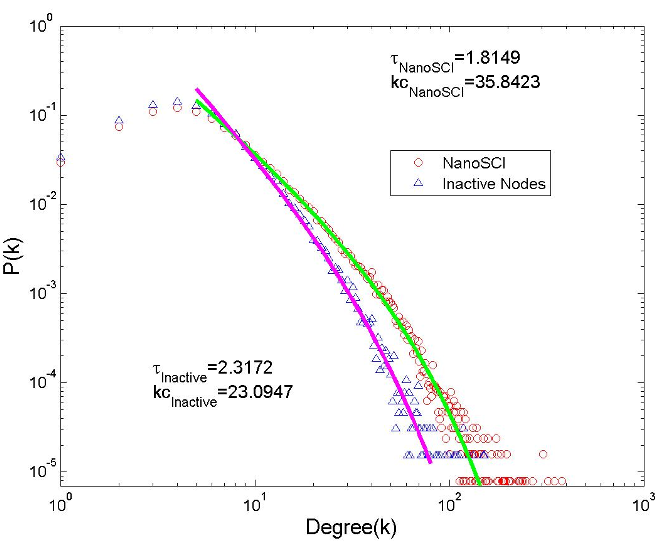
- Degree Distribution: EELAG correctly predicts the "bend" at the start of the power-law curve. This is because event-driven models add multiple edges at once, reducing the number of nodes that remain at a very low degree (degree 1 or 2).
- Clustering Coefficients (): Real social networks show that high-degree nodes have lower local clustering. EELAG matches this trend precisely, whereas basic Preferential Attachment models (AP A) fail to show this hierarchical decay.
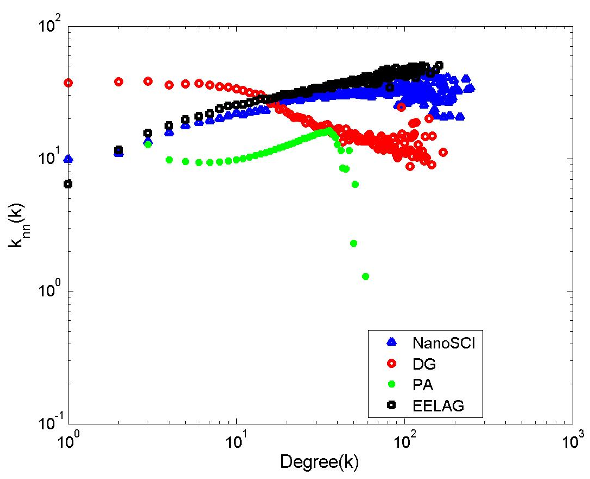 Figure: Comparing EELAG with baseline models. Only EELAG (red curve) closely tracks the real-world data (black stars) across degree distribution and clustering metrics.
Deep Insight: Why It Matters
The shift from edge-based to event-based modeling is a paradigm change. It acknowledges that social structure is a byproduct of human activity patterns. By incorporating "Behavior Evolution," the paper provides a template for simulating any network where agents gain experience over time—from GitHub contributions to corporate email networks.
Conclusion & Future Directions
EELAG proves that to understand the topology of a network, you must understand the biography of its nodes. While the model is highly effective, the authors suggest future work could incorporate richer event information—such as the "causal relationship" between events—to predict not just how a network grows, but where the next breakthrough collaboration will happen.
Takeaway for Engineers: If you are building recommendation systems or community detection algorithms, treating interactions as grouped events rather than isolated links will significantly improve your model's structural accuracy.