
The Social Life of Radios: Modeling Behavior Propagation in Cognitive Networks
12275_Behavior Propagation in Cognitive Radio Networks A Social Network Approach.
This paper proposes a social-network-inspired channel recommendation mechanism for Cognitive Radio Networks (CRNs). By modeling secondary users as intelligent agents in a society, it utilizes interacting particle systems and mean-field ODEs to characterize the propagation of channel preferences across grid and random topologies.
TL;DR
This research redefines Cognitive Radio Networks (CRNs) not just as a collection of sensors, but as a social society. By treating channel recommendations as a form of "behavioral propagation," the authors use advanced statistical physics (Interacting Particle Systems) and Mean-Field theory to determine if and how "good" (available) channels become a network-wide consensus or if the system descends into unpredictable chaos.
Problem & Motivation: Beyond Simple Sensing
Traditional CRN research focuses heavily on the "What" (spectrum sensing accuracy) and "How" (access protocols). However, as secondary users become more intelligent (utilizing FPGAs and sophisticated algorithms), they begin to "talk" and "think" collectively.
The authors identify a critical gap: Collaboration induces dynamics. When a user recommends a channel, it changes the neighbor's preference. This creates a ripple effect. If we don't understand this propagation:
- Congestion occurs when too many users "socially" migrate to the same channel.
- Unpredictability arises if the network has multiple equilibria (non-ergodicity).
- Vulnerability increases as malicious users can spread "fake" recommendations like a virus.
Methodology: Radios as Interacting Particles
The core innovation lies in mapping CRN dynamics to Spin Systems from statistical mechanics.
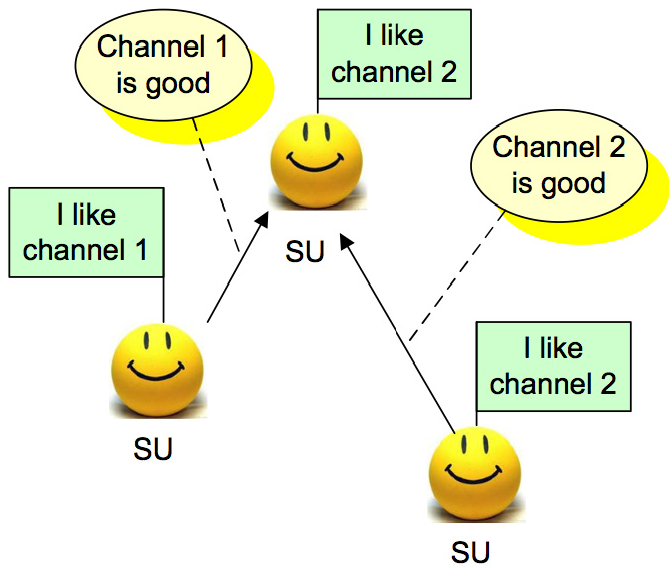
1. The Modified Contact Model
Each user is a node in a graph (Grid or Random). A state means the user prefers a specific channel; means they don't. The "flip rate" (the speed at which a user changes their mind) is governed by:
- Spontaneous Identification (): Finding a channel on your own.
- Recommendation Influence (): Adopting a channel because neighbors suggested it.
- Revocation Rate (): Abandoning a channel due to Primary User (PU) activity.
2. Mean-Field Dynamics
To track the proportion of users who prefer a channel over time, the authors derive ODEs. In random deployments, they account for the Degree Distribution, acknowledging that "influencers" (nodes with many neighbors) have a higher impact on propagation than isolated nodes.
Experiments & Results: Stability and Convergence
The authors validated their mathematical proofs through extensive Matlab simulations of 500-10,000 nodes.
Key Findings:
- Ergodicity: In grid networks, if there is a non-zero chance of finding a channel independently (), the network will always stabilize to a predictable state regardless of the starting conditions.
- Phase Transitions: In cases with zero recovery probability (), there exists a "critical value" for recommendation strength . If is too low, the "knowledge" of a good channel dies out; if is high enough, it persists.
- Degree Correlation: In random geometric graphs, the preference grows with the degree , but eventually hits a theoretical upper bound ().
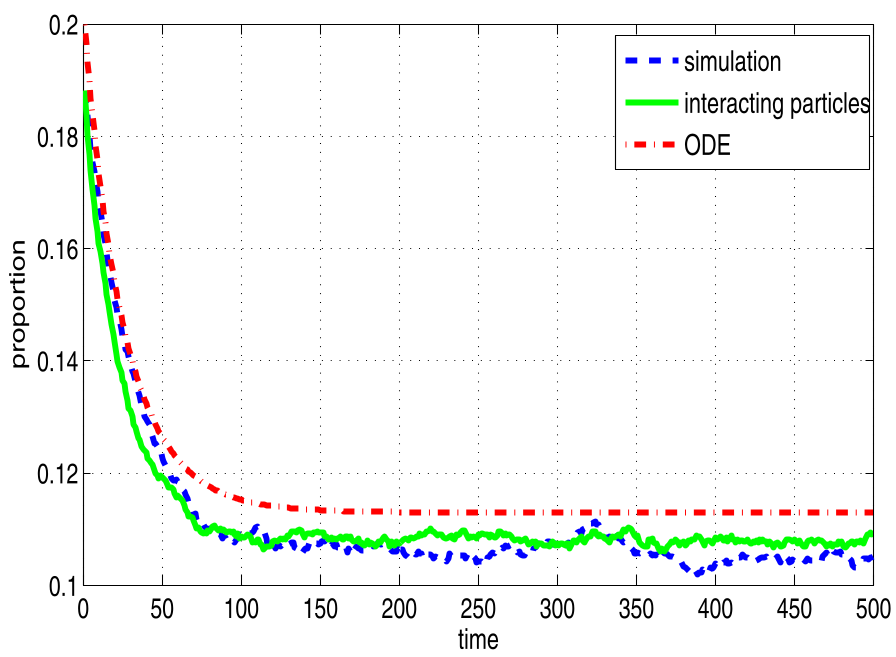 Fig 5: This result demonstrates that while ODEs (Mean-Field) provide a good approximation, the Interacting Particle model captures the stochastic nuances of the network more accurately.
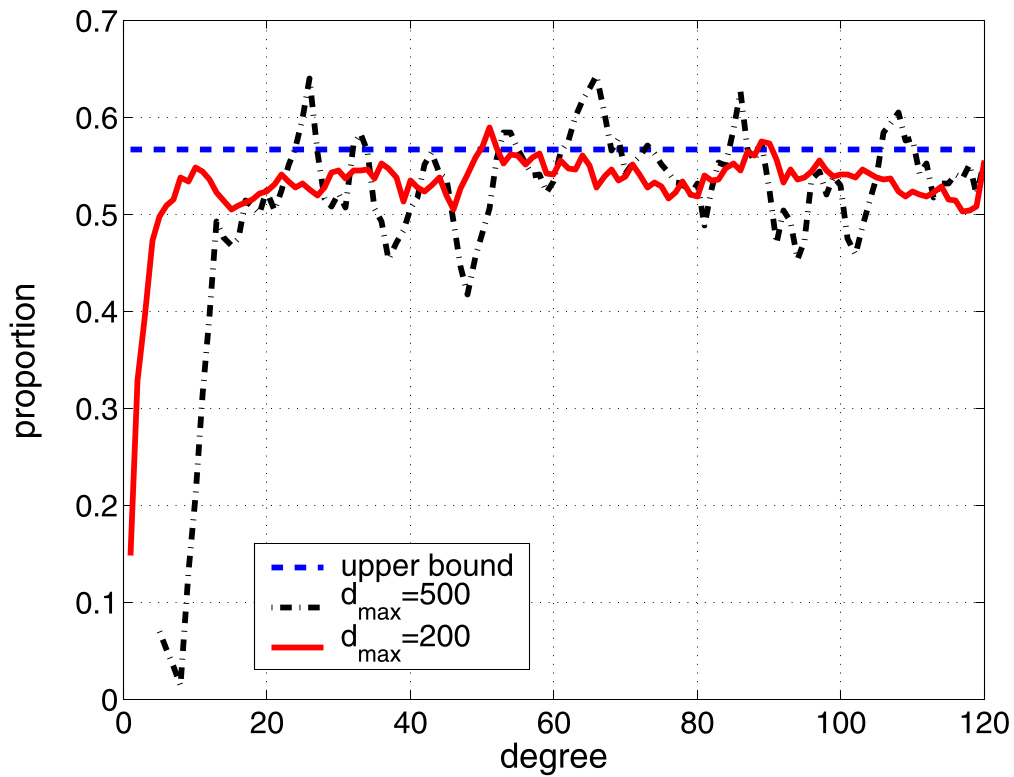 Fig 7: Numerical evidence showing that even with random locations, the collective preference for a channel eventually stabilizes.
Critical Analysis & Conclusion
Takeaway
This paper is a pioneer in merging Social Network Analysis with Physical Layer Communication. It proves that the "intelligence" of a node is a double-edged sword: it enables efficient discovery of resources through "gossip" (recommendations) but requires carefully tuned parameters to prevent systemic collapse or misinformation spread.
Limitations
- Traffic Sparsity: The model assumes sparse traffic to simplify interaction, which may not hold in ultra-dense 6G scenarios.
- Conflict of Interest: It assumes users are altruistic. In reality, a user might stay quiet about a "good" channel to keep the bandwidth for themselves.
Future Outlook
The framework established here (Poisson degree distributions and Lyapunov-based convergence) provides the mathematical "scaffolding" for future research into adversarial behavior in cognitive networks—essentially building an "immune system" for the social network of radios.