
Beyond Borders: How Digital Environments Rescue the Belonging of Immigrant Youths
Feelings of belonging or alienation and social emotional perceptions of immigrant youths in the digital age, in comparison with native-born youths
2020-09-24
Summary
Problem
Method
Results
Takeaways
Abstract
This study evaluates the social-emotional perceptions and feelings of belonging among immigrant versus native-born youths in Israel. Utilizing mixed-methods and Latent Class Analysis (LCA), it highlights how mobile technologies and digital environments serve as critical tools for linguistic and social integration during the absorption process.
## Executive Summary
**TL;DR**: While immigration traditionally fractures a young person's sense of self and social standing, the digital age offers a powerful set of tools to mend these gaps. This study reveals that nearly 36% of immigrant youths navigate their new environments with high resilience by using smartphones as "survival kits" for translation, academic support, and social connection.
**Background**: Positioned at the intersection of psychology and educational technology, this research moves beyond the "deficit model" of immigration. It establishes that in the digital age, the "absorption process" is no longer a isolated geographical event but a hybrid experience mediated by social networks and mobile applications.
## The Pain of Alienation and the "Identity Shift"
For an adolescent, immigration is rarely a personal choice; it is a parental decision that disrupts their socialization process. The study highlights that native-born youths naturally score higher in self-image (3.7 vs 3.4) and vitality (3.4 vs 3.0). Why? Because immigrants face a "dual language, dual culture" burden.
The author identifies that the lack of language proficiency isn't just about vocabulary—it’s about missing the **pragmatic aspects** of communication: irony, humor, and rhetorical nuances. This leads to a profound sense of alienation, where the "looking-glass self" (how we see ourselves through others' eyes) becomes distorted or negative.
## Methodology: Decoding the Immigrant Experience
The researcher utilized **Latent Class Analysis (LCA)** on a sample of 559 Israeli adolescents to move beyond simple averages and uncover the "profiles" of these students.

Two distinct groups emerged:
1. **Cluster 1 (Progressive Integration)**: Youths who felt a sense of pride in their new country, utilized local media, and felt supported by school staff.
2. **Cluster 2 (The Alienated)**: Youths who struggled with self-realization and often expressed a desire to return to their country of origin.
## The Digital "Cultural Bridge"
One of the most striking findings is the **universal reliance** on technology. 100% of the immigrant participants used mobile tech for:
* **Real-time Translation**: Audio-visual apps to overcome the "language wall."
* **Cognitive Offloading**: Scanning teacher's boards and recording lessons to process difficult content later.
* **Transnational Socializing**: Using WhatsApp and Skype to maintain "meaningful interactions" with those in their home country while gradually building local class groups.
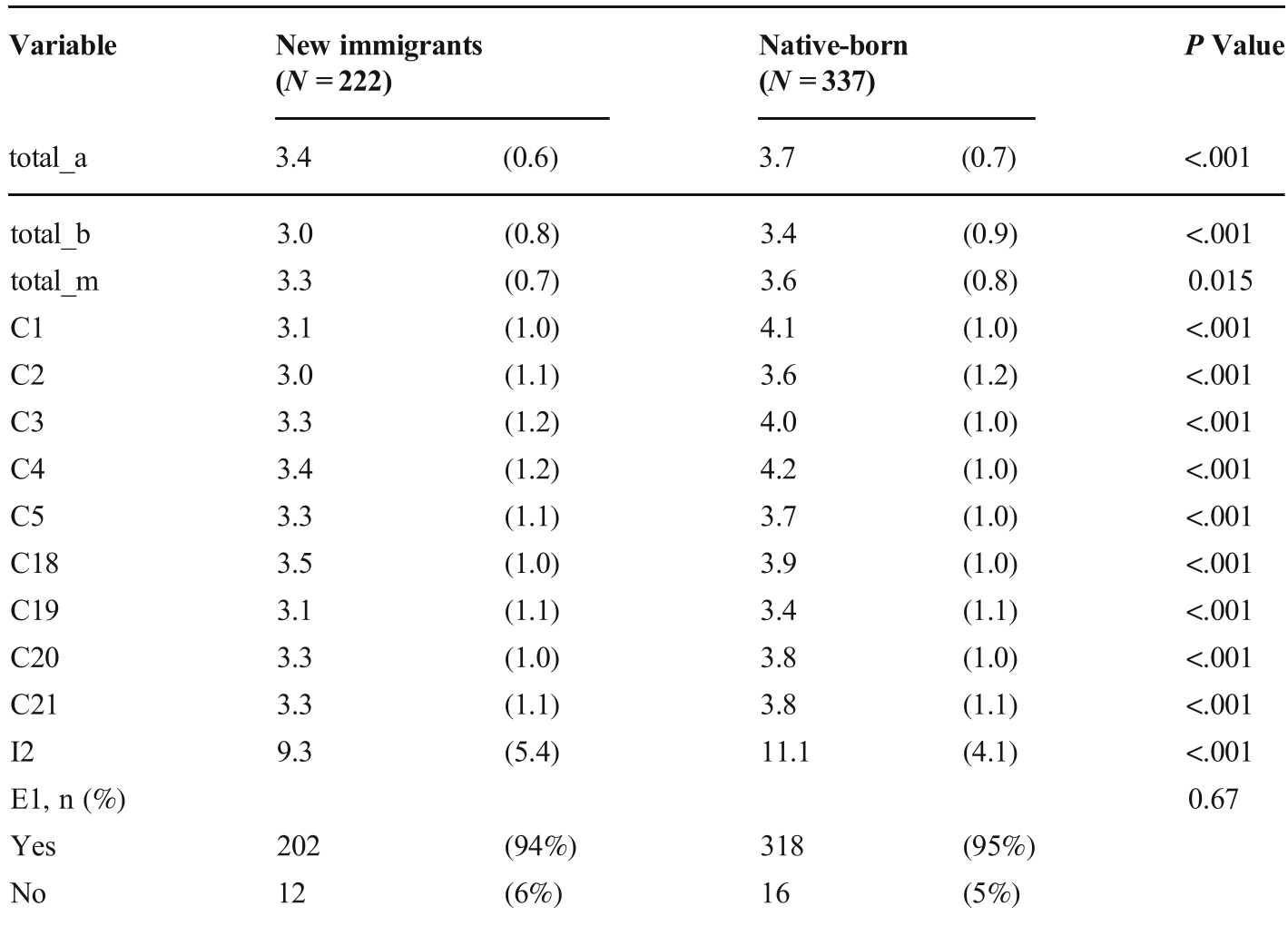
As shown in the data, while native-born students (Total_m) felt more socially integrated initially, immigrant students who embraced digital environments were able to bridge this gap, using databases and social networks to stimulate curiosity and academic engagement.
## Critical Insights & Conclusion
**Takeaway**: The study proves that "time in the country" is not the primary factor for successful absorption. Instead, the quality of digital access and the support of "significant adults" in school environments are the true drivers of resilience.
**Limitations**: The research notes a potential gap in identifying "risk situations" like truancy or delinquency that may occur despite digital connectivity. Future research should look specifically at how "digital inequality" (lack of high-end devices) might create a new class of marginalized immigrants.
**Future Outlook**: Educators must stop viewing the smartphone as a classroom distraction and start seeing it as a vital prosthetic for the immigrant soul—a tool that provides the "equal opportunity" necessary for a sense of belonging in a globalized world.