
Decoding Localized Hate: A Deep Dive into the Bengali Facebook Corpus
Towards the development of the Bengali language corpus from public Facebook pages for hate speech research
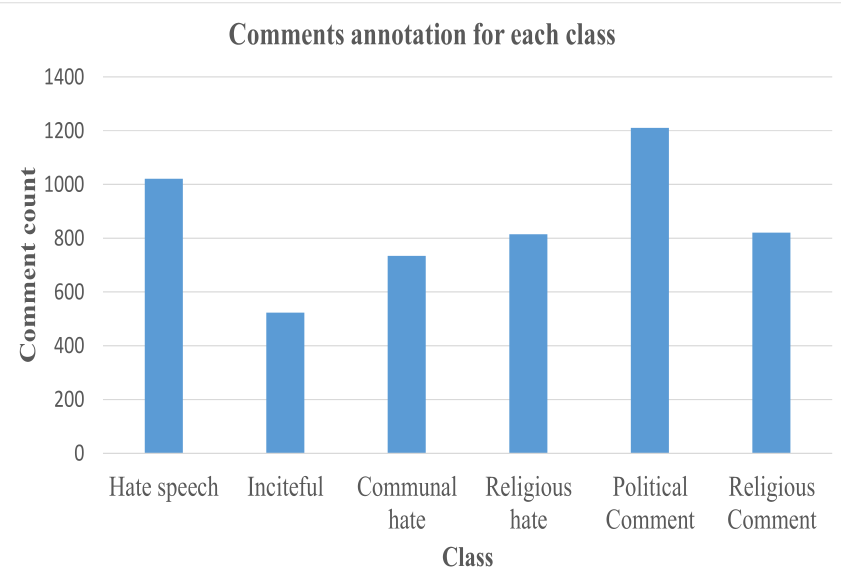
The paper presents the development and annotation of the first publicly available Bengali hate speech corpus, comprising 4,753 comments harvested from public Facebook pages. The researchers categorized the data into six classes (Hate Speech, Inciteful, Religious Hatred, Communal Attack, Religious, and Political) to capture the unique socio-cultural nuances of the Bangladeshi context.
TL;DR
Social media toxicity is often a reflection of local societal fractures. This paper pioneers the creation of a Bengali Hate Speech Corpus containing 4,753 comments from Facebook. By defining categories specifically tailored to the Bangladeshi socio-political landscape—such as communal attacks related to the 1971 Liberation War—the researchers provide a foundational dataset for training AI to understand regional online abuse.
Problem & Motivation
Most hate speech detection research focuses on Western contexts, where slurs like the "N-word" are primary features. However, in Bangladesh, toxicity is often tied to religious identity and historical alliances. For instance, certain slurs are only meaningful within the context of the 1971 war.
The authors argue that global models are blind to these nuances. With Dhaka being a global hub for Facebook activity, the lack of a specialized Bengali corpus meant that communal incitement (like the "Ramu Incident") could spread largely unchecked by automated systems.
Methodology: Capturing Subjective Malice
The researchers selected "honeypot" Facebook pages from diverse sectors: celebrities (Sakib Al Hasan), extremist political groups (Basherkella), and the ruling party (Awami League).
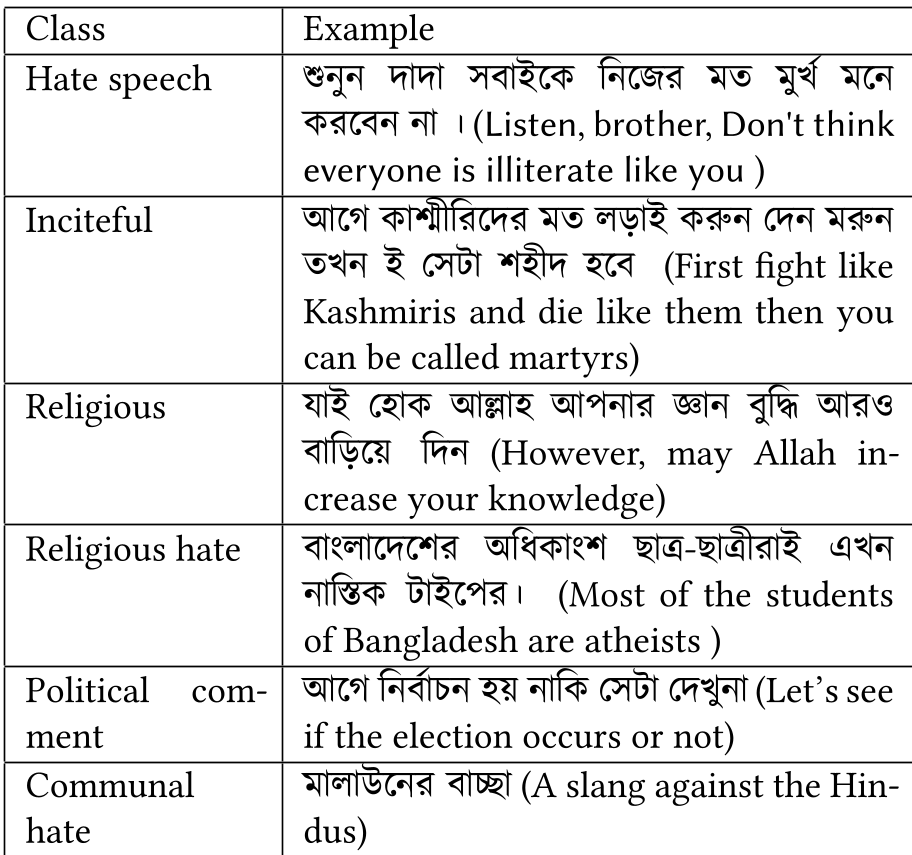
1. The Six-Class Taxonomy
The study moves beyond binary "hate vs. non-hate" by introducing:
- Hate Speech: Personal attacks on sex, ethnicity, or disability.
- Inciteful: Content that advocates mass violence.
- Religious Hatred: Offensive words targeting religious minorities.
- Communal Attack: Verbal attacks based on race or community.
- Political/Religious: Neutral comments used as baseline controls.
2. Weighted Annotation
Recognizing that hate is in the eye of the beholder, the team used three annotators. Crucially, they included a member of a religious minority to ensure that subtle communal attacks—which might be missed by a majority group member—were accurately captured. Each comment was given a weight (summing to 1) across the six classes, and the majority weighted factor determined the final label.
Linguistic Features & Experimental Results
The paper highlights fascinating regional linguistic features. For example, terms like "Rajakar" (collaborator) or "Pakiponthi" (Pakistan supporter) are potent political and communal slurs in Bangladesh.
Agreement Rates
The study used Cohen’s Kappa to measure inter-rater reliability. The results showed that while "Religious" (non-hateful) comments are easy to agree on, "Communal Hatred" is highly subjective.
| Class | Agreement Rate (Kappa) |
|---|---|
| Religious | 0.98 |
| Political | 0.91 |
| Hate Speech | 0.83 |
| Communal Hatred | 0.65 |
Critical Insight & Conclusion
This work serves as a reminder that NLP is not just a mathematical challenge, but a sociological one. The relatively low agreement rate in "Communal Hatred" (0.65) suggests that as we move toward more nuanced detection, AI cannot rely on single-label truth.
Limitations & Future Work
The dataset size (4,753 comments) is a solid start but small for modern deep learning. Furthermore, as Facebook's Graph API access becomes more restricted, manual collection becomes a bottleneck. The authors envision this corpus as a "seed" that can be expanded to build robust, automated moderation tools specifically for the Bengali-speaking world.
Takeaway: To solve global hate, we must first master local context. This corpus is the first step toward a safer digital ecosystem for millions of Bengali users.