
Who is Your Best Friend? Unveiling Personalized Trust in Social Networks
Who is Your Best Friend?: Ranking Social Network Friends According to Trust Relationship
The paper proposes a personalized ranking model to measure trust strength between friends in Online Social Networks (OSNs), specifically Facebook. Using a unique dataset of interactions and user-labeled trust scores, the authors employ an SVM-ranking approach to order friends by intimacy rather than just quantifying a fixed trust value.
TL;DR
Researchers have developed a personalized ranking model that moves beyond the simple "friend/stranger" binary of Facebook. By analyzing 12 types of interactions and normalizing them against user activity levels, the model can accurately rank your friends by trust strength, showing that photo-related interactions are much stronger signals of intimacy than simply having mutual friends.
Background: The Problem with Binary Friendship
In the physical world, we distinguish between a "best friend," an "acquaintance," and a "frenemy." However, platforms like Facebook historically treat all connections as equal. Previous attempts to quantify this "tie strength" often relied on flawed metrics, such as the number of mutual friends.
The authors point out three critical challenges:
- Quantification Difficulty: Users find it hard to give a "trust score" (e.g., 85/100) but find it easy to "rank" friends.
- Personalized Standards: A "close friend" to a shy person might interact less than a "casual acquaintance" to an extrovert.
- Activity Bias: High interaction counts might just mean your friend is a "social butterfly" (Active user) rather than someone you actually trust deeply.
Methodology: Ranking via Interaction Normalization
1. Eliminating the "Activity Level" Noise
The core insight is that interaction frequency is a function of both Trust and Activity Level. To solve this, the authors categorize users into four types based on their incoming/outgoing data:
- Active: High content, high interaction.
- Actor: High content, low interaction (broadcasters).
- Audience: Low content, high interaction (consumers).
- Inactive: The "Lurkers."
By normalizing the feature vector (interactions from user to friend ) against the average activity level of friend , the model ensures that silent friends aren't unfairly ranked lower just because they post less often.
2. The Ranking Model (SVM-Rank)
Instead of predicting a raw score, the model optimizes a ranking-oriented loss function. The goal is to learn a weight vector that minimizes "incorrect rankings" (e.g., the model predicting an acquaintance is more trusted than a best friend).
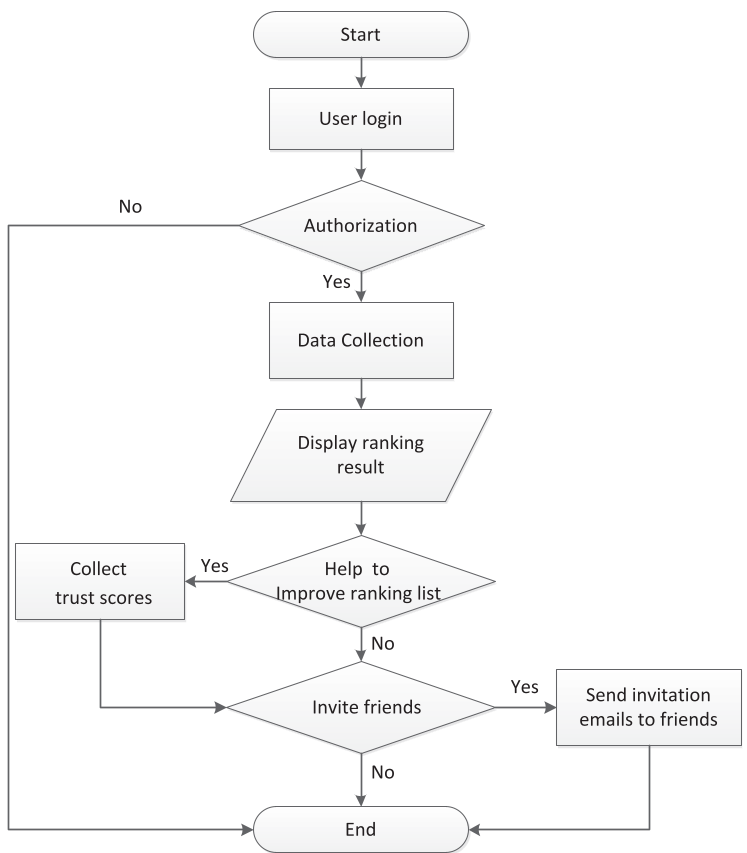 Figure: The data collection and modeling pipeline.
Experimental Insights: What Actually Signals Trust?
The study utilized a unique dataset of 59 Facebook users who provided both their full interaction history and manual trust rankings of their friends.
Key Findings:
- Mutual Friends don't matter: The correlation between mutual friends and trust was near zero (-0.0069).
- Photos are King: Features like "Photo Comments," "Tag Photos," and "Co-tagging" appeared most frequently in the top-ranked weights for the 24 personalized models.
- The Power of Personalization: The Personalized Ranking (0.695) significantly beat the General Global Ranking (0.616), proving that trust is indeed in the eye of the beholder.
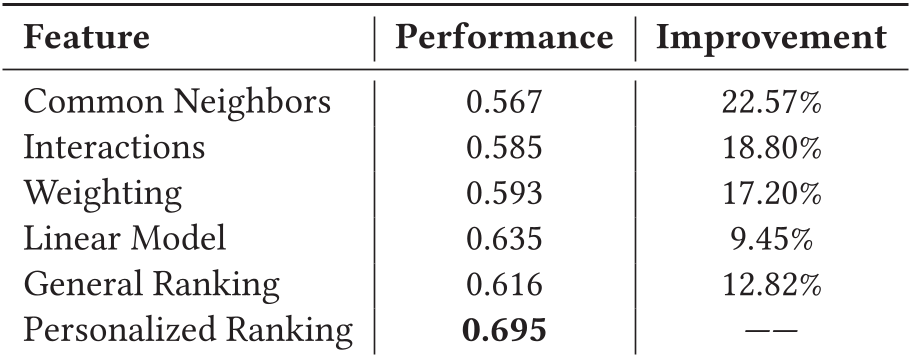 Table: Performance of Personalized Ranking vs. Baselines.
Generalization: Predicting for New Users
How do we apply this if we haven't seen a user's rankings before? The researchers proposed a "Character Similarity" method:
- Calculate a new user's "Activity Character" (their distribution across the 12 interaction types).
- Find a "Twin" from the existing 24 models using Cosine Similarity.
- Borrow that twin's weight vector .
As shown below, higher character similarity lead to significantly higher generalization performance, validating that people who use social media in similar ways often define trust in similar ways.
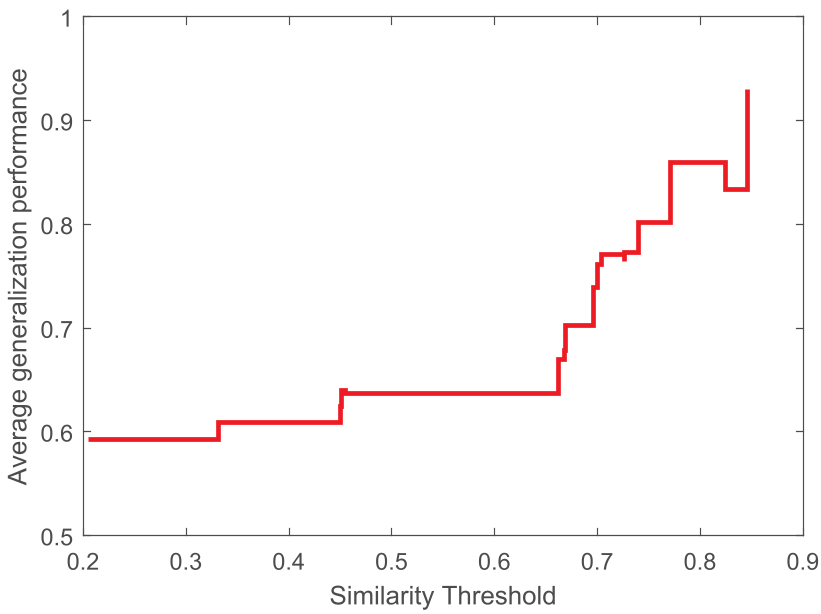 Figure: Correlation between user similarity and prediction accuracy.
Critical Analysis & Conclusion
This work provides a robust framework for moving beyond binary social graphs. By focusing on Ranking and Normalization, it elegantly solves the bias caused by "Lurkers" and "Social Butterflies."
Limitations: The sample size (59 users) is small, though the authors argue it represents a complete connected sub-network. Furthermore, the 2018-era focus on Facebook Photos might need updating for today's "Short Video" or "Ephemeral Story" (Snapchat/Instagram) era.
Future Outlook: These personalized trust models could revolutionize recommendation engines—instead of showing you what "people like you" bought, platforms could prioritize content from your "top 5 ranked" trusted friends, leading to much higher engagement and semantic web utility.