
AML: Accelerating Meta-Learning for Best Investment Strategy Selection
Best investment strategy selection using asymptotic meta learning
The paper introduces Asymptotic Meta Learning (AML), a novel framework for selecting the best quantitative investment strategies by merging Meta-learning with Ordinal Optimization. It specifically aims to maximize the Probability of Correct Selection (P{CS}) under strict computational budget constraints.
TL;DR
In the fast-paced world of quantitative finance, selecting the best trading strategy usually requires months of backtesting—time fund managers don't have. This paper proposes Asymptotic Meta Learning (AML), a framework that uses Ordinal Optimization to intelligently allocate a limited computing budget. By focusing computational resources on the "closest contenders" rather than trial-and-error, AML identifies the top strategy 200% to 400% faster than standard methods.
Background: The "Time-to-Market" Crisis in Quant Finance
A typical fund manager might have 100 candidate trading strategies. To validate one strategy via bootstrapping (e.g., 1,000 runs, 10,000 parameter combinations, 100 seconds per simulation), a serial execution would take over 3 months. In a market where regimes change in weeks, such delayed intelligence is worthless.
The authors frame this as a Meta-learning problem: the system must learn which "base learners" (trading strategies) perform best on specific "episodes" (market data). The bottleneck isn't the learning itself, but the allocation of the simulation budget.
Methodology: The Logic of Relative Importance
The core of AML is moving away from Equal Allocation. Why spend the same amount of time testing a strategy that is clearly failing as you spend on a top contender?
1. The Probability of Correct Selection (P{CS})
AML transforms the selection process into a constrained optimization problem: Subject to: (Total Budget).
2. The AML Theorem
The researchers derived a solution where the number of simulations for a strategy is determined by its competitive distance from the best strategy .
- Proximity Matters: If a strategy's mean performance is very close to the best ( is small), it gets more budget to resolve the ambiguity.
- Uncertainty Matters: Higher variance () leads to more allocated simulations to "smooth out" the noise.
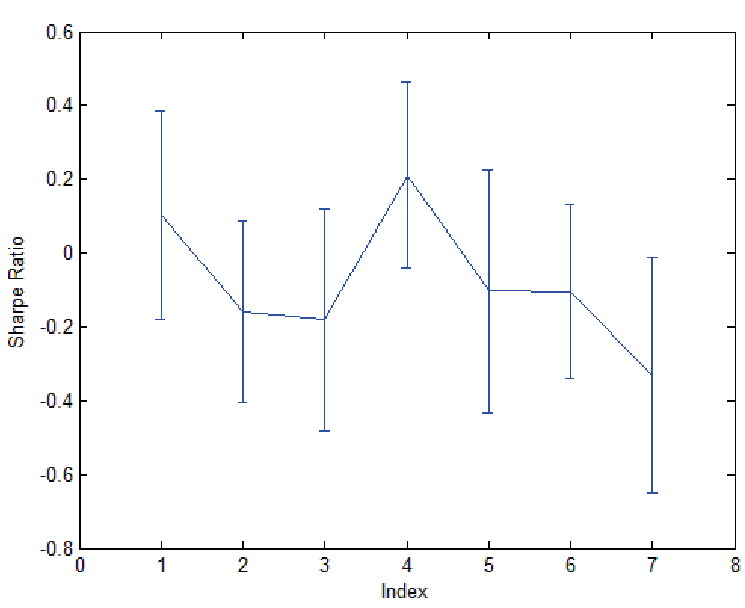 Figure: The variance and mean of different indicators. AML focuses only on overlapping regions to distinguish the true winner.
Experimental Results: Speeding Up Certainty
The authors tested AML against three baselines: Equal Allocation, Greedy Allocation, and the CCY Procedure.
Scenario: Finding the Best Indicator
Using the Sharpe Ratio as the fitness metric, AML and CCY (both based on ordinal principles) reached a 99% P{CS} significantly faster than the others. While Equal and Greedy struggled to distinguish between strategies with similar performance profiles, AML's selective attention allowed it to "pivot" its budget to the most promising candidates.
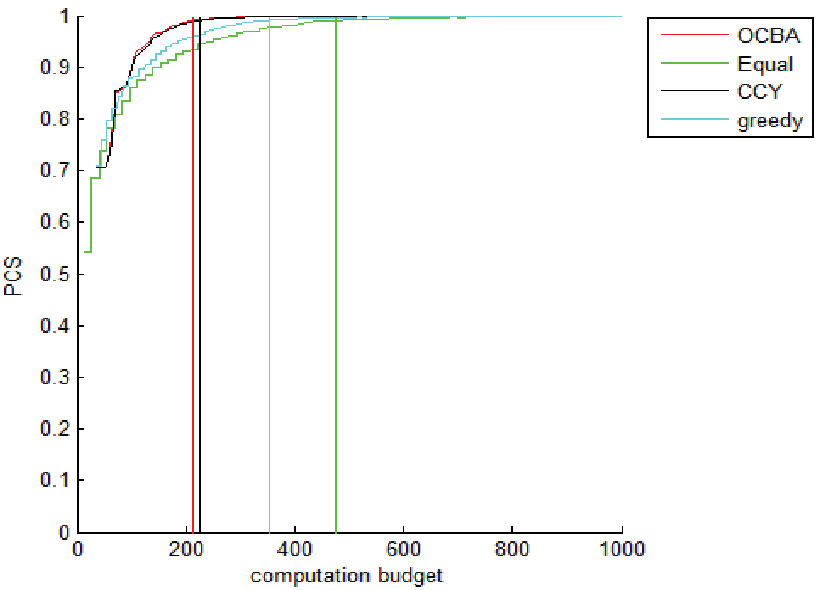 Figure: Note how AML (solid line) hits the 99% threshold (vertical line) far earlier than Equal or Greedy schemes.
Key Insights from Experiments:
- Metric Invariance: Whether using Sharpe Ratio or Maximum System Drawdown (MSDD), the efficiency gains of AML remained consistent.
- Sensitivity to Window Length: When testing which "look-back period" (e.g., 20 days vs 32 days) was optimal for a strategy, AML demonstrated its strongest lead, as many indicators perform similarly, requiring the precise "budget steering" that AML provides.
Critical Analysis & Conclusion
AML represents a shift from "How do we compute everything faster?" to "How do we compute only what matters?"
Strengths:
- Plug-and-Play: The sequential algorithm can be added to existing backtesting engines with minimal overhead.
- Proven Efficiency: The 2x-4x speedup is substantial enough to make real-time strategy rotation feasible.
Limitations & Future Work:
The current model assumes that the set of strategies is fixed. However, in modern contexts, we often use Genetic Algorithms to discover new strategies on the fly. Future research will need to look at Dynamic AML, where the candidate set expands as the simulation progresses.
Final Takeaway: In the race for Alpha, computational efficiency isn't just about hardware—it's about the statistical intelligence with which you spend every CPU cycle. AML provides that intelligence.