
β-PSML: Building a Social Network for Problem-Solving AI Agents
The Application of β-PSML in the Social Network Problem
The paper introduces β-PSML (Problem Solver Markup Language), a unified framework for distributed problem solving on the "Wisdom Web." It enables heterogeneous inference engines—specifically ontology and Horn Clause-based systems—to collaborate across social network-styled node structures to solve complex, multi-domain problems.
TL;DR
This paper introduces β-PSML (Problem Solver Markup Language), a framework designed to turn the Web into a "Wisdom Web." By using a specialized markup language, it enables different AI agents (nodes) to collaborate, decompose complex problems, and "learn" about each other's expertise within a social network structure.
Background & Motivation: Moving Beyond Simple Search
The current Web is great at finding information, but it struggles to solve integrated problems. For instance, planning a complete vacation involves hotel booking, route optimization, and shopping—each requiring different types of logic (e.g., Ontology-based reasoning vs. Rule-based Horn clauses).
The pain point identified by Su et al. is twofold:
- Incompatibility: Single inference engines can't solve multi-domain problems.
- Discovery: There is no standard way for one solver to know "who is better than me" at a specific sub-task in a distributed environment.
The Core Concept: β-PSML Knowledge Representation
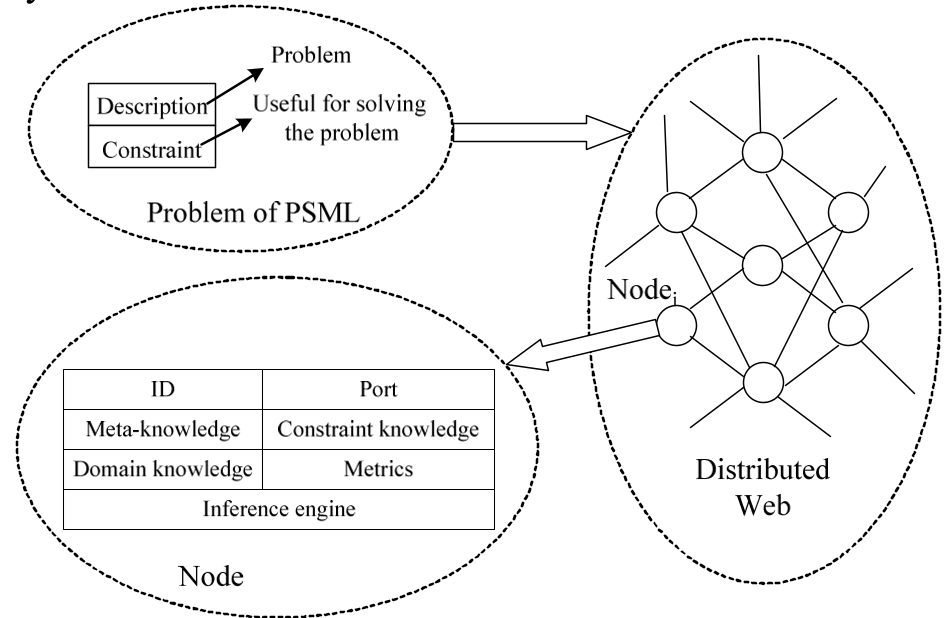
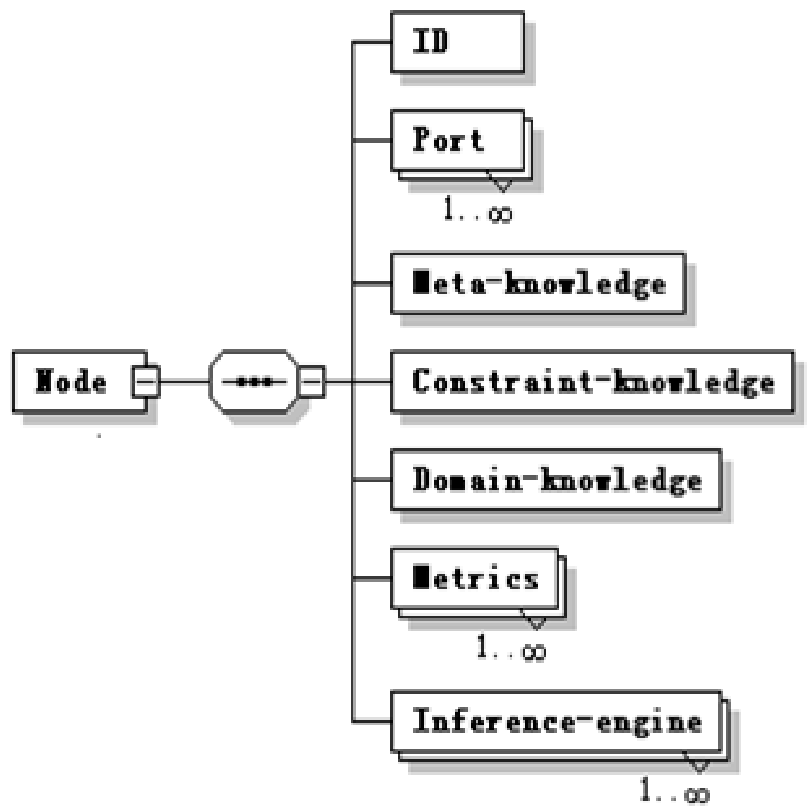
The authors propose that every solver service should be coded in β-PSML, which defines several critical components for a node:
- Meta-knowledge: Helps in classifying and dividing queries.
- Constraint-knowledge: Maps how the node connects to neighbors (social links).
- Metrics: Evaluates performance, relevance, and cost.
- Inference Engine: The actual "brain" (e.g., an Ontology engine or a Neural Network).
System Architecture
The framework treats the distributed environment as a graph of nodes and directed lines. A directed line from X to Y implies that "X knows Y is more efficient at solving or decomposing specific problems."
Methodology: Socially Distributed Reasoning
The reasoning process follows a "Decompose-Delegate-Integrate" cycle:
- Selection: A node receives a problem and checks its own
Metrics. If it cannot solve the problem efficiently, it looks at its social network. - Decomposition: Using
Meta-knowledge, the problem is broken into sub-problems (P1, P2, ...). - Delegation: The node assigns sub-tasks to neighbors based on their known strengths.
- Learning: Once a sub-task is successfully completed by a peer, the original node updates its
Constraint-knowledgeto remember that neighbor's ability for next time.
Illustrative Case Study: The Travel Problem
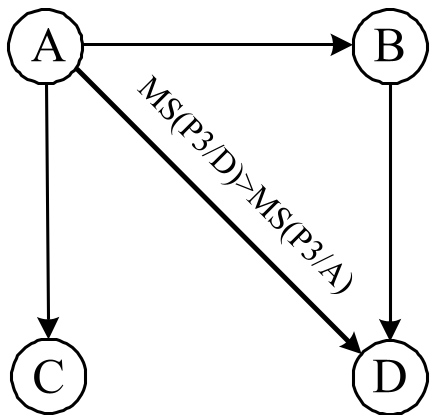
In the provided example, four research groups {A, B, C, D} form a social network.
- Node A receives a travel request but only knows about maps and timetables.
- It decomposes the problem and delegates "Hotel Booking" to Node B.
- Node B knows Node D is better at "Sightseeing" and passes that sub-problem along.
- Node C handles "Shopping."
The Resulting Evolution: After the first execution, Node A acquires new knowledge: it now knows directly that Node D is the expert for sightseeing. The social graph evolves, making future problem-solving cycles significantly faster.
Critical Analysis & Future Outlook
The beauty of β-PSML is its inductive bias toward collaboration. Unlike static APIs, these nodes behave like a professional network, where reputation and specialization are codified.
Key Strengths:
- Hybrid Reasoning: Seamlessly combines different AI methodologies (Ontology + Horn Clauses).
- Self-Organizing: The system gets smarter and better-connected as it performs more tasks.
Limitations: The paper focuses on the markup syntax and logic flow but leaves some questions open regarding the computational overhead of maintaining global metrics in massive networks and how to handle conflicting solutions from different nodes.
Takeaway for Future Research
This work is a precursor to modern AI Agent Swarms. It suggests that the path to Artificial General Intelligence (AGI) might not be a single monolithic model, but a socialized, distributed network of specialized experts communicating via a standardized "Problem Solver" protocol.