
Beyond "Local," "Categories," and "Friends": Clustering Foursquare Users with Latent "Topics"
Beyond “Local”, “Categories ” and “Friends”: Clustering foursquare Users with Latent “Topics”
This paper applies Latent Dirichlet Allocation (LDA) to Foursquare check-in data to cluster users into latent "topics" representing behavioral drivers. By treating venues as words and users as documents, the researchers successfully identify distinct groups characterized by specific interests, geographic communities, and behavioral "types" (e.g., tourists) across New York City and the San Francisco Bay Area.
TL;DR
This seminal work moves beyond the surface-level metrics of location-based social networks (LBSNs). Instead of just looking at where people are on a map or who their friends are, the authors use Latent Dirichlet Allocation (LDA) to treat users' check-ins as a "language." By doing so, they uncover hidden drivers of human mobility—revealing that our movements are dictated by latent "topics" like being a tourist, a sports fan, or part of a specific lifestyle community.
Problem & Motivation: The Limits of the "Visible"
Why do people move the way they do in a city? Most prior work answers this through three lenses:
- Geography: People stay close to home or work (neighborhoods).
- Categories: People go to "Restaurants" or "Gyms."
- Social: People go where their friends go.
However, the authors argue that these explicit labels are insufficient. For instance, a tourist visits the Statue of Liberty, Terminal 5 at JFK, and the MoMA. These places are geographically distant and belong to different categories, yet they are linked by the latent "type" of the user. By staying agnostic to coordinates and categories, the authors allow these complex patterns to emerge naturally from the raw data.
Methodology: The User as a Document
The core innovation lies in the mapping of NLP techniques to spatial behavior:
- Word = Unique Venue ID: (e.g., "The Starbucks on 5th Ave" is a distinct word from "The Starbucks on 10th Ave").
- Document = User: A collection of all venues a specific user has visited.
- Topic = Behavioral Driver: A hidden factor that explains why certain venues "co-occur" in a user's history.
By applying LDA, the model assigns each user a distribution over 20 topics. This recognizes that a person isn't just one "thing"—they might be 40% "Commuter," 30% "Nightlife Enthusiast," and 30% "College Student."
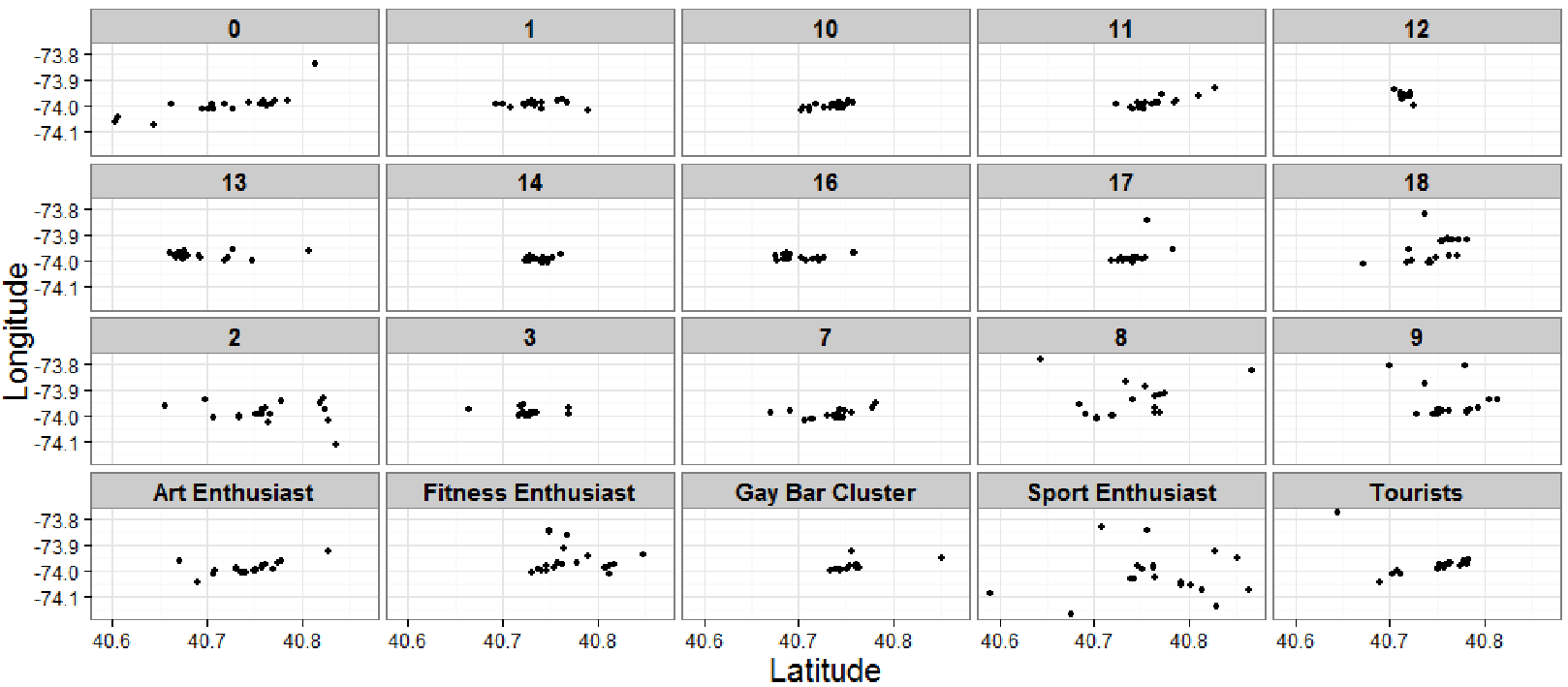 Figure 1: The geo-spatial distribution of the twenty clusters discovered in New York. Note how some clusters are tightly localized (communities), while others are spread across the city (interests).
Key Insights from the Clusters
The study successfully categorized the discovered latent topics into three distinct flavors:
1. Interest Factors
The model identified clusters of users driven by specific hobbies. For example, the "Sport Enthusiast" cluster included Yankee Stadium, MetLife Stadium, and Madison Square Garden. These venues are physically far apart but semantically linked by the user's passion for sports.
2. Community Factors
Even without being told the GPS coordinates, the model "discovered" neighborhoods. In both NYC and SF, it identified a "Gay Bar" cluster. In SF, these venues were almost exclusively located in The Castro. This shows that social homophily (the tendency of similar people to cluster) is a powerful enough signal to be detected purely through check-in patterns.
3. User Type Factors
This is where the model truly shines. It identified a "Tourist" cluster in NYC, featuring:
- Transport hubs (Penn Station, JFK Terminal 5).
- Landmarks (Central Park, Empire State Building).
- Retail (Apple Store, Macy's).
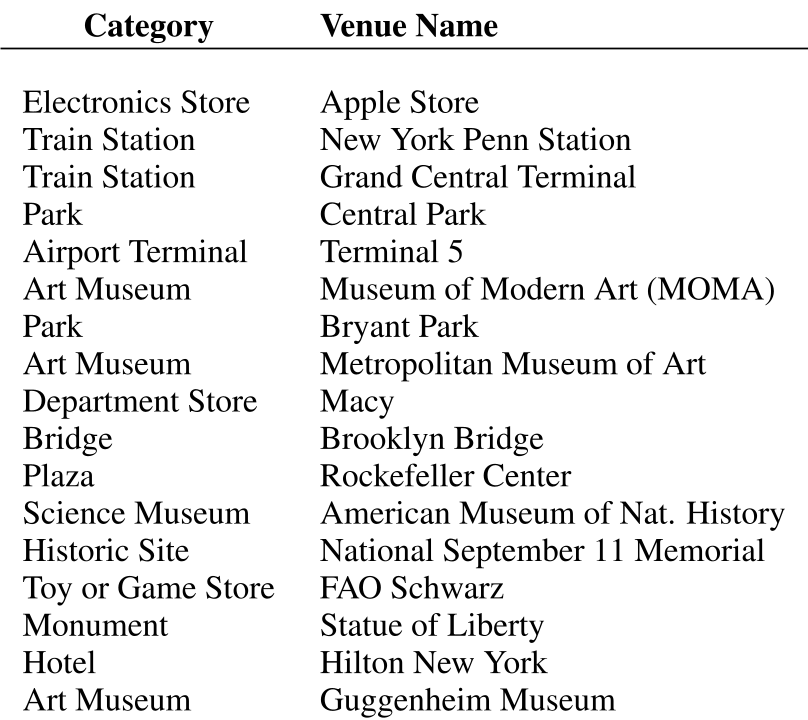 Table 1: Top venues for the "Tourist" cluster in New York City.
Critical Analysis & Future Outlook
While highly intuitive, the model has limitations. It is temporally blind; it treats a check-in from 2010 the same as one from 2012, ignoring the "flow" or "sequence" of travel. Furthermore, being a probabilistic model, the clusters can shift between runs, and interpreting them requires significant local "domain knowledge" of the city being studied.
Takeaway
The true value of this work is its proof of concept for Latent Urban Semantics. By treating urban movement as a structured language, we can build recommendation systems that suggest a visit to NikeTown not because it's "nearby," but because the user belongs to the "Fitness Enthusiast" topic. It sets the stage for modern AI-driven urban planning and personalized LBSN services.
Future Research
The authors suggest that future work should incorporate temporal dynamics (time of day/seasonality) and explore Hierarchical LDA to capture even finer-grained sub-communities within a city.