
Beyond Social Graphs: Mastering the Hidden Patterns of Human Interaction
Beyond social graphs: mining patterns underlying social interactions
This paper introduces the "Extended Social Graph" and a corresponding social recommender system designed to mine patterns underlying user interactions on Facebook. By integrating user interests directly into the graph structure and employing the Louvain method for community detection, the system provides personalized suggestions for friends and interests, outperforming the standard Facebook recommender in user-perceived accuracy.
TL;DR
While most social platforms treat "proximity" solely as a factor of distance, this research demonstrates that the Extended Social Graph—a structure merging friendship ties with semantic interests—can predict a user's behavior more accurately than standard algorithms. By utilizing the Louvain Method for community detection and a novel Expected Interest formula, the authors built a system that 74% of users preferred over Facebook’s own recommendations.
The Motivation: Why Social Graphs Aren't Enough
Existing social network analysis often falls into the trap of treating the graph as a cold set of nodes and edges. However, human society is governed by two key phenomena: Homophily (birds of a feather flock together) and Social Contagion (we adopt characteristics from our neighbors).
The researchers argue that to truly "understand" a user, we must move beyond the basic social graph. They propose the Extended Social Graph, which treats "Interest in Inception (Movie)" or "Working at Google" as nodes just as important as "User A." The pain point is clear: without grounding social structure in shared attributes, recommendations feel like stabs in the dark.
Methodology: The "Extended" Perspective
The core of this work is a three-stage pipeline: Crawl Detect Predict.
1. Community Detection via Louvain
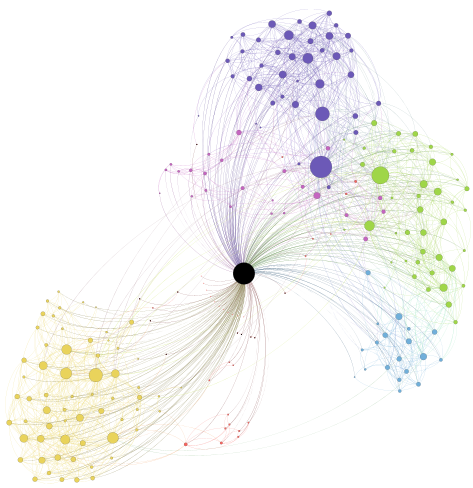
The authors chose the Louvain algorithm, a modularity-based greedy optimization technique. It’s prized for its speed and its ability to return a multi-level hierarchy of communities. This allows the system to see broad "stereotypes" (e.g., University students) and granular "cliques" (e.g., the 2015 CS graduating class).
2. The Expected Interest Formula
The "secret sauce" lies in how the system decides what to recommend. Instead of just looking at what's popular, it calculates the Expected Interest () using an exponential decay based on the shortest path distance () between users in a community:
The Intuition: You are more likely to care about a book if your best friend likes it () than if a friend-of-a-friend in your community likes it (). The division by ensures that social proximity is the primary weights-driver.
Experiments & Results: Beating the Giants
The study utilized an aggregated graph of 13,573 users and over 1.2 million connections.
Subjective Triumph
In a direct head-to-head comparison, 73.91% of users rated the Cognos.Social recommender as more accurate than Facebook’s. It successfully identified categories—particularly "Likes" and "Interests"—where the user felt a direct connection to the suggested item.
Resilience to Data Scarcity
One of the most profound findings was the Objective Evaluation. The researchers simulated a "new user" scenario by removing up to 90% of a user's friendship links. Surprisingly, the recommendation quality (the success rate) did not drop drastically.
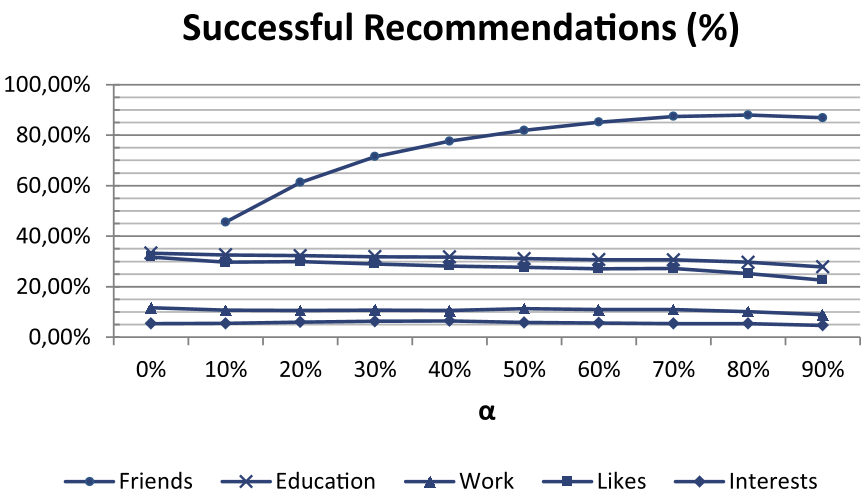
The graph above (9a and 9b) shows that even with significant data missing, the "stereotypes" formed by the remaining community members were strong enough to provide accurate predictions.
Critical Analysis & Conclusion
Takeaway: This paper proves that the structure of our social circles is a powerful "proxy" for our private interests. We don't need a perfect profile to get good recommendations; we just need to know who your neighbors are.
Limitations: The study relies on a relatively small sample size (23 users for subjective evaluation). Furthermore, the graph is static. In the real world, social ties evolve (Network Dynamics), and a "best friend" today might be a stranger in five years.
Future Outlook: The next frontier is Temporal Social Mining. By observing how communities shift over time, systems could predict not just what you like now, but what you will like next year, moving from reactive recommendation to proactive social forecasting.