
Beyond Keywords: Leveraging Social Authority for High-Precision Retrieval
Beyond the Web: Retrieval in Social Information Spaces
The paper introduces a "Social Information Retrieval" (Social IR) framework that enhances document search by integrating social network analysis. By applying PageRank to the social structures of platforms like mailing lists, the authors combine author authority with keyword relevance to improve ranking effectiveness.
TL;DR
This research moves beyond the "flat" view of the web to explore Social Information Spaces. By treating information production as a social act, the authors integrate social network analysis (specifically PageRank) into the retrieval process. The result? A system that doesn't just ask "What is this document about?" but "Who wrote this, and do we trust them?"
Problem & Motivation
Standard Information Retrieval (IR) models are often blind to the human element. They see a query and a document, but they miss the Social Context. In environments like mailing lists, wikis, or blogs, the value of a piece of information is intrinsically tied to the reputation of the creator.
The authors argue that when a user performs a search—especially an "underspecified" one where many documents might match the keywords—traditional vector-space models fail to filter out the noise. Their insight: The same spectral techniques (like PageRank) that revolutionized web search by analyzing hyperlinks can be applied even more effectively to social links between people.
Methodology: The Social IR Model
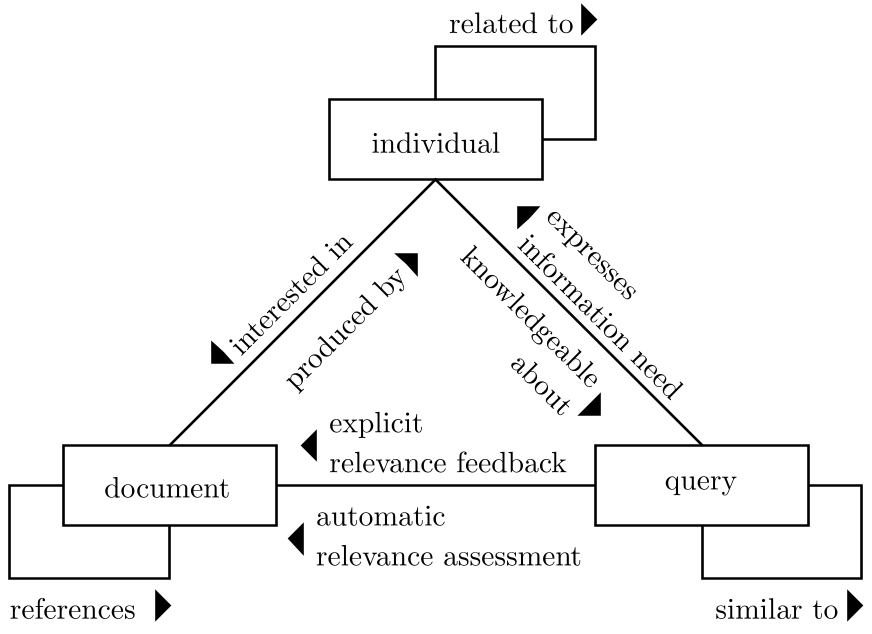
The core innovation is the expansion of the traditional IR domain. Instead of a bipartite graph of queries and documents, the authors propose a tripartite Associative Network.
1. The Tripartite Architecture
The model consists of three node types:
- Individuals (): The authors and consumers.
- Documents (): The content being retrieved.
- Queries (): The representation of user needs.
2. Computing Social Authority
The researchers extracted a social network from interactions (e.g., who replies to whom in a mailing list). They then applied the PageRank algorithm to this human graph.
The document score is then calculated as: Where is the PageRank of the author and is the traditional vector-space relevance score. This ensures that a document is highly ranked only if it is both relevant to the query and written by a socially authoritative figure.
Experiments & Results
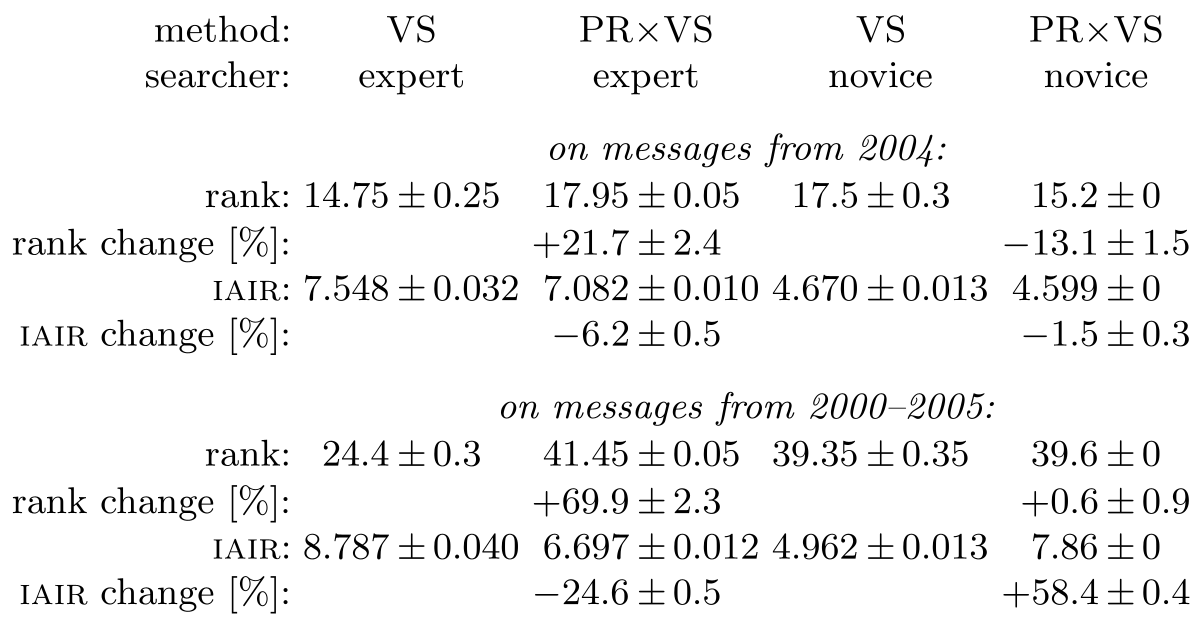
The authors tested their hypothesis using a mailing list archive (2000–2005) containing over 44,000 messages.
Key Findings:
- Small World Properties: The social network of the mailing list exhibited high clustering and short path lengths, confirming it follows "small-world" dynamics, making it ideal for PageRank analysis.
- Novice vs. Expert Searchers: Interestingly, the social boost was most effective for novice searchers on large datasets, showing a 58.4% improvement in IAIR (Inverse Average Inverse Rank).
- The Specificity Trade-off: For very specific "known-item" searches, PageRank occasionally performed worse than simple vector-space models, confirming that social authority is a better "tie-breaker" for broad queries than a precision tool for unique items.
Critical Analysis & Conclusion
Takeaway
Social IR successfully formalizes the human intuition of "checking the source." By mapping the "deep structure" of social interactions, search engines can move from mere pattern matching to authority-aware discovery.
Limitations
- Cold Start: The system requires a mature social network to be effective. New users or fragmented communities offer little signal for PageRank.
- Identity Resolution: The study did not reconcile different email addresses for the same person, which could fragment an author's true social authority.
Future Outlook
As we move toward a "Semantic Web" enriched with metadata (like FOAF - Friend of a Friend), the ability to plug social graphs directly into retrieval pipelines will become a standard requirement for personalized and congenial search systems.